
The short answer
How do rotating painted cylinders create a moving shadow narrative?
Compare the records
What the sources allow us to say
Read the object record alongside the contextual account.
| Record | Evidence | Reading limit |
|---|---|---|
| Museum record | Shadow Play uses moving cylinders and projected imagery. | Animation depends on movement and light, not still images alone. |
| Exhibition account | Documents a later presentation and expanded setting. | A new display need not mean an entirely new originating work. |
Distinguish the moving components
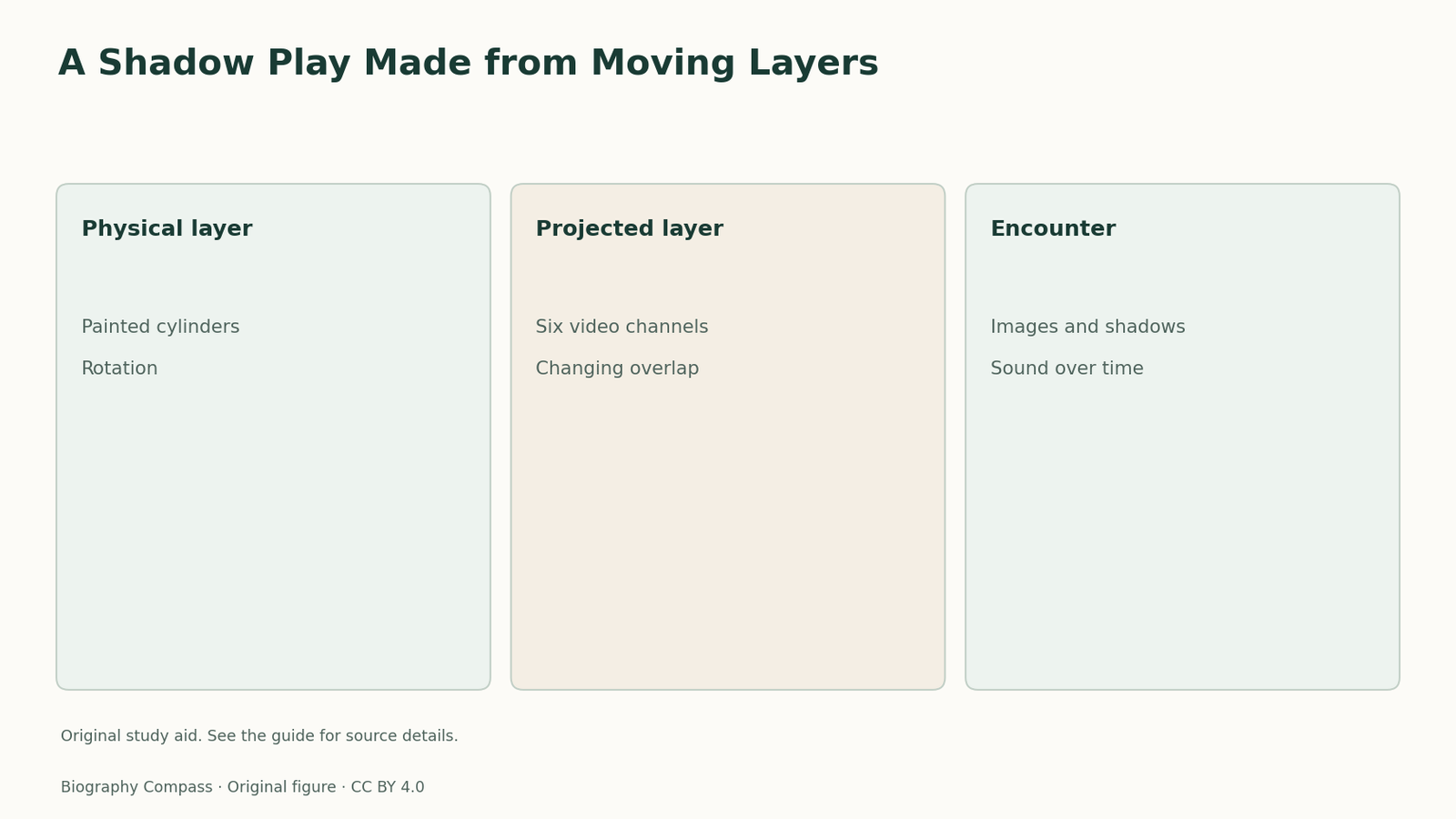
The Met identifies five reverse-painted cylinders and six video channels in In Search of Vanished Blood II. Those numbers describe different parts of the installation. A cylinder is a physical painted element that rotates. A video channel carries a sequence of projected imagery. Their interaction produces appearances that change over time and across surfaces. Beginning with the components makes it possible to explain the shadow play without treating every moving figure as though it came from the same source.
Sources for this section: [2]
The voices also come from several places
The object record names literary references including Cassandra and a sound collage drawing on different dramatic and narrative works. This multiplicity parallels the visual layering. The audience encounters connections among voices, images and shadows rather than a single illustrated text. The National Gallery’s account places the method within Malani’s sustained interest in figures marginalised by history, particularly women. That wider concern helps explain why combining sources can open a familiar story to another perspective instead of simply adding complexity for its own sake.
Map the system before interpreting one moment
Draw separate arrows for painted cylinder, video projection and sound, leading toward a shared viewing space. A useful answer explains that the appearance of a particular moment depends on several processes coinciding. Then identify a limit of a still reproduction. It may show the overlap of images but cannot preserve the complete sequence or the relation to sound across the work’s eleven-minute duration. The diagram gives a concrete foundation for an interpretation while leaving the actual installation’s timing and every projected frame to its own audiovisual record.
Continue the chronology
Related history guides
Biography context
Explore India through connected lives
Connected biographies
Read the artist’s biography
b. 1946
Nalini Malani
Video and installation artistAn Indian artist whose layered projections and painted shadows give historical and literary voices a moving form.Read biographyQuick answers
Common questions
- Are the painted cylinders and the video projections the same element?
- No. The Met lists five painted rotating cylinders and six video projections as separate components that interact.
Primary and institutional sources
How this history was checked
The listed records support the facts. Observation exercises and arguments are Biography Compass editorial interpretations. This article was reviewed on 7 November 2026.