
The short answer
When the order of operations changes, so can the person who makes the last decision. Two documented approaches make that question concrete: pleating an assembled garment and selecting pieces from a prepared textile structure.
Process and new decisions
Compare the working decisions
Keep the documented process and the new design choices visible in separate columns.
| Working question | Selected record | Original task |
|---|---|---|
| Garment pleating | Assemble before pleating | Keep the stipulated order. |
| A-POC | Selection from a prepared tube | Separate prepared and open decisions. |
Chronology
A timeline of the turning points
Pleats Please
Garment pleating.
Object record
Queen Textile.
Studio account
A-POC project.
Two material sequences
The studio describes cutting and sewing oversized garments before heat-press pleating. This reverses the starting point of making clothes from pre-pleated fabric.
MoMA describes Miyake and Fujiwara’s A-POC Queen Textile as a continuous tube with garment outlines woven into it. Customers select and cut pieces, with further adjustment possible. The record is dated 1997; the studio’s project account says 1998.
A late decision must be prepared early
Leaving a choice to the wearer does not mean abandoning design. The earlier system has to make that later choice possible. A process plan should therefore separate a material’s prepared structure from the decisions still open when somebody receives it. “Customisable” is not a complete specification.
This also changes how collaboration is credited. A person who develops a textile structure, someone who prepares the production process and someone who selects a final shape can make different contributions. The label should identify what each contribution changes rather than hiding everyone behind a single signature.
Sources for this section: [1]
Original decision-allocation task
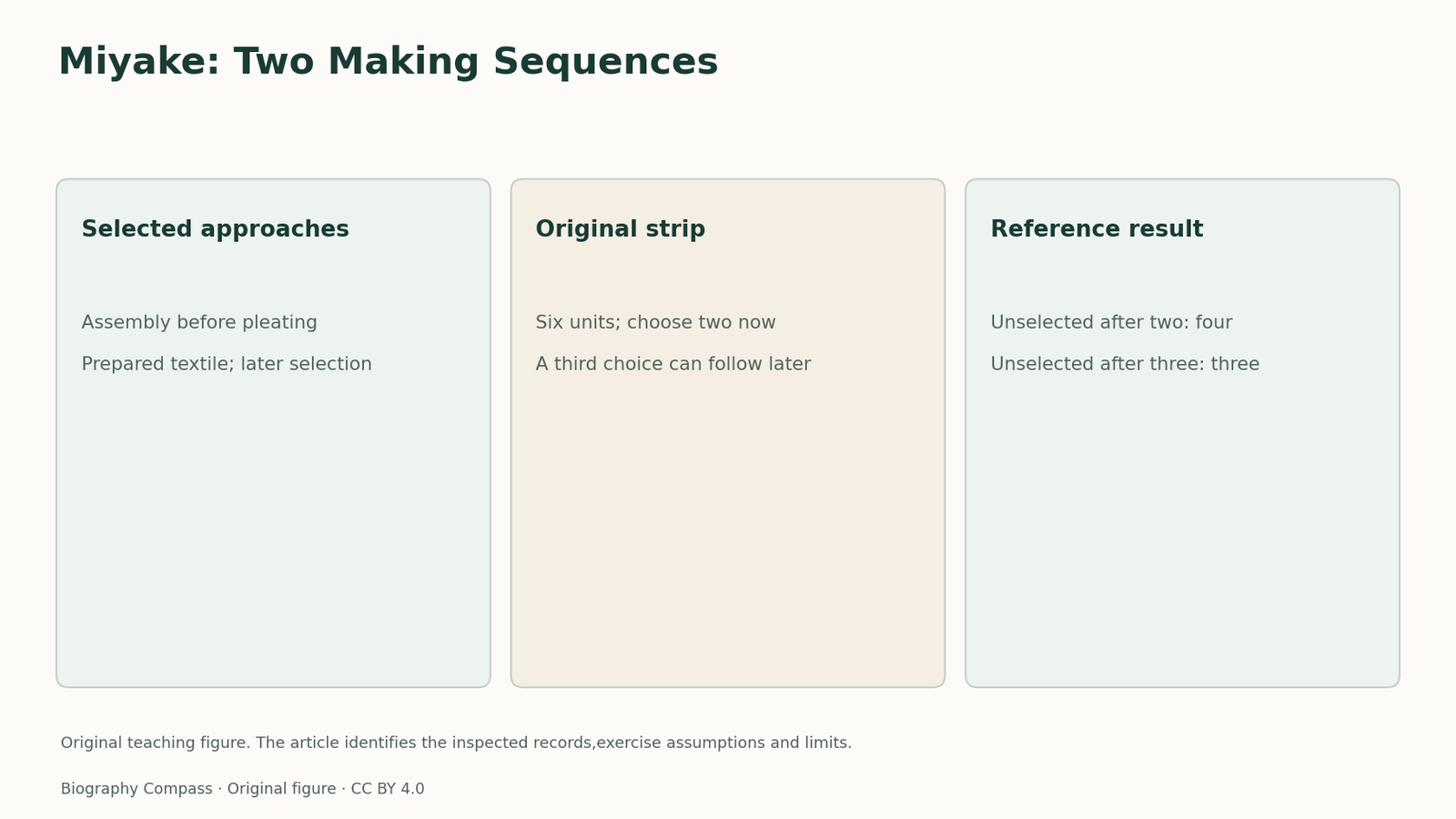
Use a fictional strip containing six selectable units, with no copied garment outlines. A customer wants two units now and may choose another later. Mark which decisions must be settled before manufacture, which can remain open and what information should accompany the strip. Compare that with an invented garment that must be assembled before a finishing operation fixes its shape.
Sources for this section: [1]
Reference answer
The strip plan must define unit boundaries and the conditions under which selecting one leaves the others available. The customer can choose units and timing, but cannot retroactively change the structure already manufactured. Two selected units leave four unselected in this invented model; choosing one more later leaves three.
In the finishing plan, assembly must be completed before the stipulated shape-setting operation. Reversing those steps would be a different process. This answer follows the toy’s stated conditions; it does not promise a working garment, a zero-waste factory or an environmental benefit. A diagram can explain decision order without reproducing a commercial textile design.
Sources for this section: [1]
Continue the chronology
Related history guides
Biography context
Explore Japan through connected lives
Connected biographies
Follow the working life
Quick answers
Common questions
- Is the strip a garment pattern?
- No. Its six units are invented and have no copied clothing outlines.
Primary and institutional sources
How this history was checked
The studio explains garment pleating; MoMA supplies joint designer credits and the A-POC object description. The toy strip is wholly original. This article was reviewed on 31 October 2026.