
The short answer
A surviving drawing and a printed page can be evidence of different stages of making. Following the material through those stages explains why an unfinished book may preserve something a completed print process would destroy.
Process and new decisions
Compare the working decisions
Keep the documented process and the new design choices visible in separate columns.
| Working question | Selected record | Original task |
|---|---|---|
| Published object | Woodblock-printed book | Identify the impression stage. |
| Unfinished project | Drawings survived | Trace the stopped branch. |
Chronology
A timeline of the turning points
First volume
Fuji book.
Second volume
Fuji book.
A completed book and an unfinished path
Tokyo Fuji Art Museum identifies the first two volumes of One Hundred Views of Mount Fuji as 1834 and 1835 woodblock-printed books.
As reported by the Sainsbury Institute, Haft explained that unpublished Great Picture Book drawings survived. Preparing printable blocks required pasting drawings to wood and cutting through them.
Separate the working surfaces
A process diagram should not use “picture” for every object. Name the drawing that guides the work, the shaped matrix that receives the design, and the impression produced from it. One object can carry information to the next without remaining intact. A photograph of a drawing therefore does not by itself show a finished printed edition.
The distinction also creates different archival questions. A surviving matrix might support investigation of repeated impressions. A drawing can reveal marks that never reached a block. Neither alone gives a complete account of the publisher, carver, printer, paper or every later impression.
Sources for this section: [1]
Original transfer exercise
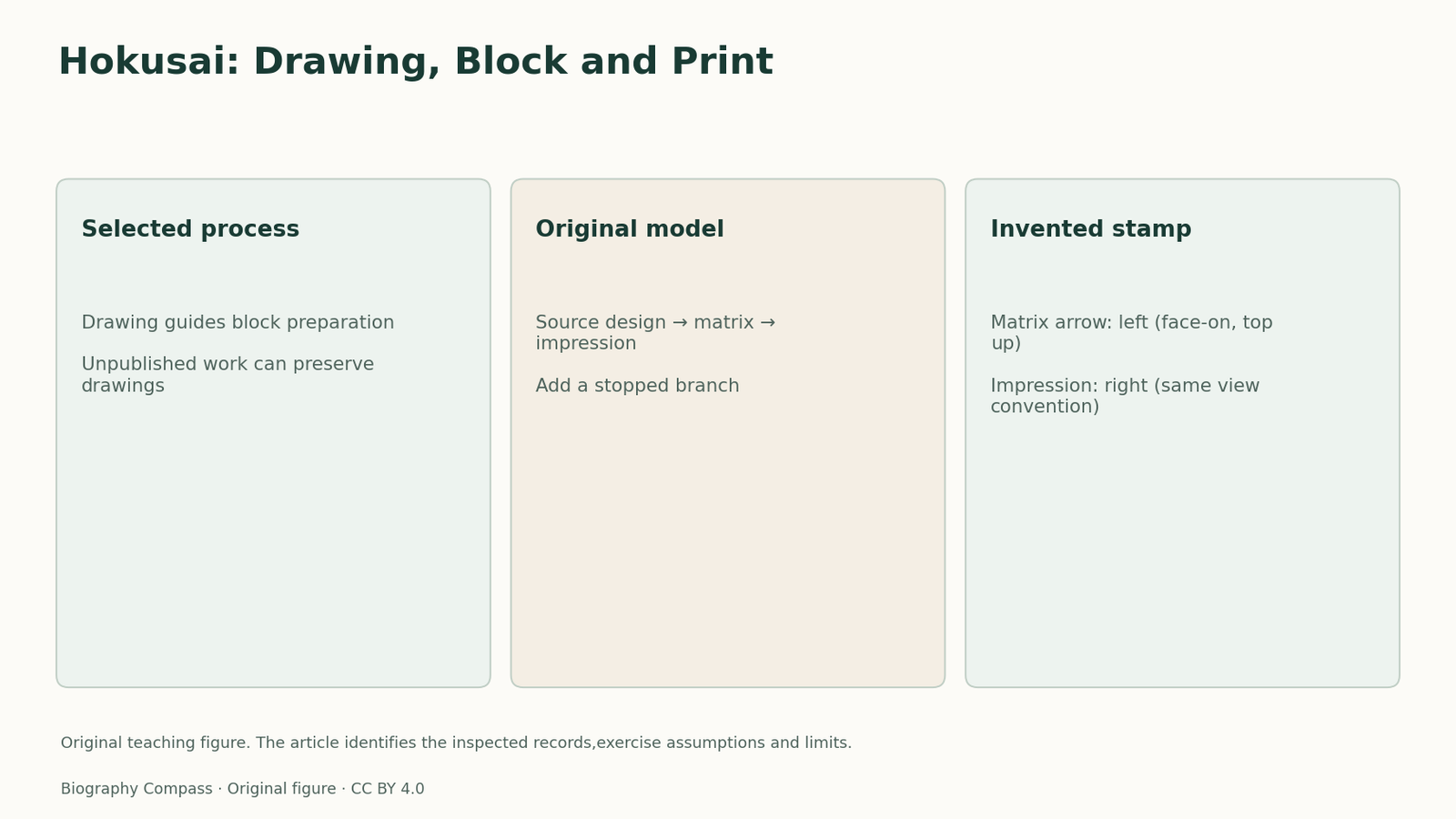
Draw three new symbols of your own on card A. Make a workflow with three boxes: source design, reusable matrix and impression. Mark the transition at which the source could be consumed. Then add a branch in which production stops before that transition. In a separate, explicitly invented stamping example, make the matrix arrow point left and ask which way its single impression points. For this toy, view the inked matrix face and the impression face-on, with the same top edge uppermost.
Sources for this section: [1]
Reference answer
The stopped branch preserves the source drawing; the completed branch can preserve a matrix and impressions while losing that drawing. The diagram must distinguish those objects instead of calling each one an original. In the invented single-stamp example, the impression reverses the matrix arrow and points right. That geometric example is not a claim to reconstruct every historical transfer stage.
A useful final label says what survives and what it can help us study. It does not claim that unpublished work was unimportant, nor that every printed copy has the same material history. The new diagram is a model of the selected account, not a substitute for examining a particular print or block.
Sources for this section: [1]
Continue the chronology
Related history guides
Biography context
Explore Japan through connected lives
Connected biographies
Follow the working life
Quick answers
Common questions
- Does the arrow reconstruct a historical block?
- No. It is an original single-stamp example used to make reversal visible.
Primary and institutional sources
How this history was checked
The technical explanation is a report of a named curator’s lecture; the museum records identify the published book. No full book or Japanese text was read. This article was reviewed on 31 October 2026.