
The short answer
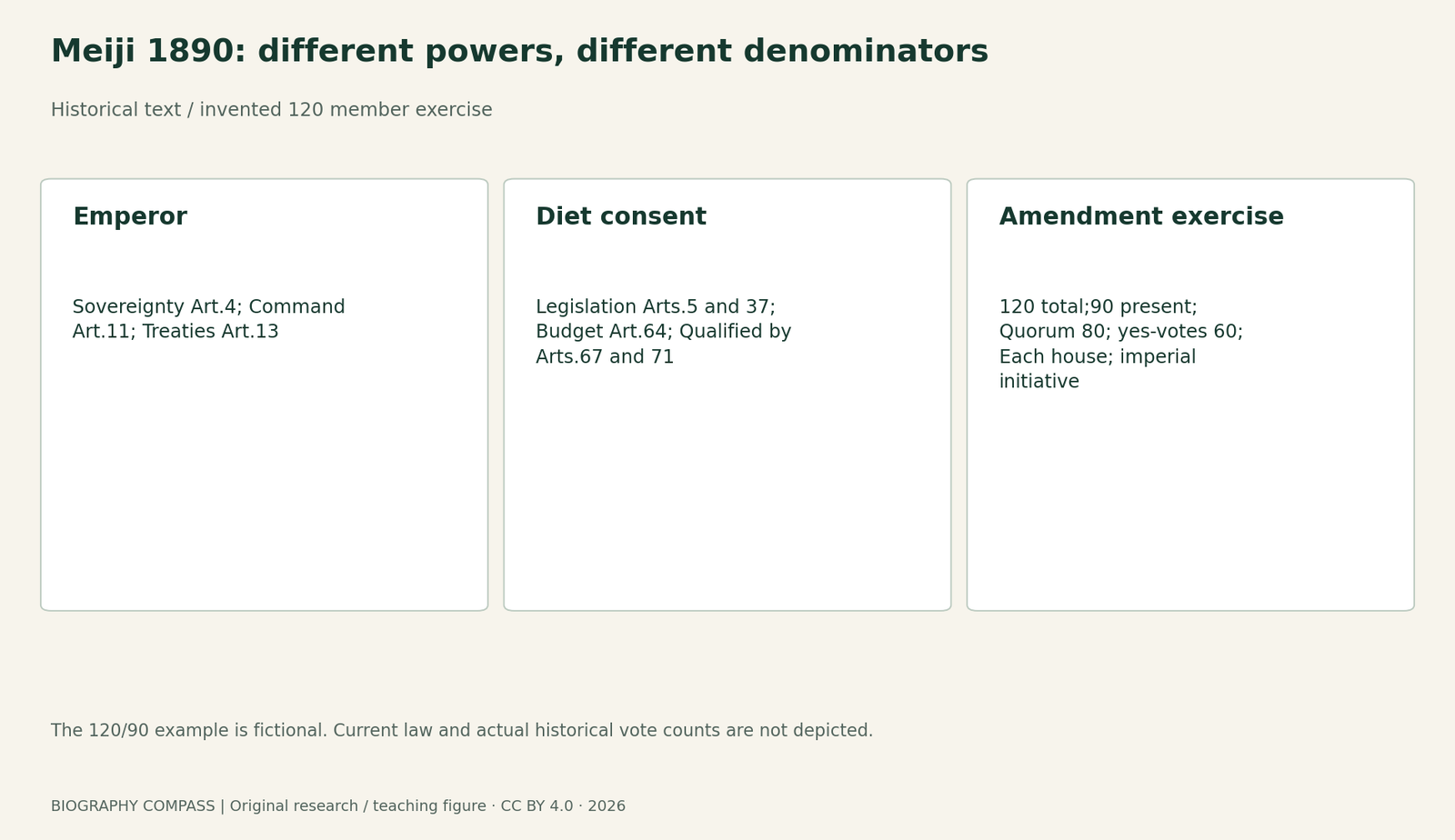
A legislature can have real powers without being the source of sovereignty. Which decisions did the Meiji Constitution reserve to the emperor, share with the Diet or protect from an ordinary budget vote?
Original source comparison
Follow the power and its qualification
The provisions answer different questions; none should be used as a substitute for an implementation history.
| Country | What the text establishes | What it does not establish |
|---|---|---|
| Articles 4–5 | Imperial sovereignty and legislative consent coexist in the text. | Sovereignty transferred to the elected lower house. |
| Articles 28–31 | Enumerated rights with stated limits and emergency qualifications. | An unqualified modern rights guarantee. |
| Articles 64,67,71 | Budget consent with protected expenditures and a fallback. | Any rejected budget immediately stops every government payment. |
| Article 73 | Separate initiative, attendance and approval conditions. | Two-thirds of all members is always the approval denominator. |
Chronology
A timeline of the turning points
Cabinet system
Itō became the first prime minister before constitutional promulgation.
Natsushima draft
The library identifies a collaborative revision stage.
Promulgation
The constitution was proclaimed.
Entry into force
The opening of the Imperial Diet marked the later operative stage.
Begin with a text and two enactment dates
The Constitution of the Empire of Japan was promulgated on 11 February 1889 and entered into force on 29 November 1890. The distinction matters when connecting it to Itō Hirobumi’s earlier cabinet reforms. The English text used here is Hanover’s transcription from Itō’s Commentaries, translated by Miyoji Itō and published in 1889. It is not a newly examined Japanese manuscript. The National Diet Library’s catalogue of drafts identifies collaboration and revision before promulgation. Its prose contains a March 1889/Meiji 21 inconsistency, while the attached clean-copy entry says March 1888; the catalogue date is retained. Sources can establish constitutional chronology without being silently harmonised where they disagree.
Sovereignty and legislation were allocated differently
Article 4 identifies the emperor as head of the empire, combining sovereign rights while exercising them according to the constitution. Articles 5 and 37 require the Imperial Diet’s consent for legislation. Those provisions should be read together. The text did not simply transfer sovereignty to an elected chamber, but neither did it make legislative consent meaningless on the page. Article 33 established two houses: the House of Peers and House of Representatives. Their membership arrangements differed. The existence of an elected lower chamber did not turn both houses into identical elected bodies or make the cabinet’s tenure depend automatically on a lower-house confidence vote.
Sources for this section: [1]
Reserved powers set limits on a parliamentary reading
The emperor’s powers included appointment and dismissal of officers, supreme command of the army and navy, and the making of war, peace and treaties. Article 55 required ministers to advise the emperor and be responsible for that advice, and required a ministerial countersignature for state laws, imperial ordinances and rescripts. This is a different textual arrangement from responsibility explicitly owed to a parliamentary majority. Article 8 also allowed urgent ordinances while the Diet was not sitting, subject to submission at the next session and future invalidity if approval was refused. A careful diagram should show both the exceptional route and its stated later check, rather than label every ordinance an ordinary statute.
Sources for this section: [1]
Rights were stated with qualifications attached
Chapter II lists subjects’ protections and freedoms, including lawful process, property, religious belief, expression, meetings and association. Its limiting language is part of the rule. Article 29 places expressive freedoms within law; Article 28 qualifies religion by peace, order and duties as a subject. Article 31 preserves imperial powers in war or national emergency. Removing those clauses would make a modern-looking rights list that the original text does not supply. Conversely, quoting the qualifications alone would conceal the fact that protections were expressly enumerated. To study how either side operated in practice, a researcher would need legislation, enforcement records and particular cases beyond this constitutional text.
Sources for this section: [1]
Budget consent did not mean an unrestricted financial veto
Article 64 required annual Diet consent to state revenue and expenditure, and Article 65 sent the budget first to the House of Representatives. But Article 67 protected specified established expenditures from rejection or reduction without government concurrence. Article 71 allowed the previous year’s budget to be carried out when a new budget had not been voted or brought into existence. These provisions made budget conflict different from an automatic shutdown of all government activity. Article 72 separately required audit and submission of final accounts. Approval, expenditure and later accounting were different stages, with different institutions responsible for the record at each point.
Sources for this section: [1]
Exercise: find the denominator in a proposed amendment
Article 73 gave the emperor the initiative for constitutional amendment. In each house, debate required at least two-thirds of the whole membership to be present; passage required at least two-thirds of members present. Consider a fictional house of 120 members with 90 present. How many must be present for debate, and how many affirmative votes are needed? Would 59 affirmative votes pass? Would 60? Now compare the ordinary quorum in Article 46. Finally explain why passing this one-house arithmetic exercise would not by itself establish that a constitutional amendment had been validly completed. The 120 and 90 are invented teaching values, not historical Diet membership data.
Sources for this section: [1]
Reference answer: initiative, quorum and approval are separate
The amendment quorum is 80 of the 120 members. With 90 present,60 affirmative votes are needed;59 fail and 60 meet that numerical condition. The ordinary quorum is 40, one-third of the whole membership. Confusing the two-thirds quorum with the two-thirds approval rule would wrongly demand 80 affirmative votes even when 90 attend. However, an amendment still required the specified imperial initiative and the applicable process in both houses. The calculation checks a defined rule in a fictional example, not a historical vote or present Japanese law. The broader lesson is to follow an institution’s authority, exceptions and denominator before assigning a label such as parliamentary government.
Sources for this section: [1]
Continue the chronology
Related history guides
Connected biographies
People and institutions
1841–1909
Itō Hirobumi
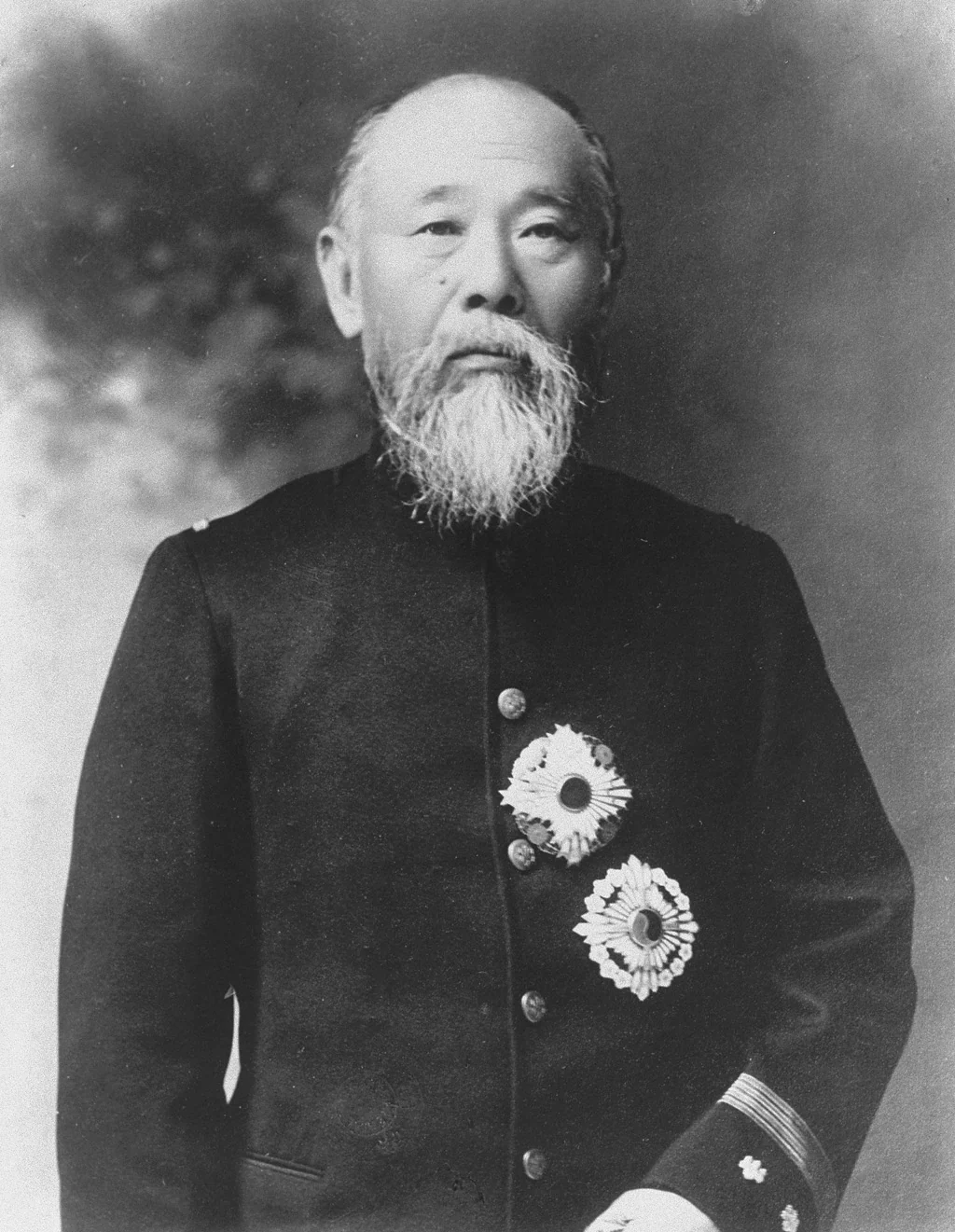
Meiji statesman and four-time prime ministerItō Hirobumi helped build the cabinet and constitutional institutions of Meiji Japan after studying abroad. His four premierships, party organisation and role in Korea connect institutional reform with the expansion of Japanese imperial power.Read biographyQuick answers
Common questions
- Is this the constitution operating in Japan today?
- No. It is a historical study of the 1889 constitution, which became effective in 1890.
- Are the 120 members a historic Diet count?
- No. The voting example is invented to test the difference between quorum and approval rules.
Primary and institutional sources
How this history was checked
Read the identified historical texts with their different speakers, dates and evidential limits; exercises are original teaching material. This article was reviewed on 27 October 2026.
- Hanover Historical Texts Project; translated by Miyoji ItōConstitution of the Empire of Japan, 1889: translated text from Itō’s Commentaries
- National Diet LibraryToward the Enactment of the Constitution: draft catalogue and historical account
- Embassy of Japan in the United KingdomHirobumi Itō and the Chōshū Five: 2013 historical commemoration