
The short answer
What changed when Kishi replaced the treaty Yoshida had signed? Compare the actual clauses before treating an alliance as an automatic promise to fight anywhere.
Original source comparison
Use the article that answers the question
This comparison concerns historical document wording, not a prediction of government action.
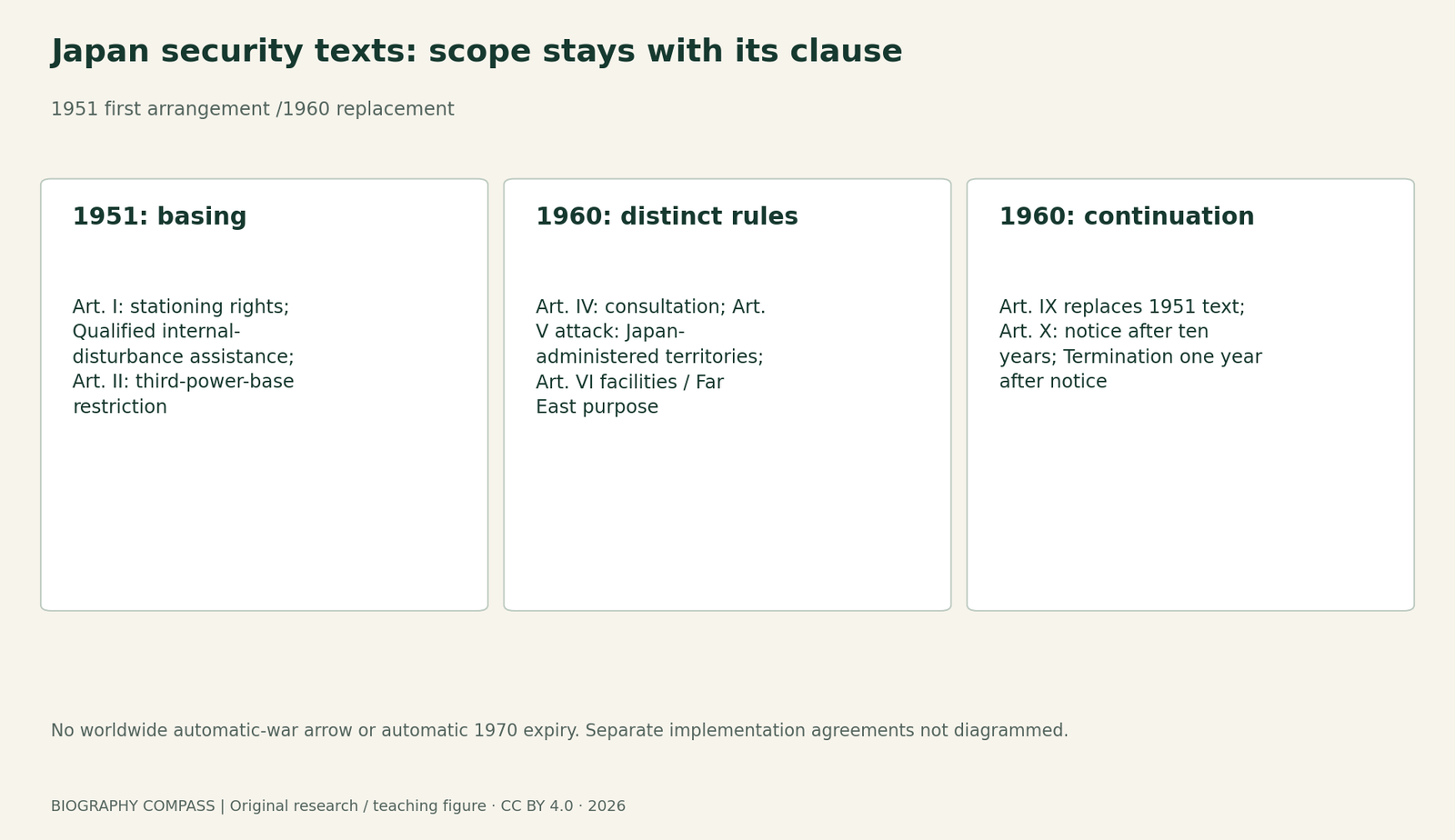
| Country | What the text establishes | What it does not establish |
|---|---|---|
| 1951 Article I | Basing and specified security purposes, including qualified internal-disturbance assistance. | An unlimited power to intervene against any protest. |
| 1960 Article IV | Consultation on implementation and specified threats. | A complete account of every separate prior-consultation arrangement. |
| 1960 ArticlesV–VI | Distinct response geography and basing purpose. | A single worldwide automatic-war trigger. |
| 1960 Article X | Notice permitted after ten years; one-year notice interval. | Automatic expiry in 1970 or termination by a cabinet resignation. |
Chronology
A timeline of the turning points
Two instruments signed
Peace and bilateral security texts answered distinct questions.
Initial treaties effective
The occupation ended as the treaties took effect.
Replacement signed
Kishi and other plenipotentiaries signed in Washington.
New treaty effective
The earlier treaty expired; Kishi announced his intent to leave.
Separate the peace settlement from the security agreement
On 8 September 1951 Japan signed both the Treaty of Peace with Japan and a bilateral security treaty with the United States. They were linked, but they were different instruments. The peace treaty addressed the end of the state of war, sovereignty and other postwar questions. The security text addressed American forces and their role in and around Japan. The National Diet Library records both entering into force on 28 April 1952, when the Allied occupation ended. Signature and effective date should therefore appear as separate events in a timeline. Nor should the peace treaty’s distinct reparations provisions be erased by describing the security agreement as a complete settlement of every wartime claim.
The 1951 text permitted forces for specified purposes
Article I granted the United States the right to station land, air and sea forces in and around Japan. It named peace and security in the Far East and Japan’s security against external armed attack. It also allowed assistance, at the Japanese government’s express request, against large-scale internal disturbances caused by outside instigation or intervention. This was not an unlimited clause allowing force against every domestic protest. Article II restricted Japan from granting third powers bases or related military rights without prior American consent. Article III left disposition conditions to administrative agreements. The text established basing arrangements without the later treaty’s equivalent mutual armed-attack response clause.
Sources for this section: [1]
The 1960 treaty added consultation and a defined response
The new Treaty of Mutual Cooperation and Security was signed on 19 January 1960. Article IV called for consultation on implementation and, at either party’s request, when Japan’s security or peace and security in the Far East were threatened. Article V addressed an armed attack against either party in territories under Japan’s administration. Each would act against the common danger through its constitutional provisions and processes. The actor, geography and procedural qualification all matter. This is not a textual promise that every attack on an American force anywhere automatically obliges Japan to fight. The clause also required reporting to the UN Security Council and recognised its role in restoring peace.
Sources for this section: [2]
Basing scope and attack scope are not interchangeable
Article VI retained American use of facilities and areas in Japan to contribute to Japan’s security and peace and security in the Far East. It referred to a separate agreement governing facilities and the status of forces. The Far East purpose in this provision should not be substituted for Article V’s more specific attack geography. Likewise, the consultation provision should not be described as an unconditional Japanese veto over every American activity without reading the relevant separate instruments. This guide examines the two treaty texts; it does not claim a full audit of the status-of-forces agreement, exchange notes or later operational practice.
Sources for this section: [2]
A treaty could survive the prime minister who negotiated it
The 1960 revision generated major opposition. The National Diet Library’s account describes police-guarded parliamentary action inMay, protests and the postponement of Eisenhower’s planned visit after a student’s death. Kishi announced his intention to step down on 23 June, and the Ikeda cabinet followed on 19 July. The political crisis and the text’s entry into force are separate facts. Article IX made the 1951 treaty expire when the new treaty entered into force. A change of prime minister did not itself undo the agreement. To assess democratic legitimacy, parliamentary procedure and the alliance’s operation, the researcher needs more than a signature page.
Exercise: test four statements against an article
Classify these fictional briefing notes and identify the relevant article. First, an attack on an American ship anywhere in the world automatically triggers Article V. Second, the Far East wording in Article VI and the geography of Article V mean exactly the same thing. Third, the treaty automatically expired after ten years. Fourth, an administration’s resignation was sufficient notice to terminate it. Rewrite each statement so that it says only what the text establishes. Then explain what additional records would be required to describe actual military action, constitutional authorisation or notice of termination. No hypothetical battlefield advice or prediction is requested.
Sources for this section: [2]
Reference answer: preserve place, process and notice
Article V concerns attacks against either party in territories under Japan’s administration and action through constitutional processes. Article VI gives a basing purpose and points to separate arrangements; it is not the same scope rule. Article X first envisages satisfactory United Nations security arrangements as a basis for ending the treaty. It also provides a notice route, rather than automatic expiry after ten years. After that period, either party may give notice of termination, with termination one year later. A cabinet’s departure is not the specified notice. Operational records, constitutional decisions and an actual notice would answer the further questions. Reading the clauses this way makes the alliance more concrete: different provisions authorise facilities, require consultation, define a danger and provide an exit procedure.
Sources for this section: [2]
Continue the chronology
Related history guides
Connected biographies
People and institutions
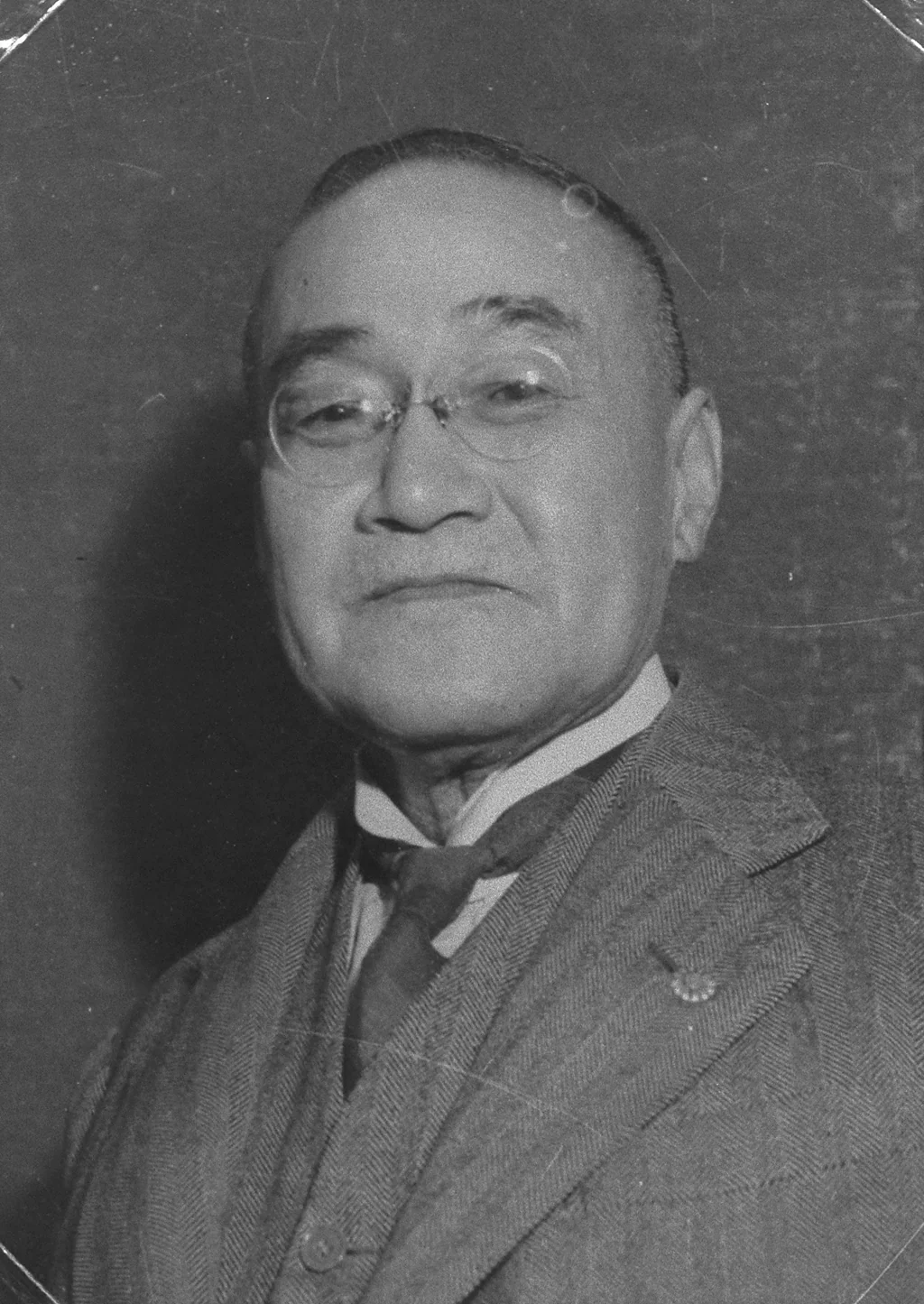
1878–1967
Shigeru Yoshida
Diplomat and postwar prime ministerShigeru Yoshida moved from a long diplomatic career into leadership of Japan during the Allied occupation. His governments helped make the postwar constitutional system work and negotiated a return to independence tied to continued American military presence.Read biography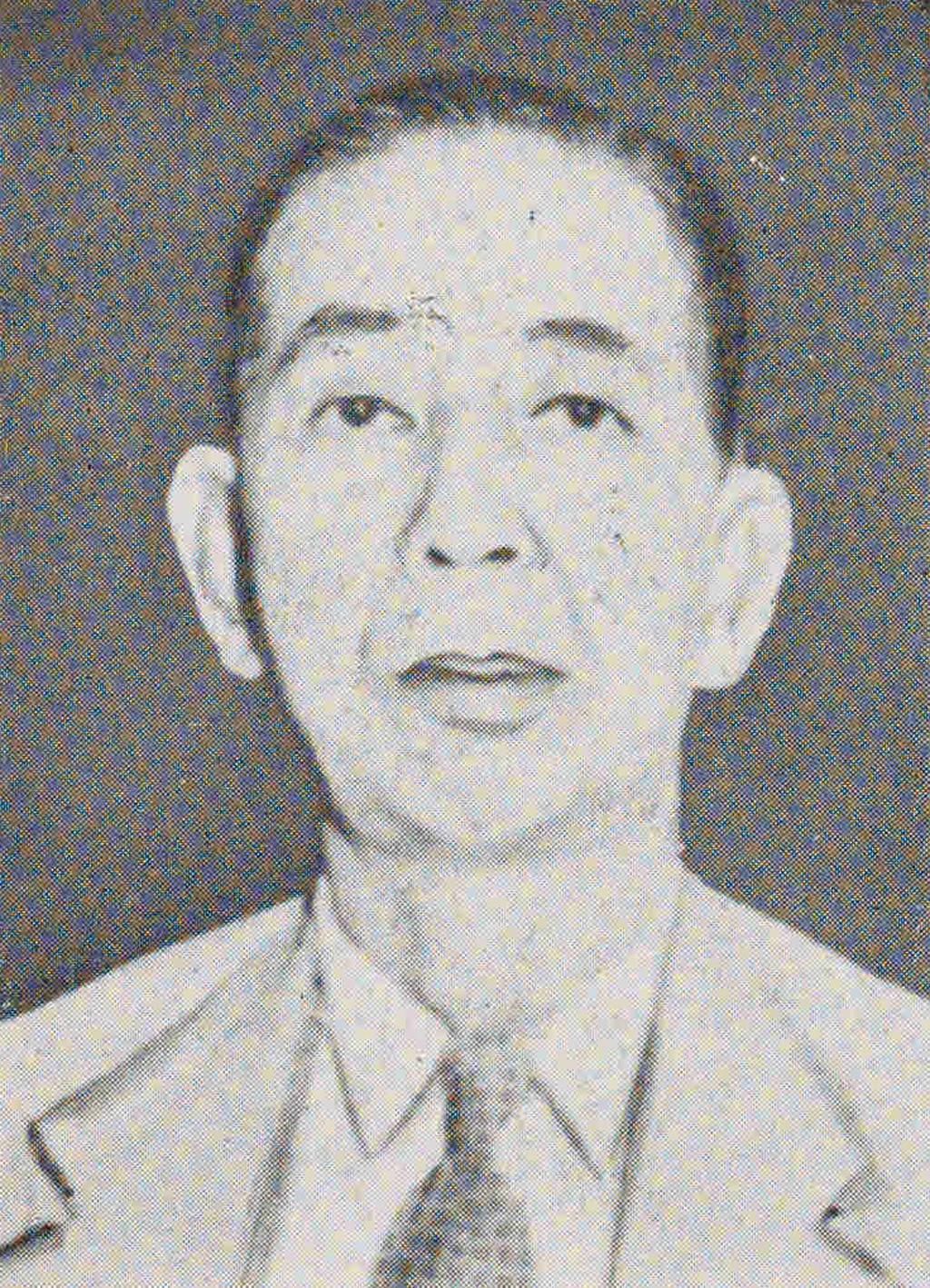
1896–1987
Nobusuke Kishi
Economic bureaucrat and postwar prime ministerNobusuke Kishi moved from imperial economic administration and wartime cabinet office to leadership of postwar Japan. His revision of the American security alliance passed amid parliamentary confrontation and mass protest, ending his government.Read biographyQuick answers
Common questions
- Did the 1960 treaty merely rename the 1951 text?
- No. It replaced the earlier instrument and changed the provisions, including a defined armed-attack response and termination procedure.
- Does this guide decide current operational obligations?
- No. It compares historical treaty texts and identifies limits; it does not supply present legal or military advice.
Primary and institutional sources
How this history was checked
Read the identified historical texts with their different speakers, dates and evidential limits; exercises are original teaching material. This article was reviewed on 27 October 2026.
- Yale Law School Avalon Project; Department of State 1957 document compilationSecurity Treaty Between the United States and Japan, 8 September 1951
- Ministry of Foreign Affairs of JapanTreaty of Mutual Cooperation and Security, 19 January 1960: complete English text
- The World and Japan Database; GRIPS and University of TokyoTreaty of Peace with Japan, 8 September 1951: text
- National Diet LibraryPeace Treaty and the U.S.–Japan Security Treaty: historical account
- National Diet Library1960 signing of the new Japan–U.S. Security Treaty: historical materials