
The short answer
How much can a Canadian-made car label tell us about where its different components and design work originated?
The records answer different questions
Keep the measures separate
The question changes when the object, unit or reporting period changes.
| Record or measure | What it establishes | What it does not establish |
|---|---|---|
| Recollection | Purchasing rights and body freedom. | Every original contract term verified. |
| Manufacturing history | Parts, engineering and body work. | Every shipment or worker reconstructed. |
| Our table | Explicit responsibility assignments. | An all-local or all-imported vehicle. |
Chronology
A timeline of the turning points
Arrangement
Buick partnership.
Vehicle
Model F production.
Reproduction
Museum publishes the participant excerpt.
A participant’s description of the arrangement
McLaughlin’s reproduced recollection describes fifteen-year rights to buy Buick engines and other parts while designing and building the bodies locally. It names his father, George and bookkeeper Oliver Hezzelwood in the discussion.
The passage is a later participant account reproduced by the museum. It gives a useful description of the division of work, but does not make the original contract available for checking every term. Its confident memory should remain labelled as memory.
Sources for this section: [1]
What the manufacturing record adds
The museum describes mostly American parts and American engineering for the early car, with the body designed and built in Oshawa. It also notes that initial auto workers came from the United States and worked directly for Buick.
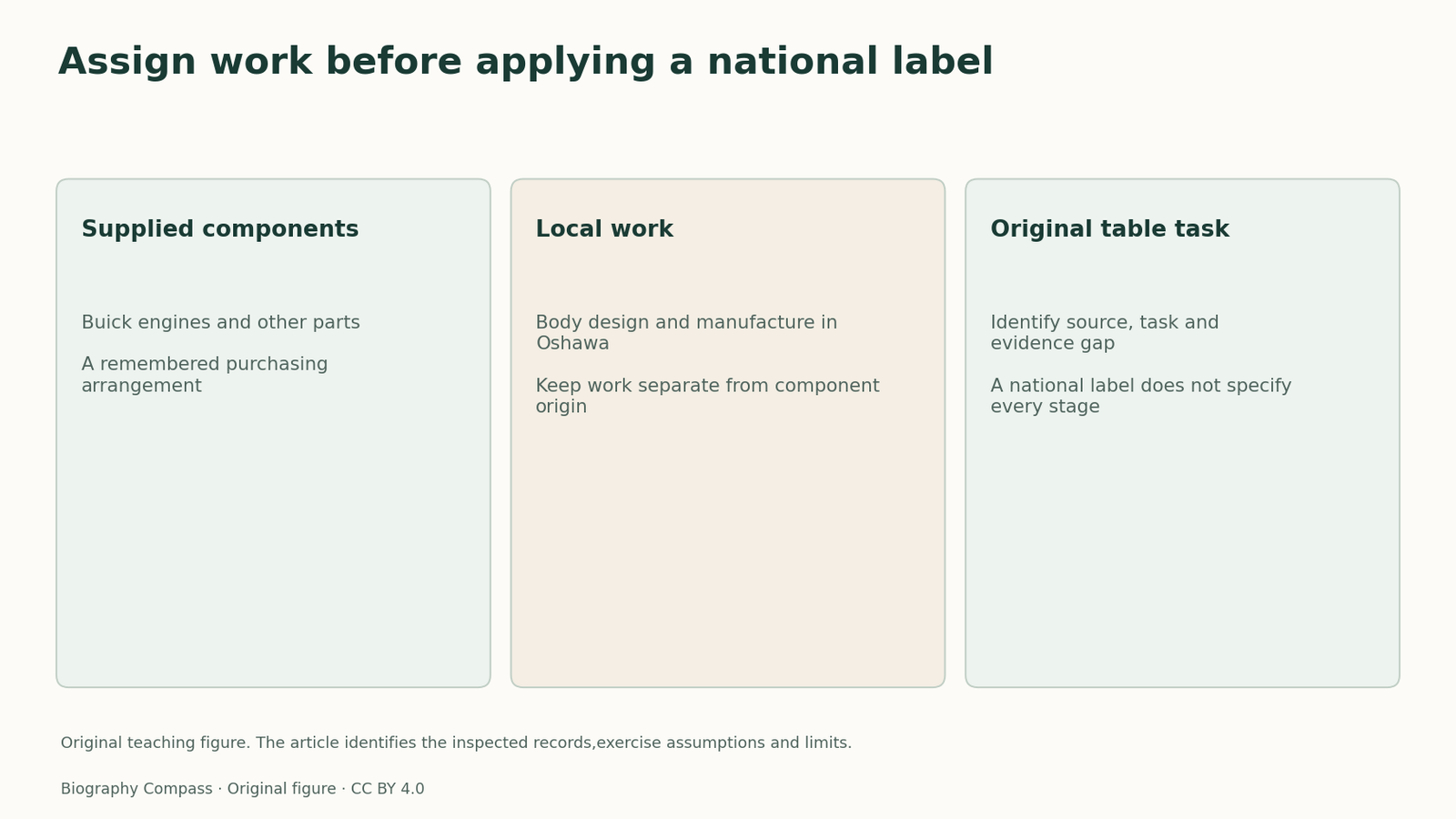
A production location and a component’s source are therefore different attributes. Local body work does not require us to call every part locally made; bought parts do not make the body work disappear. Nor does the record establish every worker’s birthplace, training or exact task.
Sources for this section: [2]
Original task: make a responsibility table
Use columns “identified source or location”, “work described” and “not established”. Fill rows for the engine and other supplied parts, body design/build, and the complete vehicle. Use only the selected accounts. A learner proposes: “Because it was made in Canada, every component and every design decision was Canadian.” Explain the unsupported step.
Then choose one question for which the original contract would be useful. Keep it narrower than “Was the business successful?” For example, distinguish the scope of a purchasing right from what actually arrived at a factory in a particular month.
Reference answer: a vehicle has several production histories
Buick supplies the engine and other parts; Oshawa supplies the described body work. The complete vehicle combines these contributions. The proposed all-Canadian sentence goes beyond those assignments.
A useful contract question concerns the exact components, duration or conditions covered by the purchasing arrangement. A particular delivery would instead need delivery evidence. Neither the recollection nor the museum label alone reconstructs every shipment.
The result is a more informative manufacturing explanation: identify the task and the supplied evidence at each stage. Avoid replacing one national label with a different national label that is equally unable to describe the whole production network.
Continue the chronology
Related history guides
Biography context
Explore Canada through connected lives
Connected biographies
The connected careers
1871–1972
Robert Samuel McLaughlin
Automobile manufacturerMcLaughlin combined manufacturing and philanthropy. His career connects a family firm with a larger industrial organisation.Read biographyQuick answers
Common questions
- Does the study inspect the original agreement?
- No. It compares a museum-reproduced participant account with a manufacturing-history record and labels their different scope.
Primary and institutional sources
How this history was checked
Read these dated records together; the original task states its own assumptions and separates them from reported facts. This article was reviewed on 31 October 2026.