
The short answer
Why can two reported inquiry conclusions differ without giving us permission to flatten either one?
The records answer different questions
Keep the measures separate
The question changes when the object, unit or reporting period changes.
| Record or measure | What it establishes | What it does not establish |
|---|---|---|
| Royal Commission | Agreement and export inquiry. | A universal criminal verdict. |
| Council committee | Examined imputations unproved. | Every issue in another inquiry resolved. |
| Parliamentary reply | Reports these separate findings. | All underlying evidence reproduced. |
Chronology
A timeline of the turning points
Agreement
Victorian supply arrangement.
Remit boundary
Date stated in the reference.
Reply
Selected parliamentary answer.
Start with what the reply actually reports
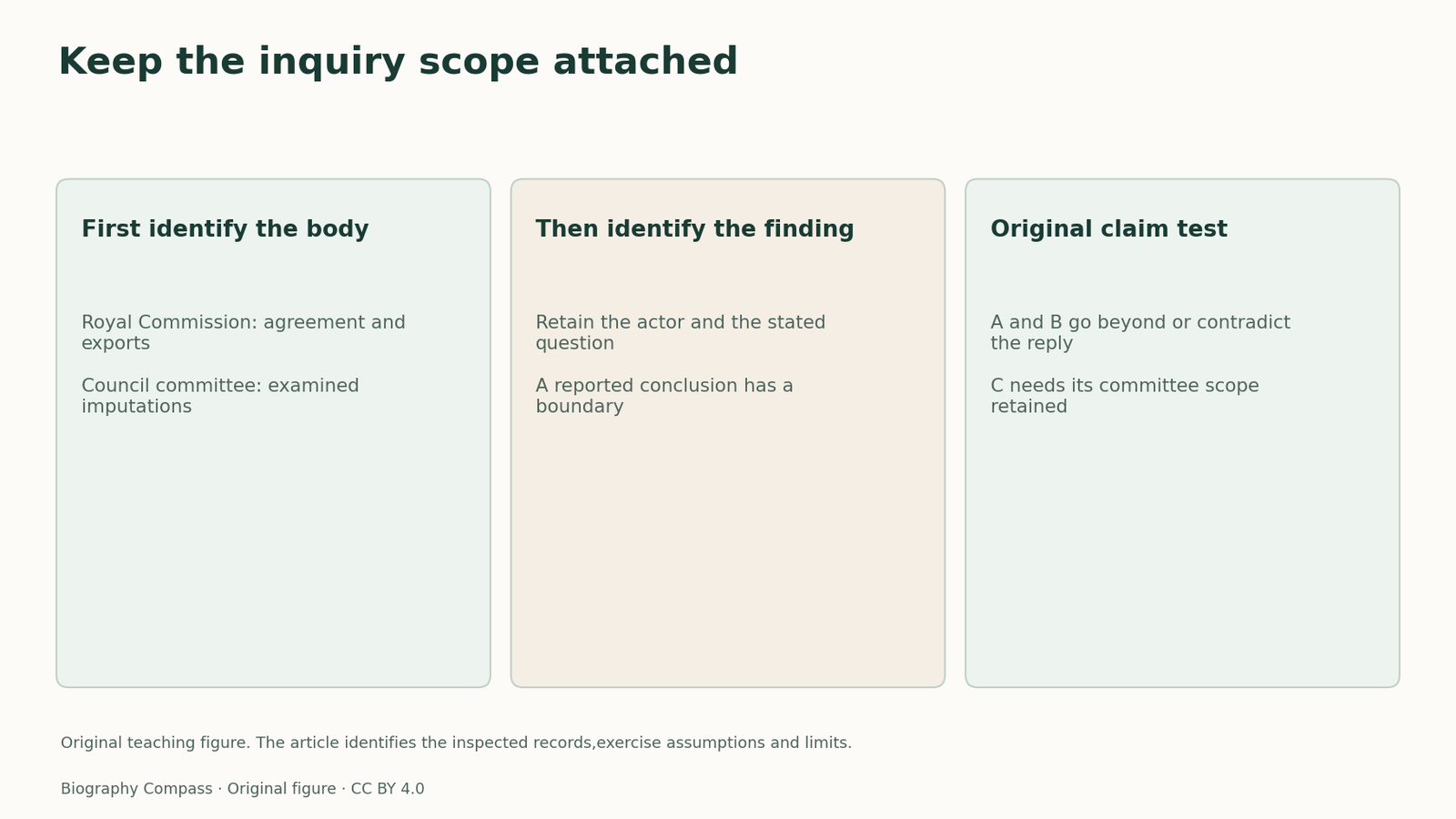
Bonar Law’s answer describes a Royal Commission on Victoria’s frozen-meat agreement and exports. It reports criticism of Angliss over ships A 36 and A 37. It then identifies a separate Legislative Council committee whose examined statements were not proved.
The parliamentary answer is the record inspected here. It reports other bodies’ work; the complete underlying reports were not read. That boundary is important both to the strength of the comparison and to its limits.
Sources for this section: [1]
Separate remit, finding and later inference
The Royal Commission considered the agreement’s terms and performance; the committee considered statements imputing improper conduct.
A finding answers a question within a remit. It cannot simply be transferred to a broader question because the same person appears in both records. The reported committee conclusion does not erase every criticism in the other report, just as a criticism does not automatically establish a criminal conviction.
Sources for this section: [1]
Original task: test three proposed claims
Classify these proposed readings of the reply: A, “Every shipper breached the arrangement”; B, “The Royal Commission made no criticism of Angliss”; C, “The committee found its examined statements unproved”. Which is supported, and what exact limitation must remain attached to it?
For each, identify whether the mistake concerns a named actor, the content of a reported finding or the reach of a conclusion. Use the answer as supplied; do not invent the contents of an uninspected report.
Sources for this section: [1]
Reference answer: keep the scope attached
C is supported only within the committee’s stated inquiry. A fails because the reply distinguishes Borthwick’s breach from the other shippers. B fails because it reports criticism of the two shipments.
The defensible note identifies the reporting speaker, the relevant body and its question. It does not use “cleared” or “guilty” as an unqualified summary of several different proceedings. To investigate the underlying evidence further would require the actual reports and their exhibits, not a stronger adjective attached to this selected answer.
Sources for this section: [1]
Continue the chronology
Related history guides
Biography context
Explore Australia through connected lives
Connected biographies
The connected careers
1865–1957
William Angliss
Meat exporterAngliss traded and exported meat. His working life also crossed commercial, public and charitable institutions.Read biographyQuick answers
Common questions
- Does a question in Parliament establish its allegation?
- No. The allegation or request must be distinguished from the answer and from any finding attributed to a separate body.
Primary and institutional sources
How this history was checked
Read these dated records together; the original task states its own assumptions and separates them from reported facts. This article was reviewed on 31 October 2026.