
The short answer
What changed when numeric entry used a small shared keypad, and what can differing object descriptions establish about the machine being described?
The records answer different questions
Keep the measures separate
The question changes when the object, unit or reporting period changes.
| Record or measure | What it establishes | What it does not establish |
|---|---|---|
| Shared display | Entry gives way to the answer. | A permanent display of every operand. |
| 1958 catalogue | 120 kg reported. | Every later specimen. |
| Museum object | 140 kg reported. | A measured before-and-after pair. |
Chronology
A timeline of the turning points
Prototype
Demonstration setback.
Market
14-A completed.
Specification
Catalogue version.
The object and the catalogue are not one timeless specification
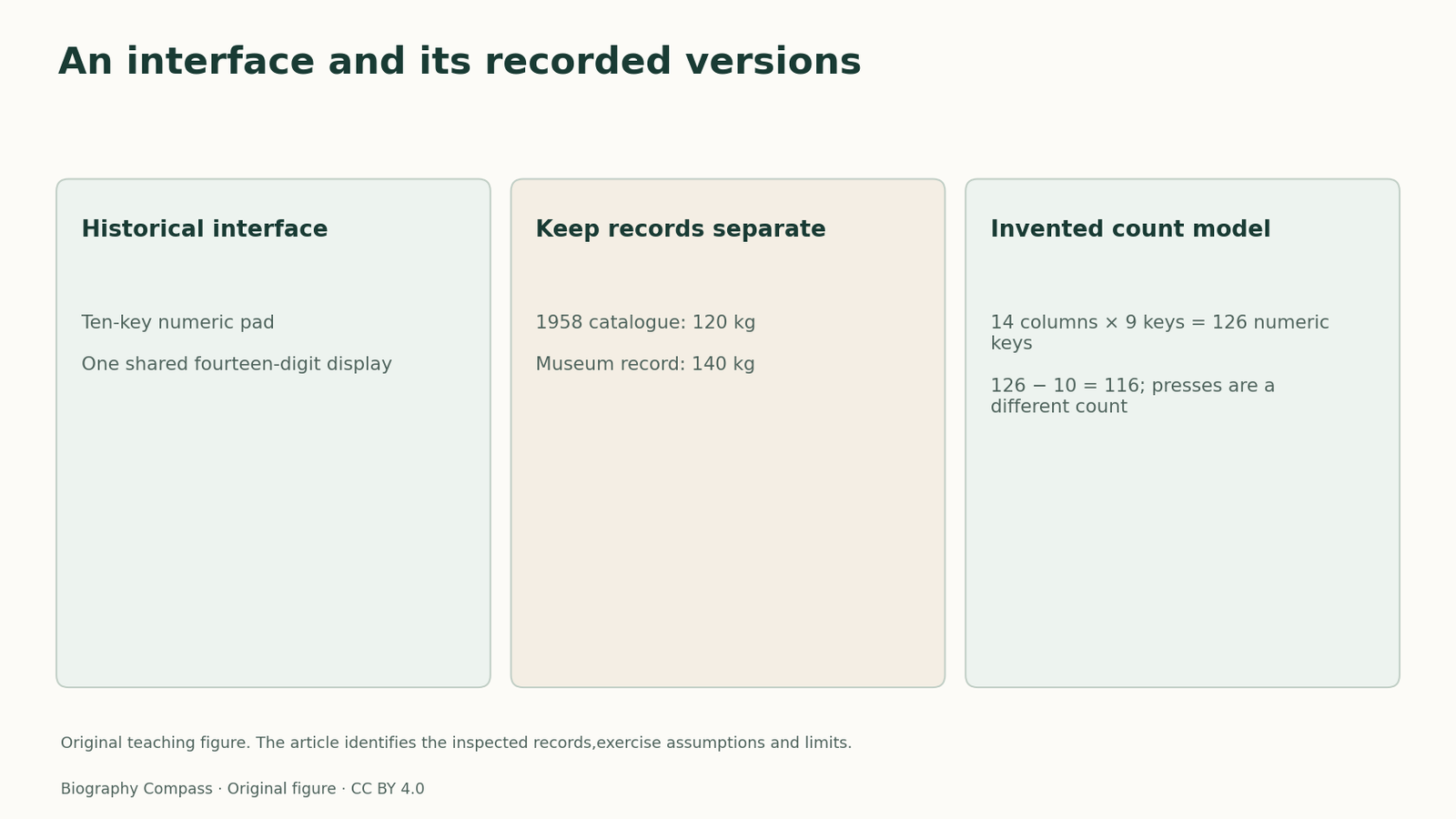
IPSJ explicitly says the machine changed through improvements. It reports a mass of 120 kg for the 1958 catalogue version.
The national science museum’s object description gives 140 kg.
The records therefore leave a version question before a measurement dispute. Neither entry, by itself, establishes that the other institution weighed the same specimen at the same time. The difference should remain attached to the record, rather than disappear into an averaged specification.
Original task: distinguish three counts
For this invented comparison, stipulate a full keyboard with 14 columns and nine numeric keys per column. Compare its numeric-key count with a 10-key panel. Ignore operation keys. Calculate the difference, then explain why this does not determine the number of presses needed for a calculation.
Separately, calculate the difference between the two reported masses above. A proposed caption calls it a measured weight reduction between two dated production models. Does the supplied record establish that claim? State the missing correspondence rather than guessing which entry is wrong.
Reference answer: capacity, actions and versions
The stipulated column panel has 14 × 9 = 126 numeric keys. The 10-key comparison has 116 fewer. That is a count of controls in the model, not an observed count of user actions or proof about every competing machine.
The reported masses differ by 20 kg. A reduction claim would additionally require a documented ordering of versions and a reliable match between each mass and that version. The selected pair does not supply that complete correspondence. A careful caption reports the two labelled records and preserves the uncertainty.
This reading keeps the useful design idea visible while preventing a later catalogue or museum entry from becoming an unqualified specification for every object sold under the same model name.
Continue the chronology
Related history guides
Biography context
Explore Japan through connected lives
Connected biographies
The connected careers
1917–1993
Tadao Kashio
Casio co-founderKashio helped build Casio. His life connects workshop skill with the organisation of a product business.Read biographyQuick answers
Common questions
- Does a smaller numeric pad prove fewer key presses?
- No. The exercise counts available controls, not the actions needed to enter particular values and operations.
Primary and institutional sources
How this history was checked
Read these dated records together; the original task states its own assumptions and separates them from reported facts. This article was reviewed on 31 October 2026.