
The short answer
How does an instruction set connect processor design to software?
Compare the evidence
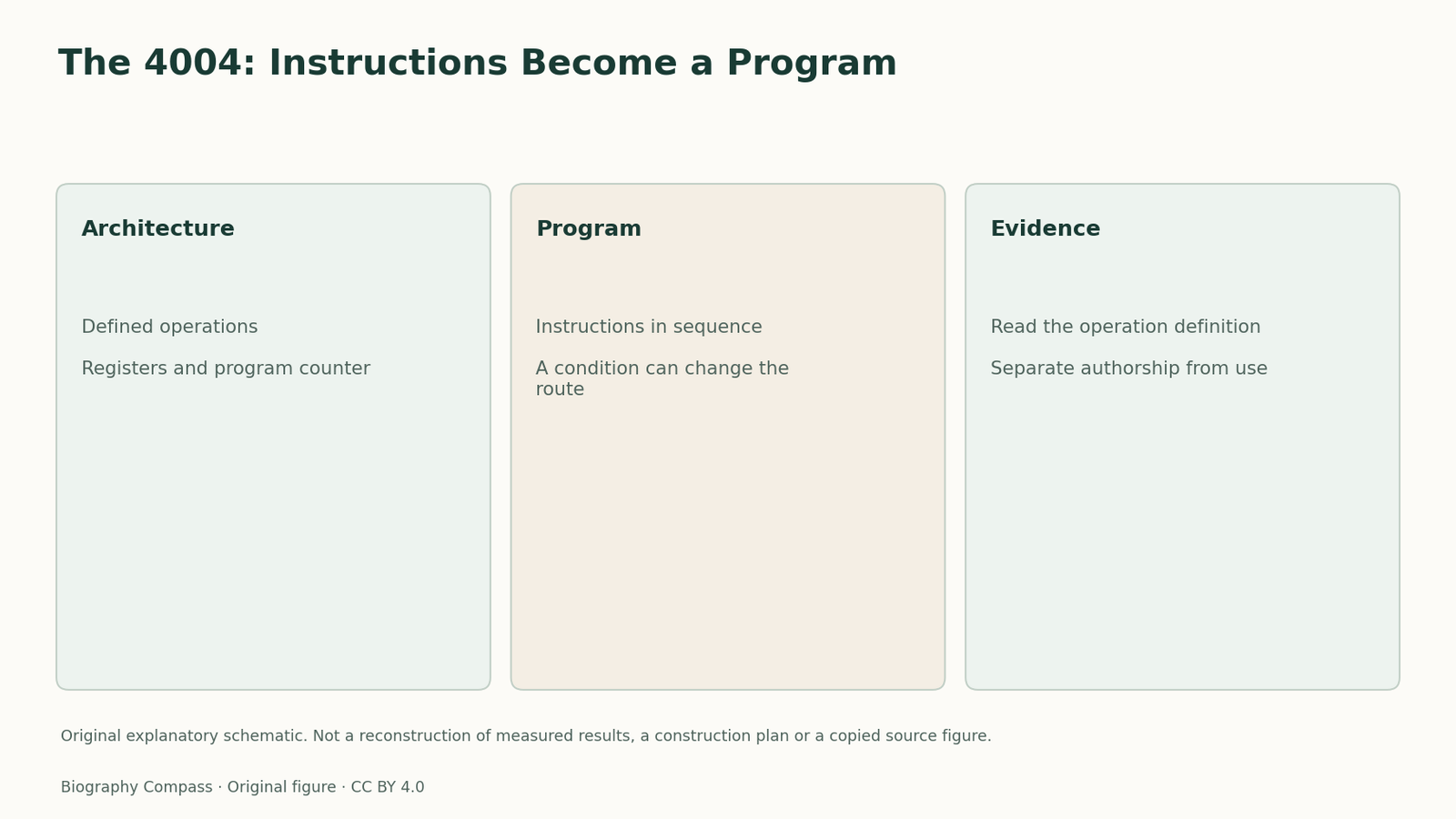
The 4004: Instructions Become a Program
Compare what each inspected record establishes with the claim that remains separate.
| Record or observation | What it supports | What remains separate |
|---|---|---|
| Museum architectural history | Places Mazor in functional and architectural work | Does not assign every implementation task to him |
| Intel manual conditional-jump example | Shows how an input changes the next instruction address | Does not imply physical rewiring or establish manual authorship |
An instruction is an operation with specified operands
Intel's MCS-4 manual explains programming as writing sequences of machine instructions. An instruction may affect a register, an accumulator, a memory location, a port or the program counter that determines what runs next. This makes an instruction set a bridge between architecture and a programmer's work. A device can be physically small without offering a useful way to express a task; programmable operations give software a vocabulary for doing so.
A conditional jump makes the sequence depend on an input
The manual's introductory example tests a switch using a conditional-jump instruction. Depending on the specified condition, execution either continues in sequence or moves to another address. This is a software decision carried out through the architecture's defined operations. It is different from claiming that the instruction changes the physical wiring of the processor. The web transcription is machine-read and incomplete, so this guide uses its explanatory logic rather than reproducing unchecked binary encodings or program listings.
Sources for this section: [3]
A branching exercise with a clear boundary
Draw an original classroom flowchart containing an input test and two labelled paths. If an invented switch state meets the test, follow path A; otherwise follow path B. Then mark the program counter as the item whose next destination changes. The supported answer separates the input value, the condition and the next instruction address. This chart is not executable 4004 code. It illustrates why a documented instruction set, a sequence of instructions and the hardware executing them are distinct parts of a programmable system.
Continue the chronology
Related history guides
Which parts of the 4004 story concern architecture and which implementation?
Which parts of the 4004 story concern architecture and which implementation?
Read the timeline1969–2009The CCD: Collect, Transfer and Read Charge
How can a charge-coupled device transfer and read an image?
Read the timelineBiography context
Explore United States through connected lives
Connected biographies
People behind the records
1941–
Stanley Mazor
Computer architect, programmer and technical educatorArchitectural work on Intel microprocessors and subsequent technical training.Read biographyb. 1937
Marcian Hoff
Electrical engineer and computer architectMarcian Ted Hoff helped define the architecture of Intel’s 4004 and later developed communications products and worked in technology consulting.Read biography
1930–2025
George E. Smith
Applied physicist and semiconductor-device researcherInvention of the charge-coupled device with Willard Boyle.Read biographyQuick answers
Common questions
- How does an instruction set connect processor design to software?
- An instruction set defines operations that software can request. A conditional jump, for example, changes which instruction is fetched next according to a stated condition; it does not rewire the processor.
Primary and institutional sources
How this history was checked
Sources distinguish individual patent or technical records from biographical and retrospective accounts. Their actual reading scope is retained in the biography source notes. This article was reviewed on 7 November 2026.