
The short answer
Which parts of the 4004 story concern architecture and which implementation?
Compare the evidence
Observation, method and result
Compare the inspected records and the different claims they support.
| Record | Evidence | Limit |
|---|---|---|
| Hoff and Shima biographies | Describe initial concept and shared functional definition. | Architecture is not sole authorship of every implementation task. |
| MCS-4 museum account | Names Faggin’s project role and a four-chip system. | The 4004 CPU is not the entire microcomputer set. |
An architectural proposal changes the problem
Hoff’s proposal replaced a larger collection of custom calculator functions with a more general programmable approach. The architectural work concerned what operations the processor would support and how they would serve the customer’s requirements. The museum credits Hoff and Mazor while its Shima biography describes joint definition involving Shima as well. These accounts can be read together without forcing all decisions into one person’s role. Functional definition is collaborative work even when one participant supplies an important initial concept.
A specification still needs implementation
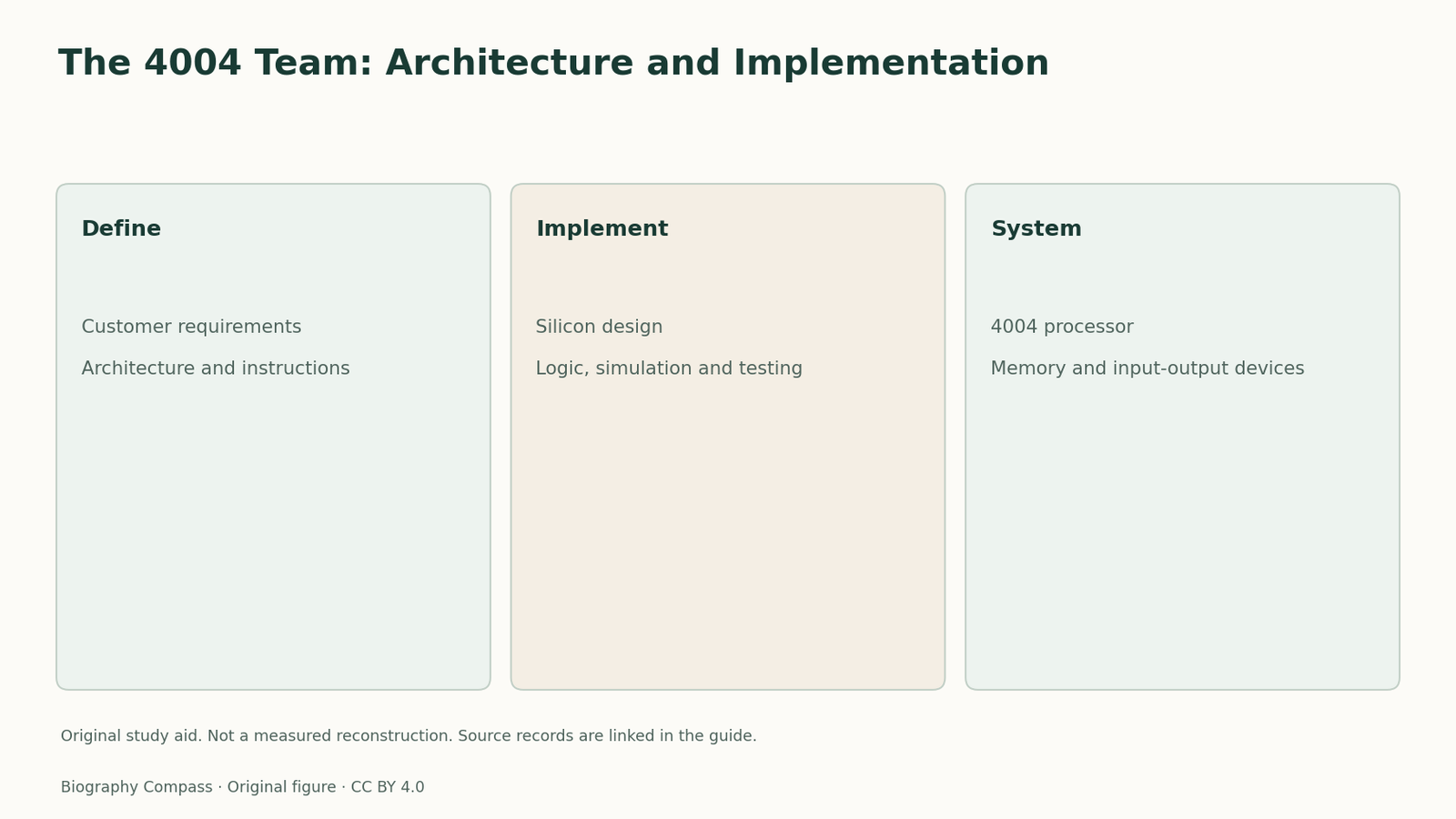
The museum identifies Faggin as project leader and principal designer for theMCS-4 chip set. Shima contributed logic design, simulation and test-program generation. Those tasks turned functional requirements into an implementation that could be checked and manufactured. Draw separate boxes for requirements, architecture, silicon design and verification. Connect the documented contributions with overlapping arrows rather than assigning each person exclusive ownership of one perfectly sealed box. The boundaries clarify different responsibilities without pretending that the team never revised or discussed work across them.
The processor and the chip family differ
The 4004 was a processor chip within the four-chipMCS-4 microcomputer set. Other system functions therefore remained outside the CPU chip. A supported answer labels processor, memory and input-output at the system level before discussing the architecture inside the processor. This avoids the misleading phrase that an entire working computer was placed on one chip in this project. The distinction also shows why an elegant architectural proposal is substantial but incomplete: implementation, verification, supporting devices and a usable application all contribute to a technological product’s existence.
Continue the chronology
Related history guides
Biography context
Explore United States through connected lives
Connected biographies
People behind the records
b. 1937
Marcian Hoff
Electrical engineer and computer architectMarcian Ted Hoff helped define the architecture of Intel’s 4004 and later developed communications products and worked in technology consulting.Read biography1924–2000
Victor Grinich
Electrical engineer and semiconductor co-founderVictor Grinich connected semiconductor devices with testing, applications and engineering education as a Fairchild founder and later teacher.Read biographyQuick answers
Common questions
- Which parts of the 4004 story concern architecture and which implementation?
- Hoff helped define a programmable architecture. Faggin, Shima, Mazor and others contributed distinct implementation and verification work; the 4004 CPU also required supporting chips withinMCS-4.
Primary and institutional sources
How this history was checked
Source notes distinguish documented facts from the explanatory examples and diagrams created for this guide. This article was reviewed on 7 November 2026.