
The short answer
How did base-selective cleavage and labelled fragment lengths encode a DNA sequence?
Read the evidence
Different records within the same investigation
The following comparison distinguishes the specific questions answered by the inspected records.
| Record or test | What it establishes | What remains different |
|---|---|---|
| End label | Provides a common length reference. | Does not alone identify a base. |
| Cleavage preference | Connects a reaction lane with possible bases. | Needs comparison with fragment ordering. |
| Combined pattern | Allows ordered base calls from the labelled end. | The complementary strand remains a separate representation. |
A common labelled end made fragment lengths comparable
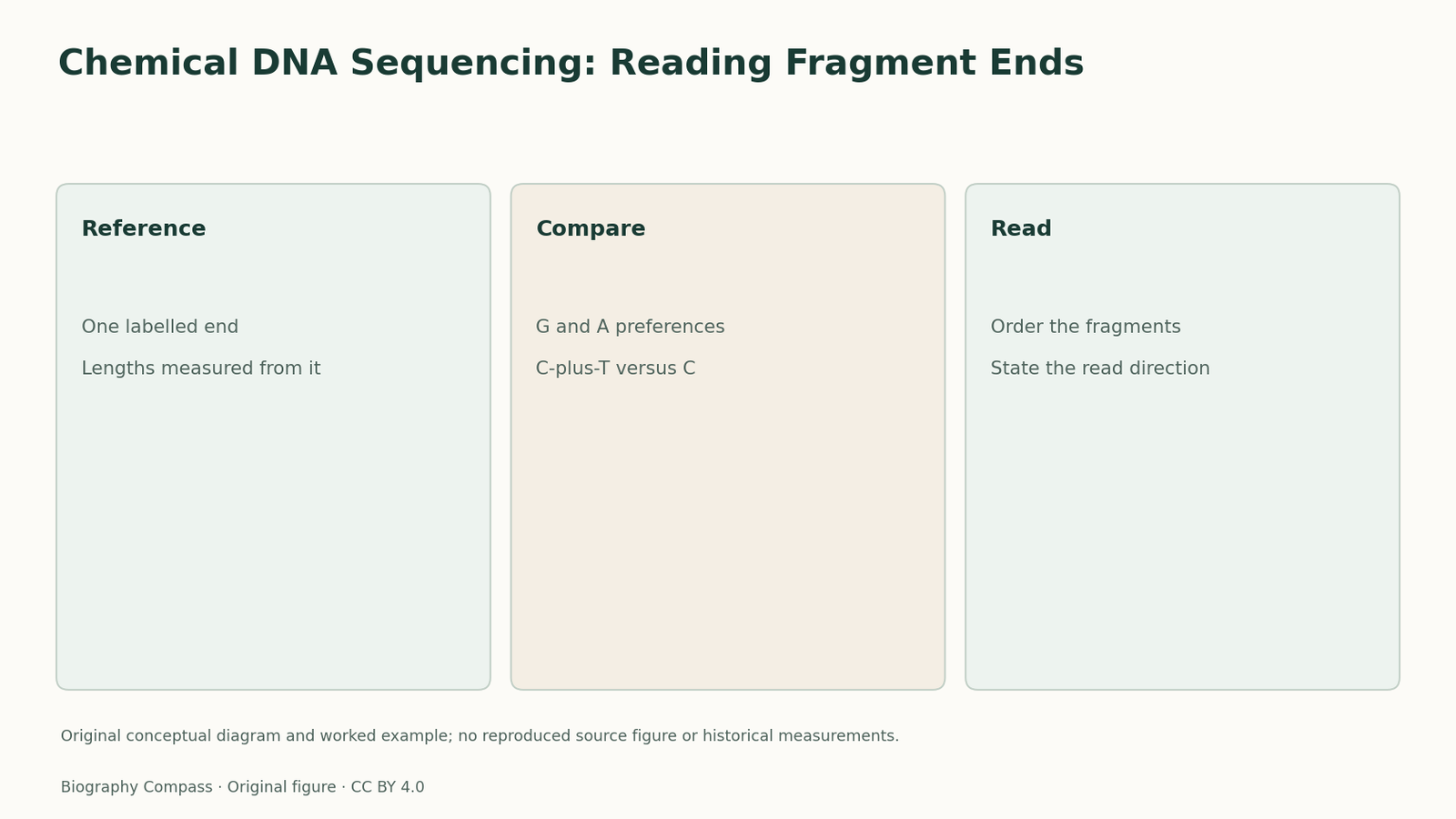
Maxam and Gilbert’s 1977 method began with DNA labelled at one end. Partial chemical cleavage generated families of fragments extending from that common reference point. Separating them by length then made each position interpretable relative to the labelled end. Without a shared endpoint, fragment length alone would not tell a reader where a cleavage event belonged in the original molecule. The reference point is therefore part of the information structure of the experiment, not an incidental preparation detail.
Sources for this section: [1]
Reaction preferences supplied the base information
The original abstract describes reaction conditions favouring cleavage at guanine, adenine, cytosine plus thymine, or cytosine. Comparing the resulting patterns allowed the investigator to infer successive bases. Gaastra’s later methods account explains the same chemical-cleavage approach as a sequencing procedure. The logic combines two observations: where a fragment falls in the length ordering and which reaction produced it. Neither a single band nor a single lane independently supplies the entire sequence. Reading the pattern requires the lanes to be interpreted together.
A sequence call is an interpretation of a pattern
Gilbert’s lecture connects the method’s development with earlier work on the lac operator and chemical probing. The historical result was not an automatic conversion of any gel image into a perfect sequence. Partial cleavage, a known labelled end and interpretable separation were needed for the intended inference. A sequence written from the labelled end must also be distinguished from its complementary strand. These relationships explain why chemical sequencing and primer-directed DNA amplification answer different laboratory questions even when both involve DNA fragments.
An original four-position exercise
Use a simplified invented pattern ordered from the shortest labelled fragment to the longest. Position one appears in the G reaction; position two appears in both the C-plus-T and C reactions; position three appears only in C-plus-T; position four appears in A. What sequence does this represent in the direction read from the labelled end? The answer is G, C, T, A. The double appearance at position two identifies C, whereas the C-plus-T-only position identifies T. This is an editorial logic puzzle rather than a copied experimental gel or a safe laboratory protocol. A good answer also states that the reading direction is defined by the labelled end; obtaining the complementary strand requires a separate base-pairing step. If a position were unclear, the reader should preserve that uncertainty rather than invent an additional base.
Continue the chronology
Related history guides
Phage Display 1985: Linking a Protein to Its Gene
Read Smith’s 1985 fusion-phage experiment alongside later selection methods, with a worked example separating enrichment from proven biological activity.
Read the timeline1983–1987PCR: Cycling, Primers and Amplification
Understand the logic of early PCR papers through an original copying exercise, distinguishing ideal amplification from identity, purity and later automation.
Read the timelineBiography context
Explore United States through connected lives
Connected biographies
Researchers and related approaches
1932–
Walter Gilbert
Molecular biologist and DNA-sequencing researcherWalter Gilbert moved from theoretical physics into molecular biology, working on gene regulation and developing chemical DNA sequencing with Allan Maxam.Read biographyQuick answers
Common questions
- Why compare C-plus-T with C?
- In the simplified logic, a position in both identifies C, while a C-plus-T position absent from C identifies T.
- Is the worked pattern an original gel?
- No. It is an invented four-position exercise explaining the inference.
Primary and institutional sources
How this history was checked
The references below distinguish the original study from later explanations. The worked exercise and comparison are newly written for this article. This article was reviewed on 8 November 2026.
- Maxam and Gilbert, PNAS, 1977A new method for sequencing DNA
- W. Gaastra, Methods in Molecular Biology, 1985Chemical cleavage (Maxam and Gilbert) method for DNA sequence determination
- Nobel Prize OutreachWalter Gilbert — Nobel lecture
- Nobel Prize OutreachWalter Gilbert — Facts
- Nobel Prize OutreachWalter Gilbert — Biographical