
The short answer
How did displaying a foreign peptide on phage connect a binding property with recoverable genetic information?
Read the evidence
Different records within the same investigation
The following comparison distinguishes the specific questions answered by the inspected records.
| Record or test | What it establishes | What remains different |
|---|---|---|
| 1985 display experiment | Links a surface antigen with an encoding phage particle. | Does not establish every later library application. |
| Affinity selection | Changes which displayed variants are recovered. | Enrichment does not make every survivor the desired variant. |
| Subsequent characterisation | Tests an isolated candidate’s behaviour. | Binding alone does not establish clinical effectiveness. |
A particle carried both a feature and its instructions
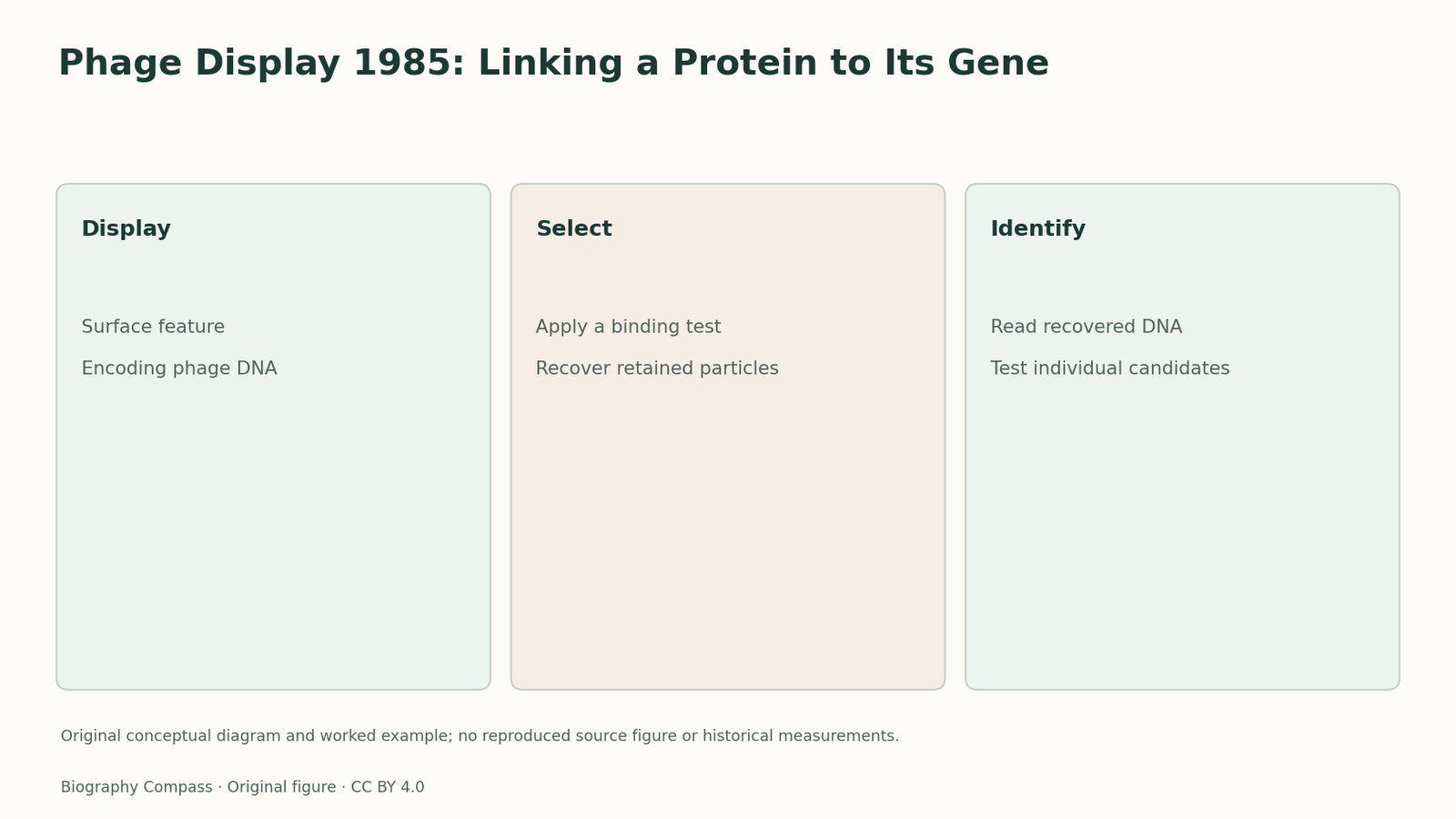
Smith’s 1985 experiment placed foreign DNA within gene III of a filamentous bacteriophage. The resulting fusion protein presented a cloned antigen on the particle’s exterior while infectivity was retained. The phage therefore combined a testable surface feature with the genetic material encoding that feature. This linkage mattered because a particle recovered through a binding experiment could lead back to its DNA, rather than leaving the investigator with an unidentified protein isolated from a mixture.
Sources for this section: [1]
Displaying an insert was one result; selecting it was another
The original paper also described antibody-based enrichment of fusion phage. Parmley and Smith’s 1989 methodological account developed the use of filamentous fusion-phage vectors for studying epitopes and considering vaccine design. These records distinguish producing a displayed insert from recovering particular particles through affinity selection. A selection procedure changes the composition of a population. Its success does not mean that every displayed molecule has the desired activity or that binding in one assay establishes an effective treatment.
Libraries made the linkage a search method
Smith’s Nobel lecture credits subsequent work on practical vectors, affinity selection and random peptide libraries. A library supplies variation; the binding step favours some variants; amplification makes recovered genetic material available for another round or for analysis. This explains why the method was more than an alternative container for a protein. Its experimental power came from making molecular recognition usable as a retrieval rule. The original paper and later library programme describe related stages rather than an already complete technology arriving in one publication.
An original enrichment exercise
Consider an invented library containing 100 particles: ten display feature A and ninety display other features. A binding test retains eight A particles and twelve others. What changed? A now constitutes eight of twenty retained particles, or forty percent, compared with ten percent initially. The population is enriched for A, but twelve retained particles still lack it. If all twenty are amplified, the next population reflects both the selection and the amplification process. The supported conclusion is enrichment under this assay, followed by a need to identify and characterise individual variants. These invented counts are not measurements from Smith’s experiments. A useful follow-up would test isolated candidates separately and ask whether the selected binding behaviour survives a changed assay condition.
Continue the chronology
Related history guides
Biography context
Explore United States through connected lives
Connected biographies
Researchers and related approaches

1941–
George P. Smith
Molecular biologist and phage-display researcherGeorge P. Smith developed phage display, linking a molecule’s binding behaviour with recoverable DNA and opening a route to selection from libraries.Read biography
1951–
Gregory P. Winter
Biochemist and antibody-engineering researcherIn 1990 John McCafferty, Andrew Griffiths, Winter and David Chiswell reported antibody variable domains displayed on filamentous bacteriophage.Read biographyQuick answers
Common questions
- What is the essential linkage?
- A testable displayed molecule remains associated with the DNA carried by its phage particle.
- Does enrichment mean purity?
- No. A selected population can contain both desired and undesired variants.
Primary and institutional sources
How this history was checked
The references below distinguish the original study from later explanations. The worked exercise and comparison are newly written for this article. This article was reviewed on 8 November 2026.
- Science, 1985Filamentous fusion phage: novel expression vectors that display cloned antigens on the virion surface
- Parmley and Smith, 1989Filamentous fusion phage cloning vectors for the study of epitopes and design of vaccines
- Nobel Prize OutreachGeorge P. Smith — Nobel lecture
- Nobel Prize OutreachGeorge P. Smith — Facts
- Nobel Prize OutreachGeorge P. Smith — Biographical