
The short answer
The surviving machine helps explain controlled screw cutting. It does not, by itself, prove that every workshop adopted an identical thread standard.
Compare the evidence
Maudslay’s Lathe: Following the Leadscrew
Keep the observations and the conclusions they support together.
| Record | What it supports | What it does not establish |
|---|---|---|
| Surviving lathe | The slide rest, leadscrew and supporting bars remain inspectable. | Missing change wheels limit direct inspection of the original gearing. |
| Library mechanism account | Gearing links tool travel to workpiece rotation. | A mechanism for repeatability does not document industry-wide standard adoption. |
Trace two connected movements
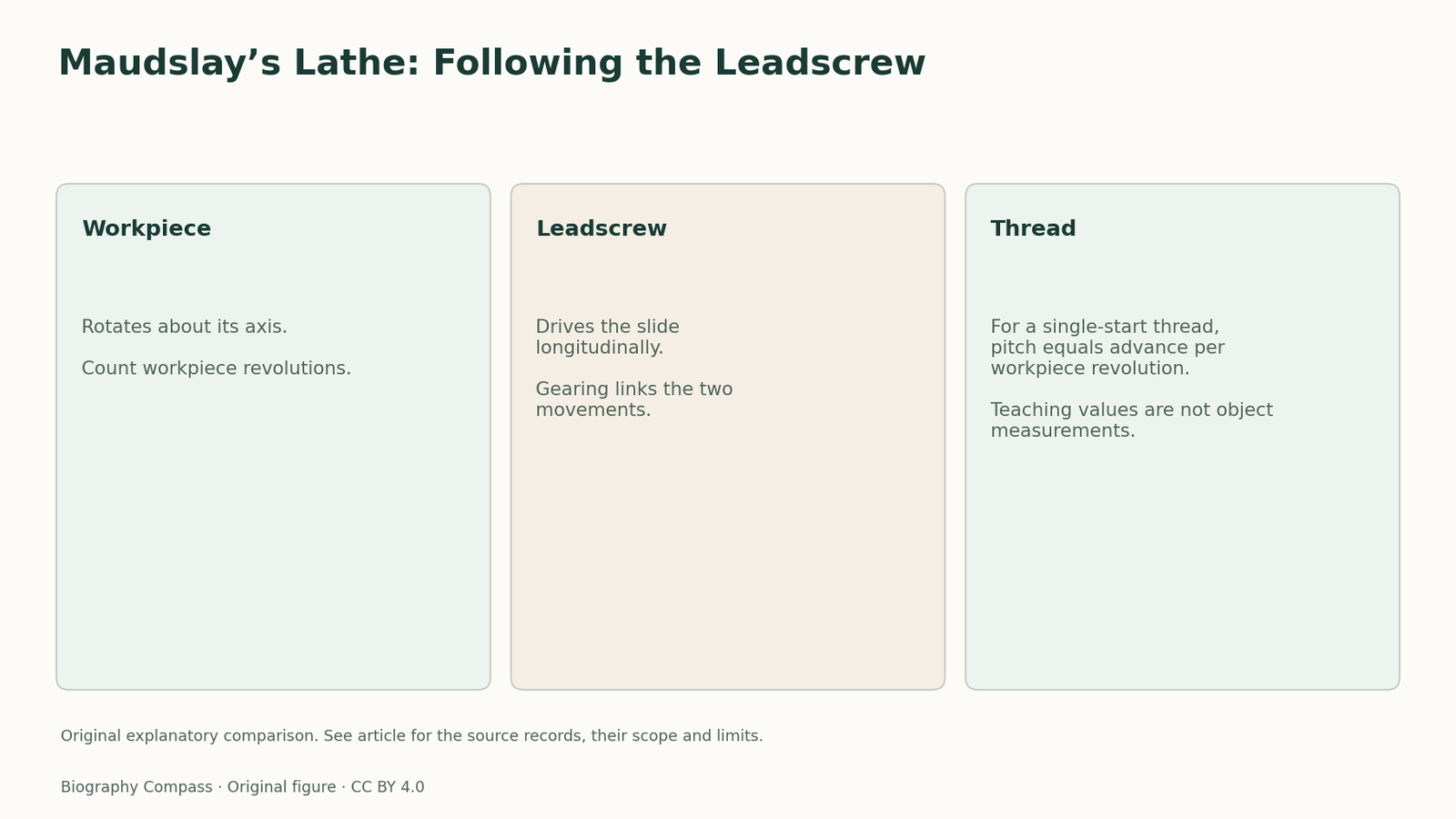
The Science Museum’s lathe has a tool holder carried by a slide rest and a leadscrew running between the supporting bars. Turning the workpiece and moving the cutter along its length must be coordinated to produce a regular helical thread. Linda Hall Library’s account explains the role of replaceable gears in setting that relationship. Follow the power path and the cutter path separately before bringing them together in the resulting screw.
Distinguish the object from the reconstruction
The catalogue says the machine’s change wheels are now missing. That is an important observation about its present state, not evidence that gearing played no part in its operation. An explanatory diagram may show the functional link while clearly labelling it as a reconstruction of the relationship described by the record. The museum’s circa 1800 date also deserves retention. Replacing an approximate catalogue date with a precise invention year would create certainty the particular object entry does not supply.
Sources for this section: [2]
A ratio exercise with a limited conclusion
In an original classroom model, suppose a leadscrew advances a slide four millimetres in one revolution. If gearing makes it turn once for every two workpiece revolutions, the cutter advances two millimetres per workpiece revolution. This gives a two-millimetre lead; for the single-start thread assumed in this classroom model, the pitch is also two millimetres. The numbers are chosen for teaching and do not describe the museum machine. Repeating a pitch within this model is different from establishing a common standard across manufacturers, where screw diameter, thread form, measurement and adoption also matter.
Continue the chronology
Related history guides
Bramah’s Press: Force, Area and a Seal
Learn why Bramah’s hydraulic press multiplies force, how a pressure-energised seal helps it work, and what an ideal teaching calculation leaves out.
Read the timeline1839–1897Nasmyth’s Hammer: Model, Machine and Memoir
Compare Nasmyth’s hammer model, a surviving Royal Mint machine and his memoir to separate operation, object dates and disputed invention credit.
Read the timelineBiography context
Explore United Kingdom through connected lives
Connected biographies
People behind the records
1771–1831
Henry Maudslay
Machine-tool maker and engineering employerHenry Maudslay brought tools, controlled movement and skilled workshop practice together in machines that helped make precision manufacture repeatable.Read biography1748–1814
Joseph Bramah
Inventor, locksmith and manufacturerJoseph Bramah built a manufacturing business around improved locks and hydraulic machinery, with workshop colleagues helping turn principles into working equipment.Read biography1808–1890
James Nasmyth
Engineer, manufacturer, artist and astronomical observerJames Nasmyth built a successful machine-making business and promoted the steam hammer, then devoted his retirement to astronomy, drawing and recollection.Read biographyQuick answers
Common questions
- What does Maudslay’s surviving lathe show about screw cutting?
- The surviving lathe connects a guided cutting tool to a leadscrew driven in relation to the turning workpiece. Its change wheels are now missing, so the catalogue description and surviving parts need to be read together.
Primary and institutional sources
How this history was checked
The sources distinguish institutional biographies, participant accounts and records of individual objects. The related biography gives context for their use. This article was reviewed on 7 November 2026.
- European Route of Industrial HeritageHenry Maudslay
- Science Museum GroupHenry Maudslay’s original screw-cutting lathe,c1800
- Linda Hall LibraryHenry Maudslay
- James Nasmyth, edited by Samuel Smiles / Project GutenbergJames Nasmyth, Engineer: An Autobiography
- Sandvik CoromantThread turning application tips: Multi-start thread