
The short answer
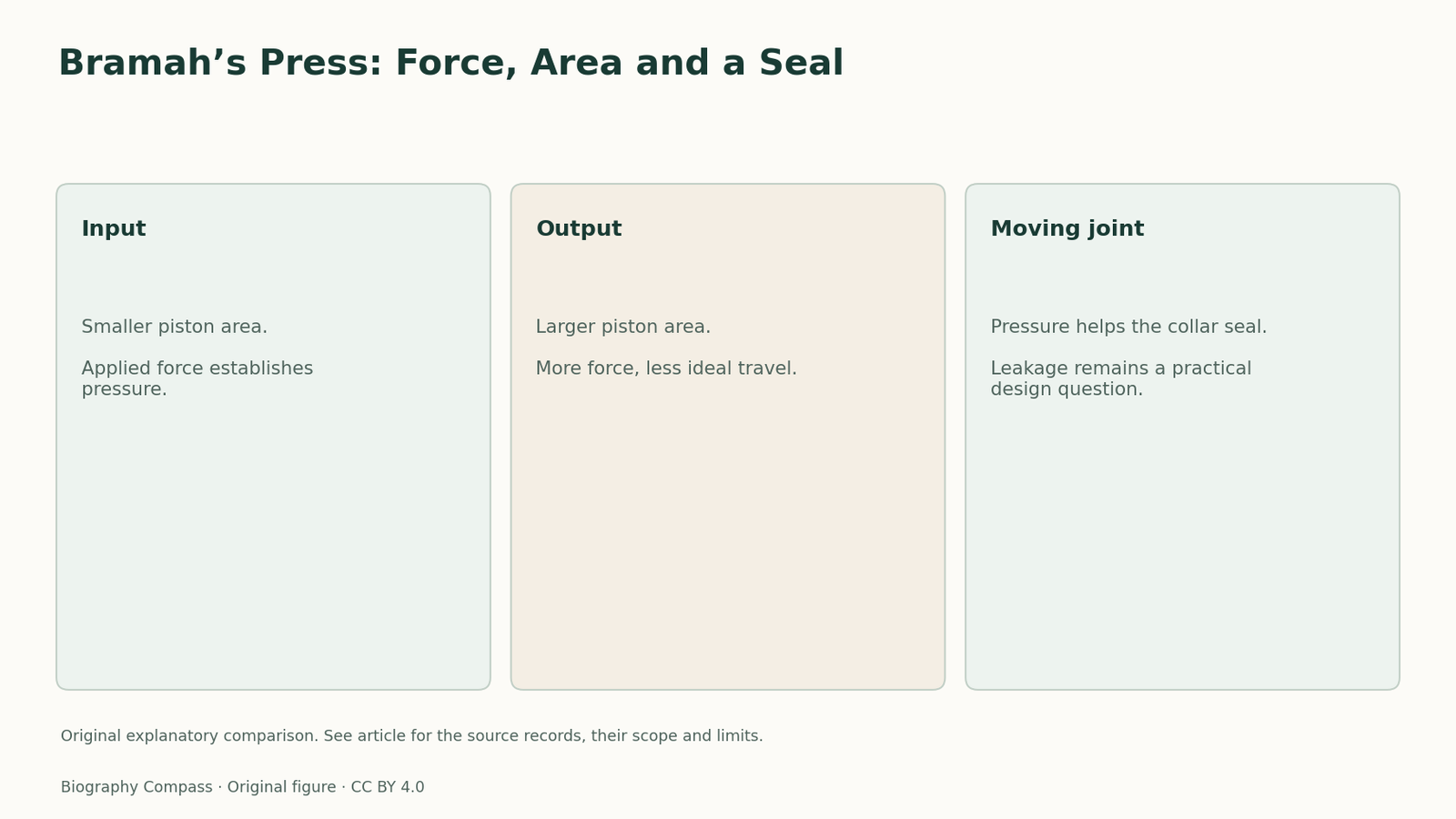
The force advantage of a hydraulic press and the problem of keeping high-pressure water inside it are connected, but they require different explanations.
Compare the evidence
Bramah’s Press: Force, Area and a Seal
Keep the observations and the conclusions they support together.
| Record | What it supports | What it does not establish |
|---|---|---|
| IMechE principle | Equal fluid pressure can act on unequal piston areas. | An ideal force ratio is not a measured efficiency. |
| Smiles’s collar account | Pressure presses the leather against the moving joint. | Retrospective credit is not a complete patent-priority investigation. |
A calculation with an explicit assumption
For an original teaching example, suppose the output piston has ten times the area of the input piston. An input force of 20 newtons then corresponds to an ideal output force of 200 newtons. These are invented values, not measurements from Bramah’s machine. In an ideal incompressible system, the larger piston also travels a smaller distance for a given input displacement. The force advantage therefore does not supply extra work without an accompanying trade-off in movement.
Sources for this section: [2]
A principle still needs a sealed machine
Smiles’s historical account describes leather shaped so that water pressure pressed its edges against the ram and cylinder. Increasing pressure helped the collar seal rather than merely increasing the tendency to leak. The passage credits Maudslay for this practical contribution. Compare that description with the area calculation: one explains a mechanical advantage, the other how a moving joint can contain the water. Neither provides tested losses, allowable loads or an operating procedure for a modern press. Those would need a particular machine and its engineering documentation.
Continue the chronology
Related history guides
Thames Tunnel: Shield, Face and Lining
Understand how the Thames Tunnel shield supported excavation, how brick lining followed it, and why the mechanism did not eliminate flooding.
Read the timelineCirca 1800Maudslay’s Lathe: Following the Leadscrew
Follow the leadscrew, slide rest and turning workpiece in Maudslay’s surviving lathe, and distinguish its mechanism from claims about universal screw standards.
Read the timelineBiography context
Explore United Kingdom through connected lives
Connected biographies
People behind the records
1748–1814
Joseph Bramah
Inventor, locksmith and manufacturerJoseph Bramah built a manufacturing business around improved locks and hydraulic machinery, with workshop colleagues helping turn principles into working equipment.Read biography1771–1831
Henry Maudslay
Machine-tool maker and engineering employerHenry Maudslay brought tools, controlled movement and skilled workshop practice together in machines that helped make precision manufacture repeatable.Read biography
1810–1900
William George Armstrong
Engineer, hydraulic-machinery manufacturer and industrialistWilliam George Armstrong moved from law into hydraulic engineering, then built an international manufacturing business on Tyneside. Cranes, accumulators, guns and warships generated wealth that supported scientific experiments and public gifts, while tying his legacy to the global arms trade.Read biographyQuick answers
Common questions
- How did Bramah turn hydraulic pressure into a working industrial press?
- Applied fluid pressure acts on pistons of different areas, producing a larger force at the larger piston. A reliable moving seal made the principle useful in a working machine; the ideal force advantage also involves a trade-off in travel.
Primary and institutional sources
How this history was checked
The sources distinguish institutional biographies, participant accounts and records of individual objects. The related biography gives context for their use. This article was reviewed on 7 November 2026.