
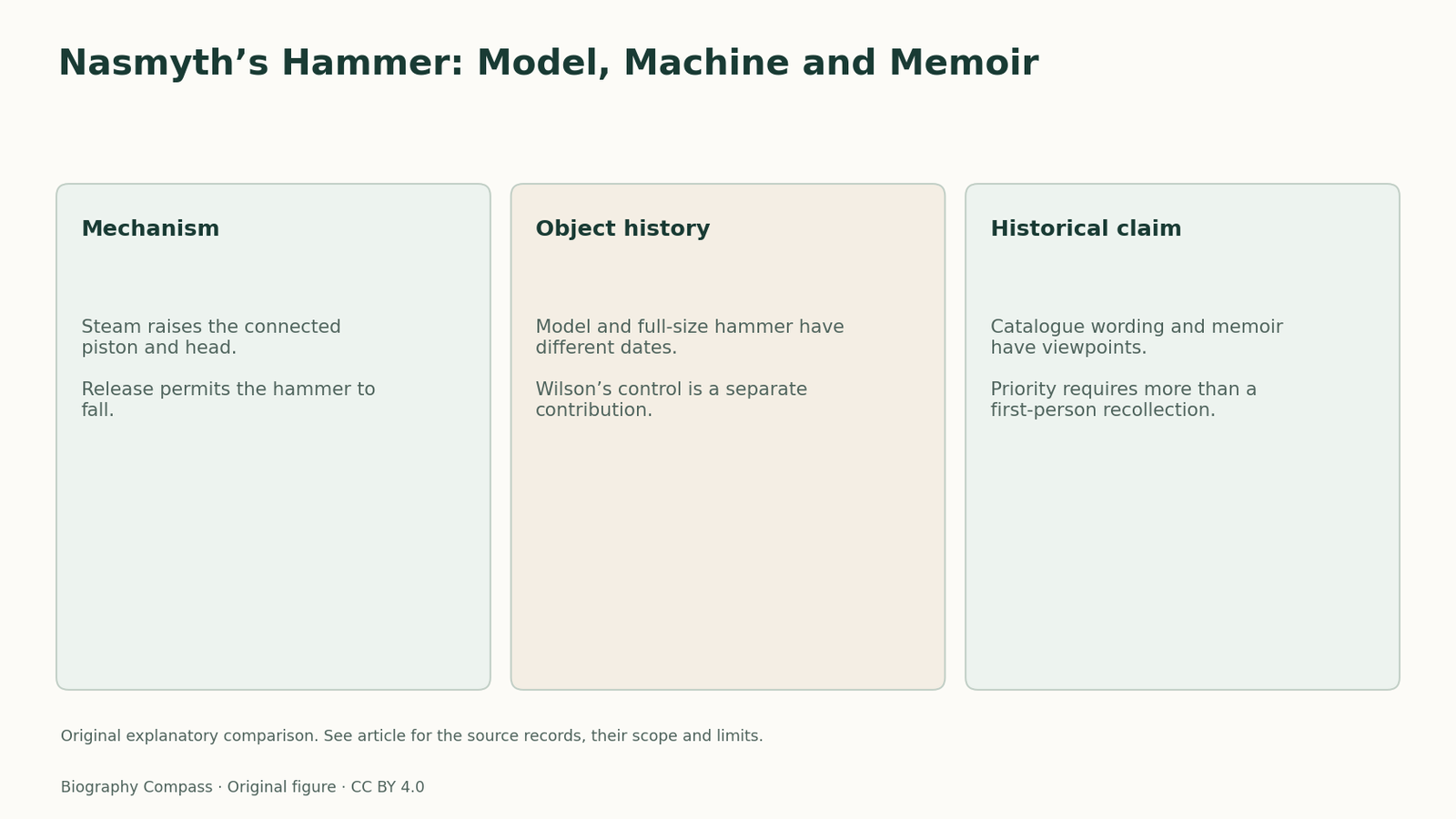
The short answer
A working model can explain a mechanism, while a later memoir explains its author’s recollection. Neither alone settles the steam hammer’s disputed origins.
Compare the evidence
Nasmyth’s Hammer: Model, Machine and Memoir
Keep the observations and the conclusions they support together.
| Record | What it supports | What it does not establish |
|---|---|---|
| Scale model | Shows direct action and an automatic-control arrangement. | Its production date is not the date of the first idea. |
| Royal Mint hammer record | Documents another surviving object and acknowledges the Bourdon dispute. | A later maker’s memoir cannot independently settle that dispute. |
Follow the operation in the model
The Science Museum’s quarter-scale model represents a direct-action hammer. Steam admitted beneath a piston raises the connected hammer head. Releasing the steam allows the head to fall onto the work. The model also includes automatic regulating equipment credited to Robert Wilson in 1843. This is a description of a particular mechanism and its represented improvements. It is not evidence that every later hammer used precisely the same arrangement or that one person supplied every feature.
Sources for this section: [4]
Keep three dates separate
The model is dated 1843–1857. A different surviving hammer, used at the Royal Mint, is dated 1845–1855. Those are object-production ranges, distinct from the 1839 design story and the 1842 patent recorded in Nasmyth’s biography. His autobiography is later still; the linked digital text follows a 1897 popular edition and includes Smiles’s account of editing the recollections. Put conception, patent, manufacture and recollection on separate lines instead of assigning every object the date of the first idea.
Read a priority claim with its perspective
The model description uses a strong first-invention formulation, while the museum’s full-size hammer account explicitly says Nasmyth was not first and describes the dispute with François Bourdon. That contrast should remain visible. A reader can explain the model’s operation without deciding the priority issue. To investigate priority further, seek dated drawings, patent specifications and records from both workshops. A later memoir is evidence of a participant’s account; presenting it as an independent verdict would erase the central historical question.
Continue the chronology
Related history guides
Maudslay’s Lathe: Following the Leadscrew
Follow the leadscrew, slide rest and turning workpiece in Maudslay’s surviving lathe, and distinguish its mechanism from claims about universal screw standards.
Read the timeline1818–1843Thames Tunnel: Shield, Face and Lining
Understand how the Thames Tunnel shield supported excavation, how brick lining followed it, and why the mechanism did not eliminate flooding.
Read the timelineBiography context
Explore United Kingdom through connected lives
Connected biographies
People behind the records
1808–1890
James Nasmyth
Engineer, manufacturer, artist and astronomical observerJames Nasmyth built a successful machine-making business and promoted the steam hammer, then devoted his retirement to astronomy, drawing and recollection.Read biography1771–1831
Henry Maudslay
Machine-tool maker and engineering employerHenry Maudslay brought tools, controlled movement and skilled workshop practice together in machines that helped make precision manufacture repeatable.Read biography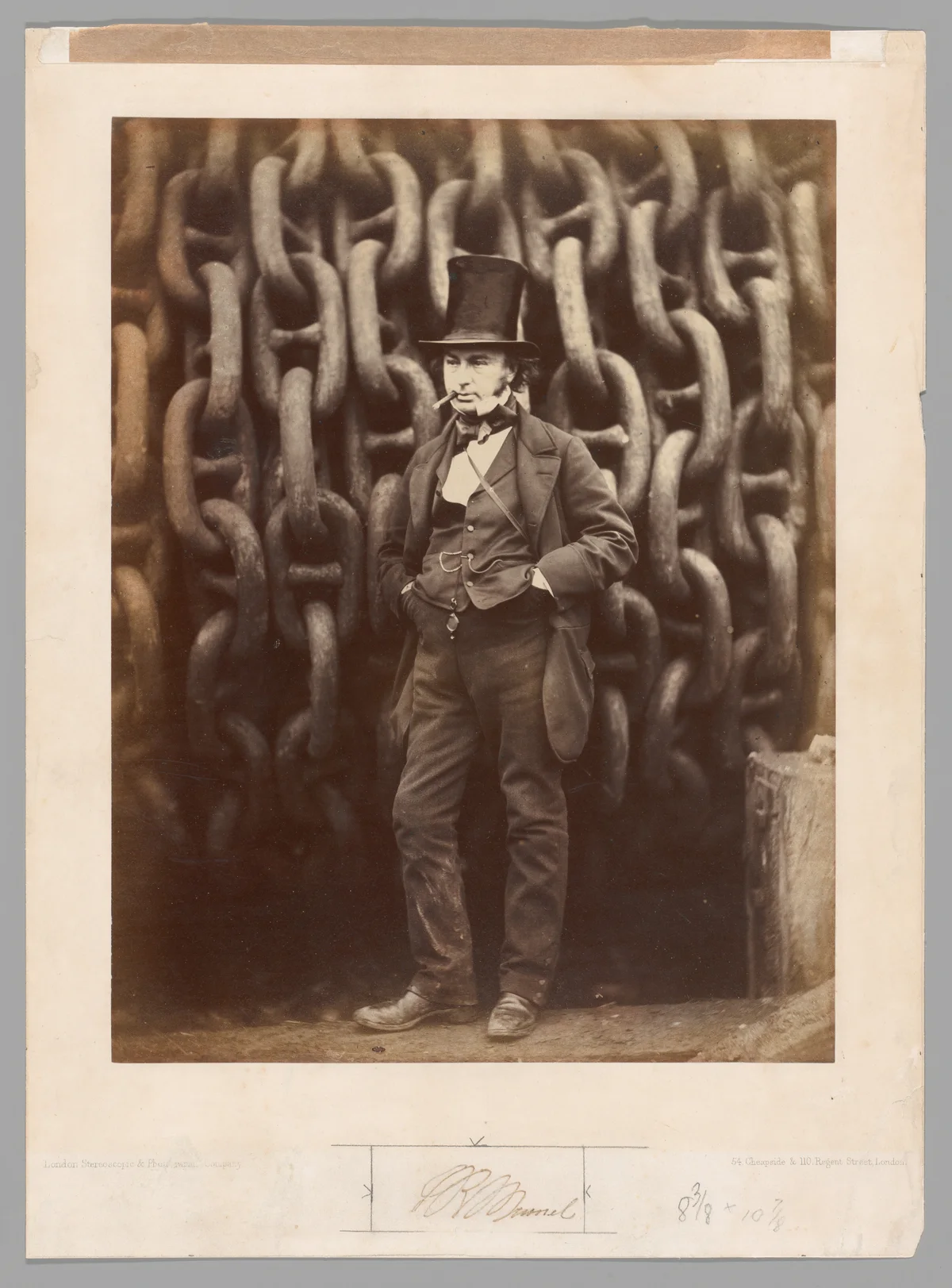
1806–1859
Isambard Kingdom Brunel
Consulting civil engineer for railway, bridge, dock and steamship enterprisesIsambard Kingdom Brunel ran an engineering practice serving railway and maritime companies. As the Great Western Railway’s engineer, he helped connect London and Bristol in 1841. His ships and structures combined technical ambition with financial risk and depended on investors, contractors and workers.Read biographyQuick answers
Common questions
- How do Nasmyth’s hammer model, surviving machine and memoir differ as evidence?
- The model explains a represented mechanism, the full-size hammer has its own manufacture and use history, and the memoir records a participant’s later recollection. Their different purposes must remain visible when discussing disputed priority.
Primary and institutional sources
How this history was checked
The sources distinguish institutional biographies, participant accounts and records of individual objects. The related biography gives context for their use. This article was reviewed on 7 November 2026.