
The short answer
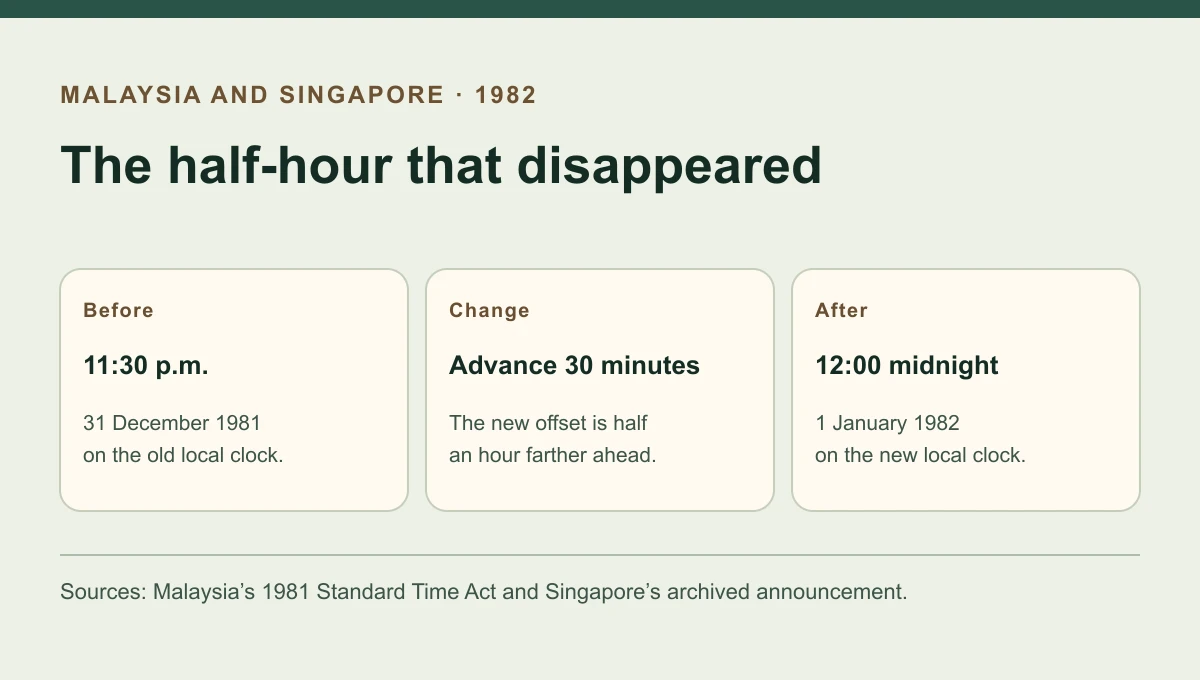
At New Year 1982, Peninsular Malaysia moved its clock time thirty minutes forward to match East Malaysia. Singapore made the same change. On the old clocks, 11:30 p.m. on 31 December was followed by midnight under the new standard. Sabah and Sarawak already used the time that became common across Malaysia.
How the transition worked
Before, at and after the change
The same moment can be labelled under the old and new local standards.
| Place | Before | After |
|---|---|---|
| Peninsular Malaysia | GMT+7:30 | GMT+8 |
| Sabah and Sarawak | GMT+8 | GMT+8 |
| Singapore | GMT+7:30 | GMT+8 |
Chronology
A timeline of the turning points
Malaysia provides for a common time
Its Standard Time Act specifies the legal offset and the first instant of 1 January.
Singapore publishes its adjustment
The government explains that matching Malaysia will avoid confusion for cross-border business and travel.
Clocks align across the border
People using the changed clocks advance by thirty minutes.
What Malaysia’s law changed
Malaysia’s 1981 Standard Time Act applied throughout Malaysia and established a time eight hours ahead of Greenwich mean time. Its transitional clause specifies the instant at which 1 January 1982 began. That detail tells a reader how to handle the last half-hour of the old date on a peninsular clock.
The adjustment aligned two parts of a country that had previously used different times. East Malaysia already had the later clock reading. The change therefore applied differently to people in the peninsula and those in Sabah and Sarawak.
Why Singapore made the same adjustment
Singapore’s archived government announcement links its decision to the close practical relationship with Malaysia. Travellers and firms used timetables and appointments across the border, so keeping a common clock reading reduced a recurring conversion.
The adjustment was made by Singapore under its own rules. Its practical effect was alignment with its neighbour. That is why the Malaysian Act and Singapore’s change belong on the same timeline.
What happened to 11:30 p.m.
At the instant specified by the new rule, an old clock in Peninsular Malaysia or Singapore would have shown 11:30 p.m. The updated display showed midnight. The jump skipped half an hour of local labels while elapsed time continued normally.
This is also why the year can be described as changing either on 31 December 1981 under the old clock or at the start of 1 January 1982 under the new one. The descriptions refer to the same instant.
Continue the chronology
Related history guides
How Indonesia Reassigned Provinces to Three Time Zones
Compare a Southeast Asian reform that reassigned particular areas within a multi-zone system.
Read the timeline1894–1899Why South Australia Adopted a Half-Hour Time Offset
Compare a different thirty-minute shift of legal time.
Read the timelineConnected biographies
People connected to this history
Quick answers
Common questions
- When did Malaysia and Singapore change their clocks?
- The change introduced the new reading at midnight at the start of 1 January 1982. On the old clocks, the transition came at 11:30 p.m. on 31 December.
- Did Sabah and Sarawak advance their clocks?
- They already used the offset that became common across Malaysia. Peninsular Malaysia advanced its clocks by half an hour.
Primary and institutional sources
How this history was checked
Dates, legal milestones and historical claims are checked against the official and institutional records below. This article was reviewed on 19 November 2026.