
The short answer
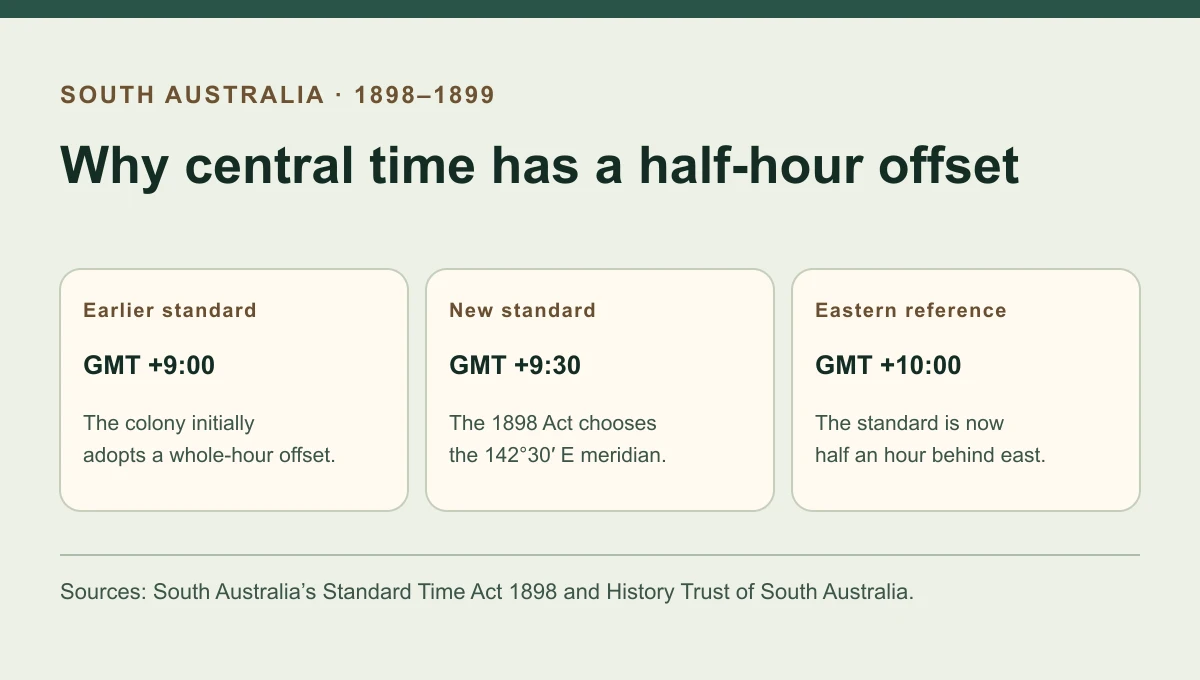
South Australia advanced its clocks by thirty minutes on 1 May 1899. A new Act moved the statutory reference from nine hours ahead of Greenwich to nine and a half. The resulting offset left the colony’s clocks half an hour behind the eastern reference instead of a whole hour.
The arithmetic of the change
From a whole hour to a half-hour gap
The legal reference shifted by 7½ degrees of longitude, which equals half an hour of mean solar time.
| Reference | Ahead of Greenwich | Difference from the eastern reference |
|---|---|---|
| Earlier South Australian standard | +9:00 | One hour behind. |
| Revised South Australian standard | +9:30 | Half an hour behind. |
| Eastern reference | +10:00 | Same time as the eastern reference. |
Chronology
A timeline of the turning points
A whole-hour standard is put in place
The first standard used a reference nine hours ahead of Greenwich.
Legislature chooses a new meridian
The replacement Act specifies mean time at 142°30′ east.
Clocks move forward by half an hour
The new standard is applied.
What the new Act replaced
South Australia’s first standard put its clocks nine hours ahead of Greenwich. The later Act changed the reference to the meridian of 142 degrees 30 minutes east. That is a legal choice of the mean time used throughout the area covered by the statute.
The two references would give different clock readings at the same instant. They did not involve moving an observatory or altering the physical length of the hour.
How the half hour was calculated
Fifteen degrees of longitude corresponds to about one hour of mean solar time. The new reference at 142½ degrees east gives nine and a half hours. Compared with an eastern reference at ten hours ahead, that left half an hour rather than a full hour between the clocks.
The calculation explains the practical result of choosing the meridian. Historical evidence about why particular people supported the change belongs to the public and legislative debates, rather than to the arithmetic alone.
Why 1898 and 1899 both appear
The Act dates the legislation. The History Trust dates the resetting of clocks to Monday, 1 May 1899. A timetable expecting the new clock reading needed the second date, even though the law had already been passed.
The change created a new standard rather than a recurring seasonal adjustment. The reference in the Act gives the ordinary clock time, while daylight-saving arrangements are a separate question.
Continue the chronology
Related history guides
Connected biographies
People connected to this history
Quick answers
Common questions
- When did South Australia advance by half an hour?
- The History Trust dates the change to 1 May 1899, following the Standard Time Act of 1898.
- How did the 1898 Act create a half-hour offset?
- It chose the mean time of the 142°30′ east meridian, nine and a half hours ahead of Greenwich.
Primary and institutional sources
How this history was checked
Dates, legal milestones and historical claims are checked against the official and institutional records below. This article was reviewed on 19 November 2026.
- South Australian LegislationStandard Time Act 1898, No. 699
- History Trust of South AustraliaStandard Time Act Redefined: change on 1 May 1899
- History Trust of South AustraliaTime: historical development of South Australian standards
- Queensland Parliament LibraryResearch brief on daylight saving, with chronology of standard time