
The short answer
How did the Human Rights Committee distinguish the original loss of status from continuing effects, and what does that distinction permit a reader to conclude?
Read before concluding
An evidence checklist
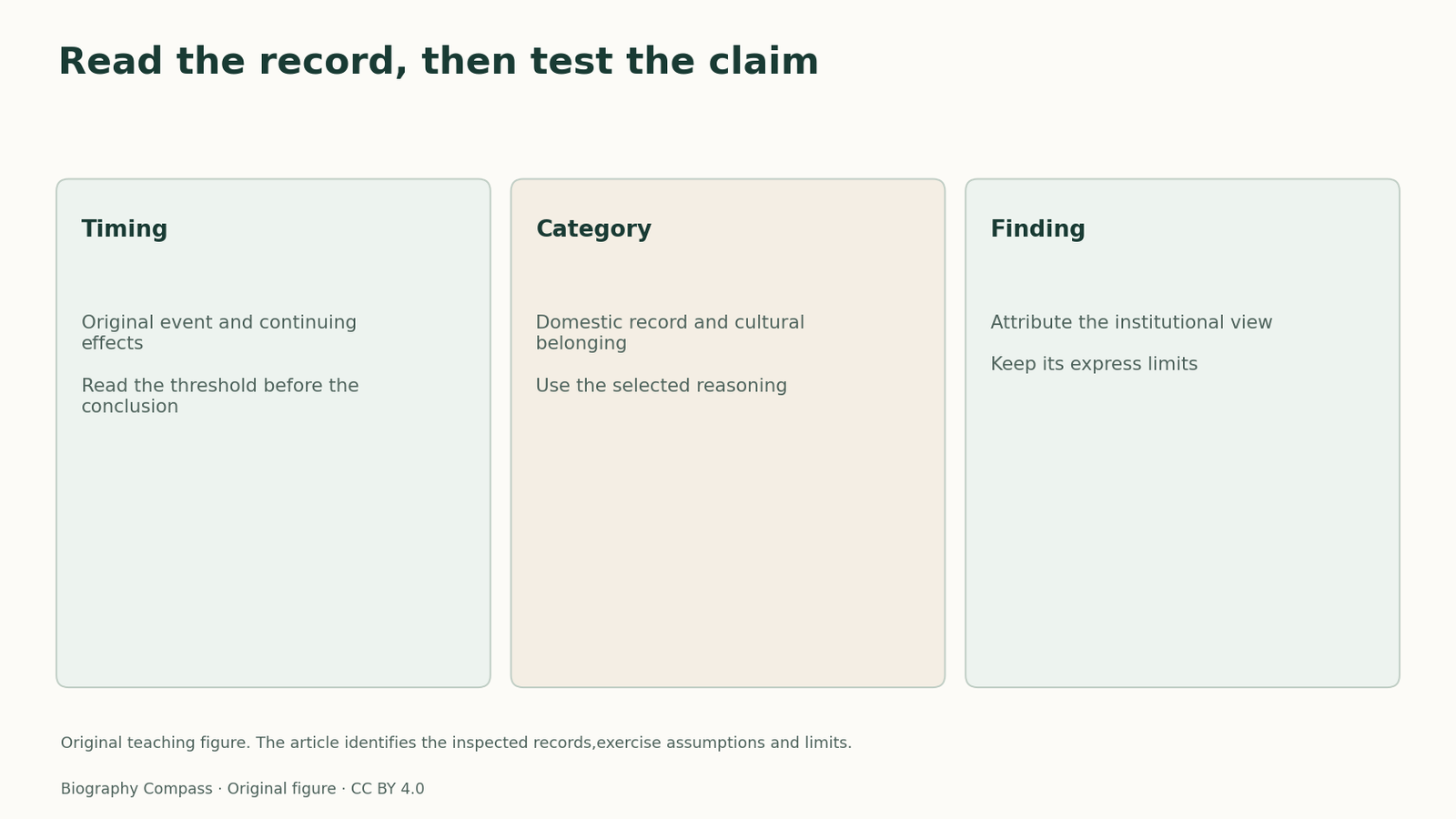
Use the selected record for the question it can answer.
| Check | Ask | Avoid |
|---|---|---|
| Timing | Identify the continuing situation. | Treating every consequence as outside scope. |
| Category | Read the account of cultural belonging. | Equating identity with one domestic record. |
| Finding | Name what was and was not decided. | Assuming every allegation succeeded. |
Chronology
A timeline of the turning points
Marriage
Loss of status.
Threshold
Covenant entry into force for Canada.
Views
Article 27 breach.
Temporal scope comes before the finding
In paragraphs 10–13, the Committee distinguishes the 1970 marriage-related loss of status from continuing effects after the Covenant entered into force for Canada on 19 August 1976. It does not pronounce on that original application as a violation at the time.
Read the distinction as a limit on the question examined. It is not an endorsement of the earlier rule. A decision can decline one temporal question while still examining a later, continuing situation.
Sources for this section: [1]
Culture and community in the selected reasoning
Paragraphs 14–19 separate domestic registration from article 27 belonging. Denying recognition and Tobique residence unjustifiably interfered with cultural access; other alleged articles were not separately decided.
The text is the Committee’s Views under the Optional Protocol. It is not a Canadian court order rewriting the whole Indian Act. A later legislative change needs its own legislative record.
Original exercise: three claims about a decision
Claim A: “Because the original event predates the temporal threshold, no later effect can be examined.” Claim B: “A domestic registration category conclusively decides whether someone belongs to a minority for cultural-rights purposes.” Claim C: “Finding one breach means every article alleged was separately found violated.” For each claim, identify the reasoning step it skips.
Next, draft a two-sentence source note. Sentence one must identify the institution and the selected finding. Sentence two must state a limit. Avoid slogans such as “all rights restored immediately”; they combine propositions that require different evidence.
Sources for this section: [1]
Reference answers and a second test
A skips the inquiry into continuing effects. B collapses distinct legal categories instead of reading the Committee’s account of belonging and community ties. C assumes a finding that the Committee said it did not need to make. Each error expands or closes the decision beyond the reasoning actually given.
A sound note attributes the finding to the Committee and limits it to the circumstances and article it addresses. A separate question about subsequent registration, residence or legislation must name the additional record needed. This is a method for reading the selected historical decision, not an assessment of a present claim.
For a final check, remove the outcome sentence from your note. Does the remaining explanation still show how the reasoning moves from timing to continuing effects to the selected right? If it does, the note explains an argument rather than merely announcing a winner.
Sources for this section: [1]
Continue the chronology
Related history guides
Biography context
Explore Canada through connected lives
Connected biographies
The related public life
1948–
Sandra Lovelace Nicholas
SenatorCommunity organising, an international petition and parliamentary work formed a connected career.Read biographyQuick answers
Common questions
- Are the practice files historical individual cases?
- No. All practice files and reference answers are original teaching examples.
Primary and institutional sources
How this history was checked
Reading is limited to the identified passages. The invented tasks do not determine present-day legal entitlements. This article was reviewed on 31 October 2026.
- UN Human Rights Committee; University of Saskatchewan document scanLovelace v. Canada: Views adopted 30 July 1981, selected paragraphs 10–19
- UN Human Rights Committee / OHCHRLovelace v. Canada, communication 24/1977: case metadata
- Noël Kinsella / University of SaskatchewanSandra Lovelace v. Canada, 1977–1981: collection preface