
The short answer
Why can the same court result contain different reasoning, and how does a comparison of the Lavell and Bédard opinions help a reader avoid overstating agreement?
Read before concluding
An evidence checklist
Use the selected record for the question it can answer.
| Check | Ask | Avoid |
|---|---|---|
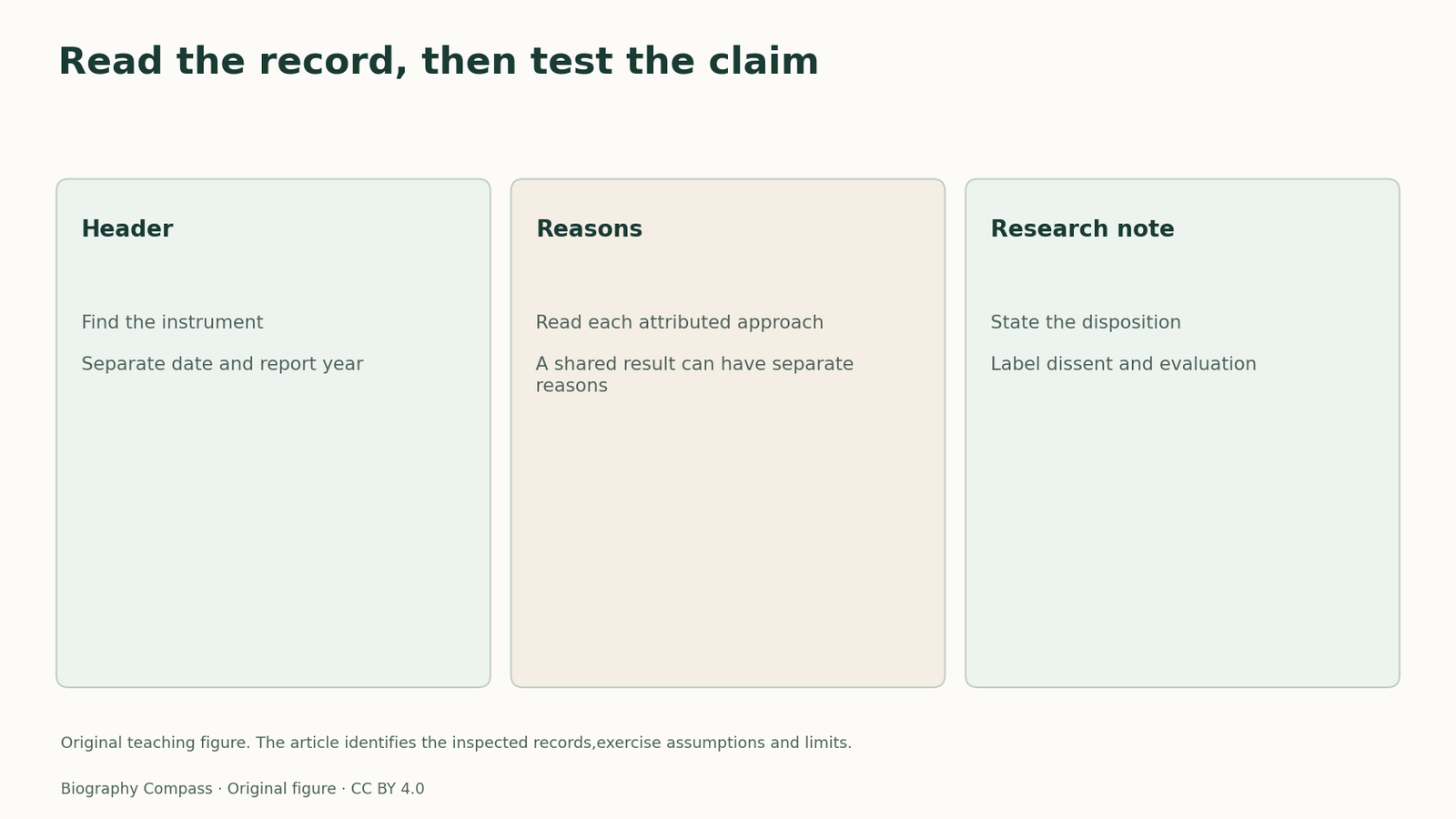
| Header | Separate decision date and report locator. | Turning a citation year into a decision date. |
| Opinion | Attribute the selected reasoning. | Merging separate opinions. |
| Result | Record the disposition separately. | Turning a dissent into the outcome. |
Chronology
A timeline of the turning points
Rights instrument
Canadian Bill of Rights.
Decision
Appeals allowed.
Report
Law-report citation.
Identify the proceeding and the instrument
The joined appeals were decided on 27 August 1973 and reported at [1974] SCR 1349. They concerned the Canadian Bill of Rights and Indian Act section 12(1)(b), not the later Charter. The appeal result was five to four against the women.
The report year is a bibliographical locator. Treating it as the decision date would shift the chronology. Likewise, naming a later rights instrument would change the legal question rather than modernise the wording.
Sources for this section: [1]
Compare reasons before counting a single majority
Ritchie’s reasons locate equality in administration and application of law. Laskin’s dissent focuses on the sex distinction and its unequal effects on women and men. Pigeon concurs in the result on separate reasoning concerning the Bill’s effect on legislation.
A reader should therefore distinguish a shared disposition from a shared chain of reasoning. The comparison does not require agreement with a judge: it requires an accurate statement of the question that judge treated as decisive.
Sources for this section: [1]
Original exercise: repair three research notes
Note A says: “Five judges agreed on every reason, so one paragraph explains the whole result.” Note B says: “The dissent compared the treatment of women and men; it was therefore the operative judgment.” Note C says: “This was a Charter ruling in 1974.” Identify the error in each note and replace it with a narrower sentence.
Then make a two-column table of your own. One column should record the issue an opinion asks; the other should record the factual comparison it regards as relevant. Keep a third, separate line for who won the appeal. Do not use the number of votes as a substitute for reading the reasoning.
Sources for this section: [1]
Reference answers and a transferable method
A confuses concurrence in a result with agreement on reasons. Replace it with: the result had five votes, including a separate concurrence. B correctly notices the dissent’s comparison but wrongly treats dissent as the court’s disposition. Replace it with: this is the dissent’s approach, which did not determine the result.
C substitutes an inapplicable instrument and mistakes a report date for a decision date. A repaired note should identify the instrument and decision date from the header. More generally, build case notes in this order: parties, instrument, question, disposition, individual reasons and limits.
As a final peer exercise, give another reader only your table. Can that person tell which statements are holdings, which belong to a dissent, and which are your own evaluation? If not, repair attribution before adding a broad claim about the case’s legacy.
Sources for this section: [1]
Continue the chronology
Related history guides
Biography context
Explore Canada through connected lives
Connected biographies
The related public life
1942–
Jeannette Corbiere Lavell
EducatorAn unsuccessful court challenge became one part of a much longer public career.Read biographyQuick answers
Common questions
- Are the practice files historical individual cases?
- No. All practice files and reference answers are original teaching examples.
Primary and institutional sources
How this history was checked
Reading is limited to the identified passages. The invented tasks do not determine present-day legal entitlements. This article was reviewed on 31 October 2026.