
The short answer
How can a reader distinguish registration, band membership and voting eligibility when using the original amendment rather than a retrospective summary?
Read before concluding
An evidence checklist
Use the selected record for the question it can answer.
| Check | Ask | Avoid |
|---|---|---|
| Record | Which list or application is supplied? | Treating unlike records as interchangeable. |
| Condition | Which stated condition is established? | Assuming an unstated fact. |
| Date | Which commencement rule applies? | Dropping the express exception. |
Chronology
A timeline of the turning points
General rule
Deemed commencement.
Royal Assent
Enactment.
Exception
Act sections 17 and 18.
Start with the enacted words
The 1985 amendment defines an elector through a Band List entry, age eighteen and absence of a voting disqualification. Its replacement section 5(5) distinguishes entitlement from an application for registration. Sections 8 and 9 address Band Lists and their maintenance.
The selected text therefore supplies different record questions. Do not replace a missing list entry with a general assertion of identity, or infer that every statutory entitlement has already been entered in an administrative record.
Sources for this section: [1]
A date is not a completed individual file
The enactment received Royal Assent on 28 June. Section 23 generally deems commencement to 17 April, except Act sections 17 and 18, effective six months after assent. The exception is part of the text and must travel with any statement about commencement.
A commencement provision establishes when the specified law operates. It does not, by itself, provide an application, list entry or decision for a named person. Ask which record is actually in front of you before giving it evidential weight.
Sources for this section: [1]
Original exercise: three incomplete files
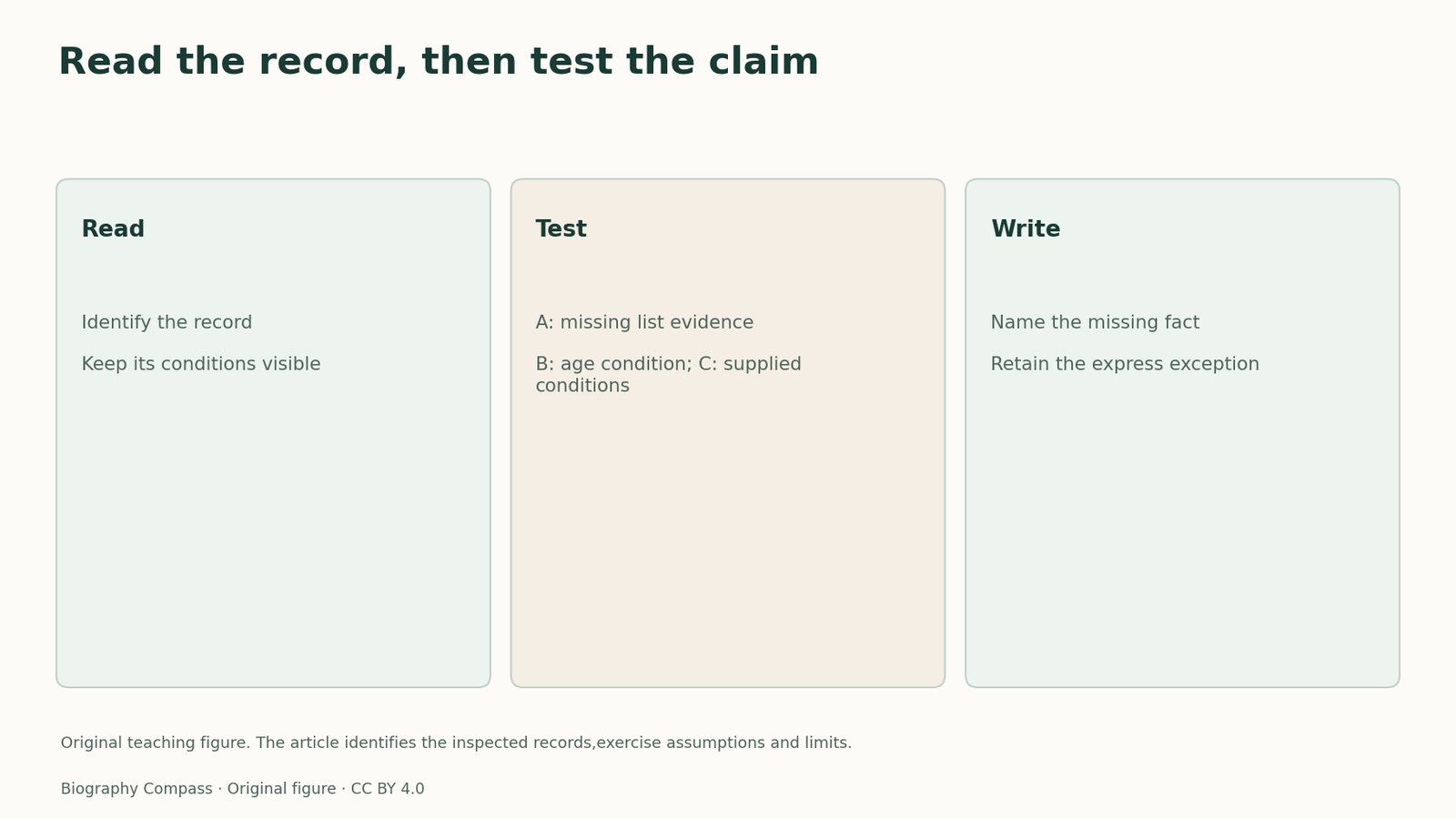
Use only these stipulated facts and the selected elector definition. File A: a twenty-year-old appears in the Indian Register but the file supplies no Band List entry. File B: a seventeen-year-old appears on a Band List. File C: a twenty-year-old appears on a Band List and is not disqualified from voting. For each, decide whether the supplied facts establish the selected definition. Then name the precise missing condition rather than guessing it.
Second question: an undated card says “eligible to apply”. Does it prove a completed registration? Third question: a summary says all provisions commenced on a single date. Which part of the enacted text must the reader check? These are invented teaching files, not applications by the three campaigners.
Sources for this section: [1]
Reference answers and a better research note
A is insufficient: the supplied registration entry does not establish the required Band List entry. B fails the stated age condition. C satisfies the selected definition on the stipulated facts. This is a reading exercise, not a determination under every historical election arrangement or current self-government rule.
The card does not prove completed registration: eligibility, application and entry are different propositions. The single-date summary must be checked against the commencement exception. In a research note, quote the relevant section number, state the document date and label any unresolved fact. Do not fill the gap by inventing a certificate.
A useful final check is to reverse the inference. If a registration certificate were found, which other conclusion would still need its own evidence? The exercise is successful when the reader can keep separate records separate, rather than merely repeat three labels.
Sources for this section: [1]
Continue the chronology
Related history guides
Biography context
Explore Canada through connected lives
Connected biographies
The related public life
1911–1996
Mary Two-Axe Earley
AdvocateA campaign for belonging exposed the distance between identity and official records.Read biographyQuick answers
Common questions
- Are the practice files historical individual cases?
- No. All practice files and reference answers are original teaching examples.
Primary and institutional sources
How this history was checked
Reading is limited to the identified passages. The invented tasks do not determine present-day legal entitlements. This article was reviewed on 31 October 2026.