
The short answer
What changed when insurers pooled their brigades?
A worked comparison
What each part contributes
Use the specific distinctions developed in the study.
| Part or record | What it establishes | Why the distinction matters |
|---|---|---|
| Pooling | Common use of apparatus | Does not remove capacity limits |
| Superintendent | Operational coordination and training | Different from insurer governance |
| Minute books | Staff and management records | Different from an incident report |
What changed when insurers pooled their brigades?
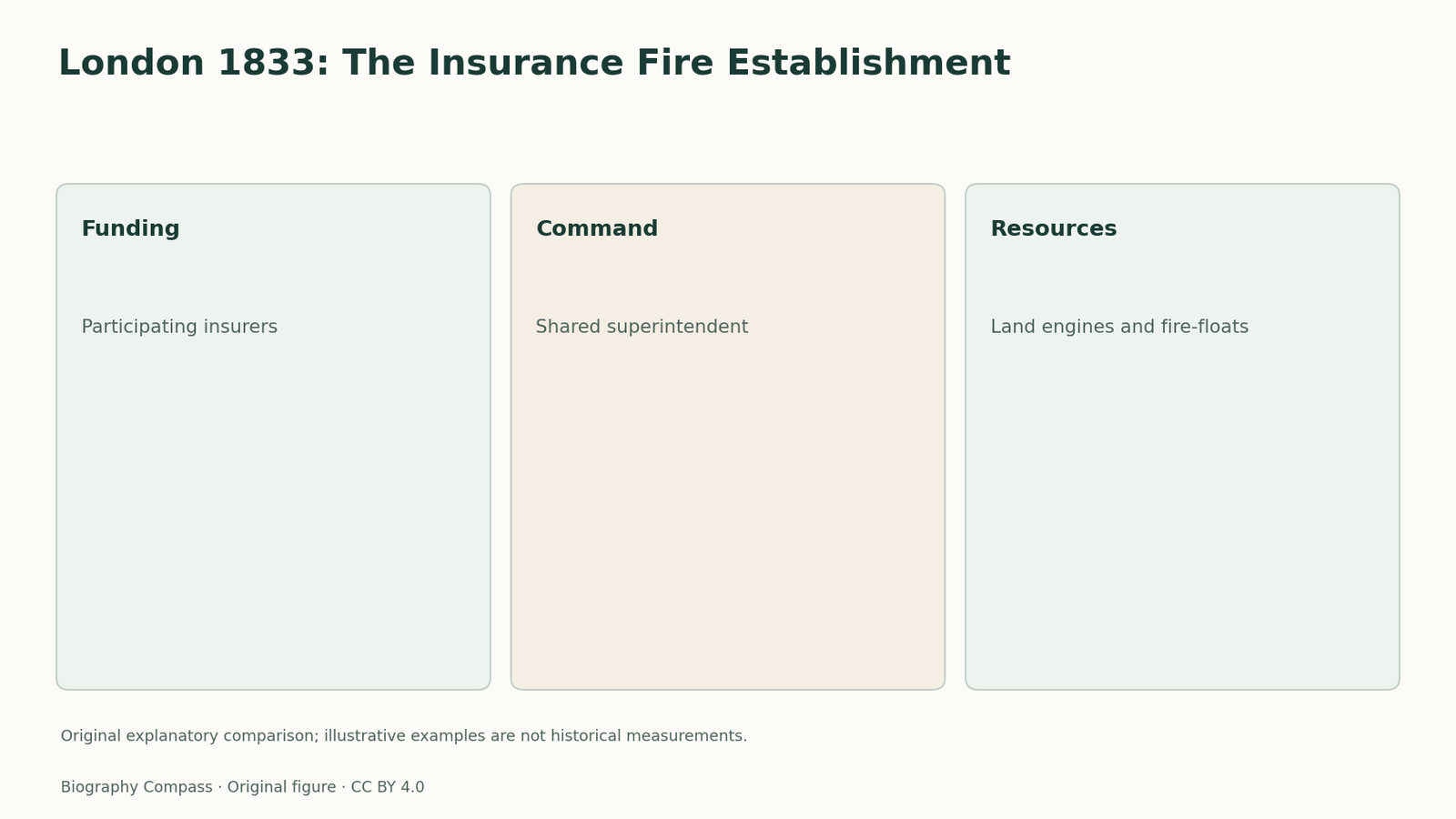
The London Fire Engine Establishment began operating in January 1833 under James Braidwood. It brought previously independent insurance-company firefighting arrangements into a shared organisation. The useful question is what pooling changed in practice: apparatus, staffing and command could be coordinated rather than managed as separate responses. The participating insurers remained central to financing and governance. This is therefore a study of cooperation between businesses providing an emergency service, distinct from the later transfer to a public authority under the 1865 Act.
A common superintendent connected apparatus with training
Braidwood’s published interests included equipment, the training of firefighters and the conduct of operations. These categories explain why amalgamation was more than a change of name. A pump requires people who can move and operate it; crews need a shared understanding of orders; a response needs coordination at the scene. The historical sources connect Braidwood with those professional concerns. The point is not that every technique originated with him, but that the establishment placed continuing leadership over a pooled service rather than relying entirely on separate company arrangements.
The surviving records distinguish management from an incident
The London Archives identifies committee minute books and lists of firefighters within the establishment’s records. Such administrative records can establish staffing and decisions over time, while a fire report concerns a particular event. The archive catalogue is a guide to those sources, not a substitute for a complete transcription. It shows how a researcher could test questions about the organisation’s development rather than assume that one dramatic fire represents every year of its operation. It also helps separate the insurance committee’s role from Braidwood’s operational responsibilities.
Sources for this section: [4]
Resource-pooling exercise and checked answer
Two fictional insurers each maintain an engine, but only one has suitable river access. They agree to a shared superintendent and response system. Which improvement follows directly from the arrangement? The resources can be assigned through a common command instead of two independent decisions. Does that prove the combined force is large enough for every warehouse fire? No: equipment, staffing, access and the incident’s scale still need assessment. The checked answer distinguishes coordination from unlimited capacity. It explains both the value and the limits of the 1833 organisational change without inventing an incident outcome or assuming that a shared name automatically solved every operational problem.
Continue the chronology
Related history guides
Biography context
Explore United Kingdom through connected lives
Connected biographies
People and wider context
1800–1861
James Braidwood
fire-service organiser and superintendentJames Braidwood was a fire-service organiser and superintendent, known for Edinburgh’s early organised fire service and leadership of the London Fire Engine Establishment.Read biographyQuick answers
Common questions
- Was Braidwood’s London establishment already the public Metropolitan Fire Brigade?
- No. It was funded through participating insurance companies; the public reorganisation came after his death.
Primary and institutional sources
How this history was checked
The source notes distinguish original records, institutional descriptions and later historical interpretation. Exercises and comparisons are original editorial analysis. This article was reviewed on 8 November 2026.