
The short answer
What made London’s new fire brigade public?
A worked comparison
What each part contributes
Use the specific distinctions developed in the study.
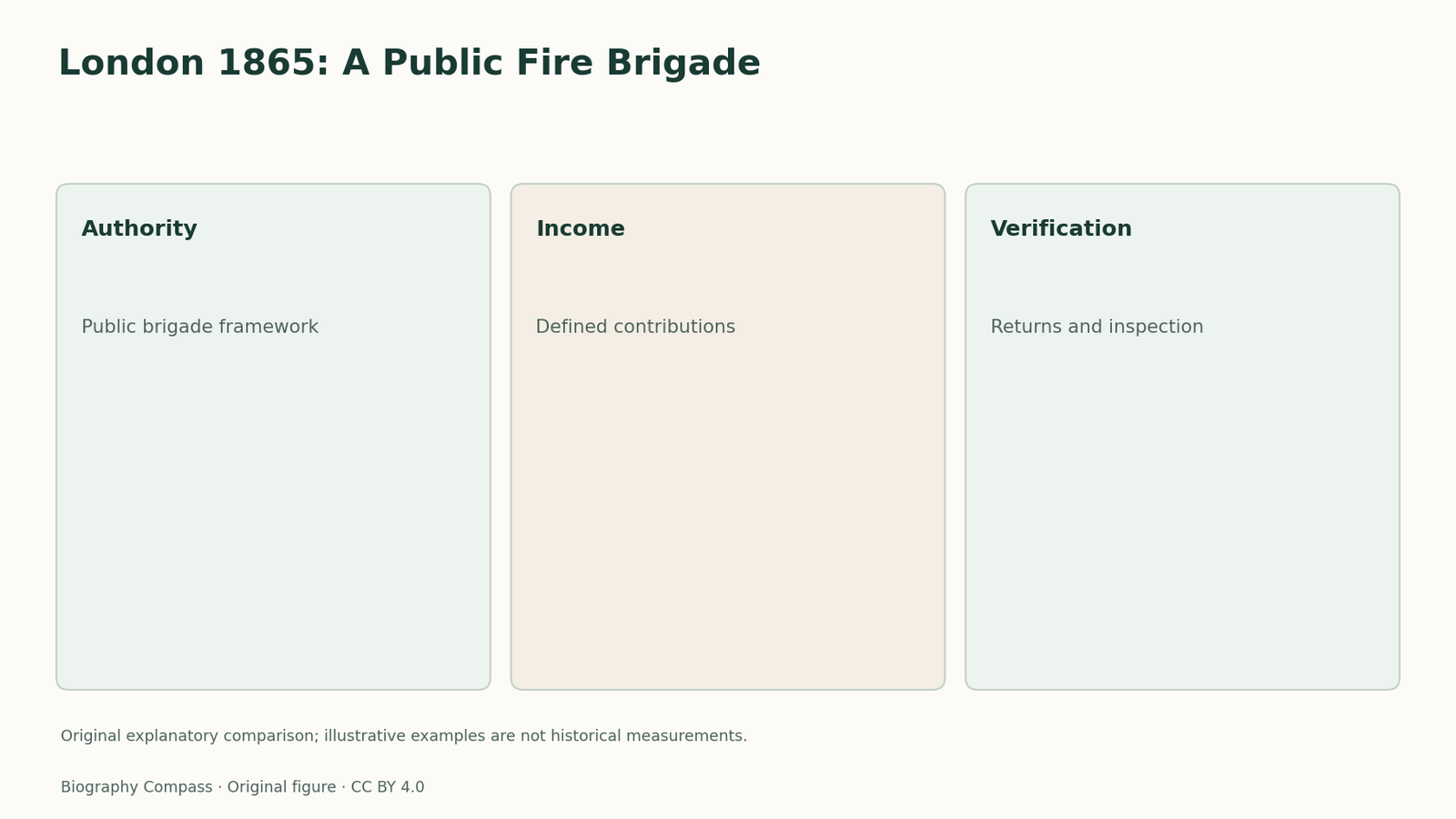
| Part or record | What it establishes | Why the distinction matters |
|---|---|---|
| 1865 Act | Legal framework | Different from the operational start |
| Insurer contribution | Rate on qualifying insured amounts | Needs a defined base |
| Returns and inspection | Information and verification | Makes the rate administrable |
What made London’s new fire brigade public?
The Metropolitan Fire Brigade Act of 1865 changed the institutional responsibility for London’s fire service. The existing establishment continued until the new brigade formally began on 1 January 1866, with Shaw remaining in charge. The distinction between legislation and operation is the starting point. Passing an Act established a framework; transferring a service required people, apparatus and financial arrangements to work within it. This study examines the funding provisions as enacted, rather than assuming that a new title alone explains how the brigade could be maintained.
Insurance contributions were linked to the business insured
Section 13 required insurers covering property in the metropolis to contribute at a specified rate on insured amounts, excluding reinsurance. It also set out quarterly payments and transitional arrangements. The relevant base was the amount insured, not simply the number of fires a company experienced. That makes the provision a financing rule for a standing service. It connected an industry benefiting from fire protection with the public organisation’s expenses while avoiding the idea that each incident had to be financed by a new collection after it occurred.
Sources for this section: [4]
Returns and inspection supported the contribution rule
The Act required returns of insured amounts and a declaration checked against company books. It also provided for inspection of records used to establish the contribution. These provisions show that a rate is only part of a workable funding system. The authority needed information about the base to which the rate applied and a means of checking that information. A company’s payment could therefore be examined through records, not merely accepted as an unsupported total. The legal text makes accountability a practical documentary process.
Sources for this section: [4]
Other public contributions completed a mixed structure
The original expenses provisions also addressed a Treasury contribution and local contributions within stated limits. The public framework therefore did not mean that insurance companies ceased to have any financial role. Nor did the insurers’ continuing payments make the brigade identical to the earlier voluntary establishment. Governance and funding are related but distinct: an organisation may be publicly administered while receiving income from several legally defined sources. The Act’s structure allows those relationships to be identified precisely, instead of forcing the service into a simple public-versus-private label.
Sources for this section: [4]
Contribution exercise and checked answer
Using the enacted rate of thirty-five pounds for each million pounds insured, what would the annual contribution be on a fictional two-million-pound qualifying amount, before any transitional qualification? Seventy pounds. Is the calculation complete without checking the relevant year, exclusions and return? No. The checked answer needs both arithmetic and the correct statutory base. This is an explanation of the original historical provision, not present-day compliance advice. It demonstrates why financial administration required a rate, a defined amount, a reporting date and supporting records, all of which performed separate tasks within the new brigade’s funding system.
Sources for this section: [4]
Continue the chronology
Related history guides
Biography context
Explore United Kingdom through connected lives
Connected biographies
People and wider context
1828–1908
Eyre Massey Shaw
fire-service superintendent and public administratorEyre Massey Shaw was a fire-service superintendent and public administrator, known for London’s transition from the insurance establishment to the Metropolitan Fire Brigade.Read biographyQuick answers
Common questions
- Did the public brigade begin operating as soon as the 1865 Act passed?
- The formal operational transition was on 1 January 1866; legislation and service commencement are separate milestones.
Primary and institutional sources
How this history was checked
The source notes distinguish original records, institutional descriptions and later historical interpretation. Exercises and comparisons are original editorial analysis. This article was reviewed on 8 November 2026.