
The short answer
How do the 1965 Magsaysay citation and Lim Kim San’s response distribute credit for Singapore’s housing programme?
Read the records together
Evidence, functions and interpretation
Compare the particular records and mechanisms discussed in this study.
| Record or mechanism | What it establishes | The distinct question |
|---|---|---|
| Awardcitation | Establishes recognition and its stated rationale. | Not an independent annual housing return. |
| Acceptance response | Shows the recipient’s public allocation of credit. | Does not list every worker or appointment. |
| Institutionalrecord | Distinguishes construction, rental and purchase. | These outcomes need different evidence. |
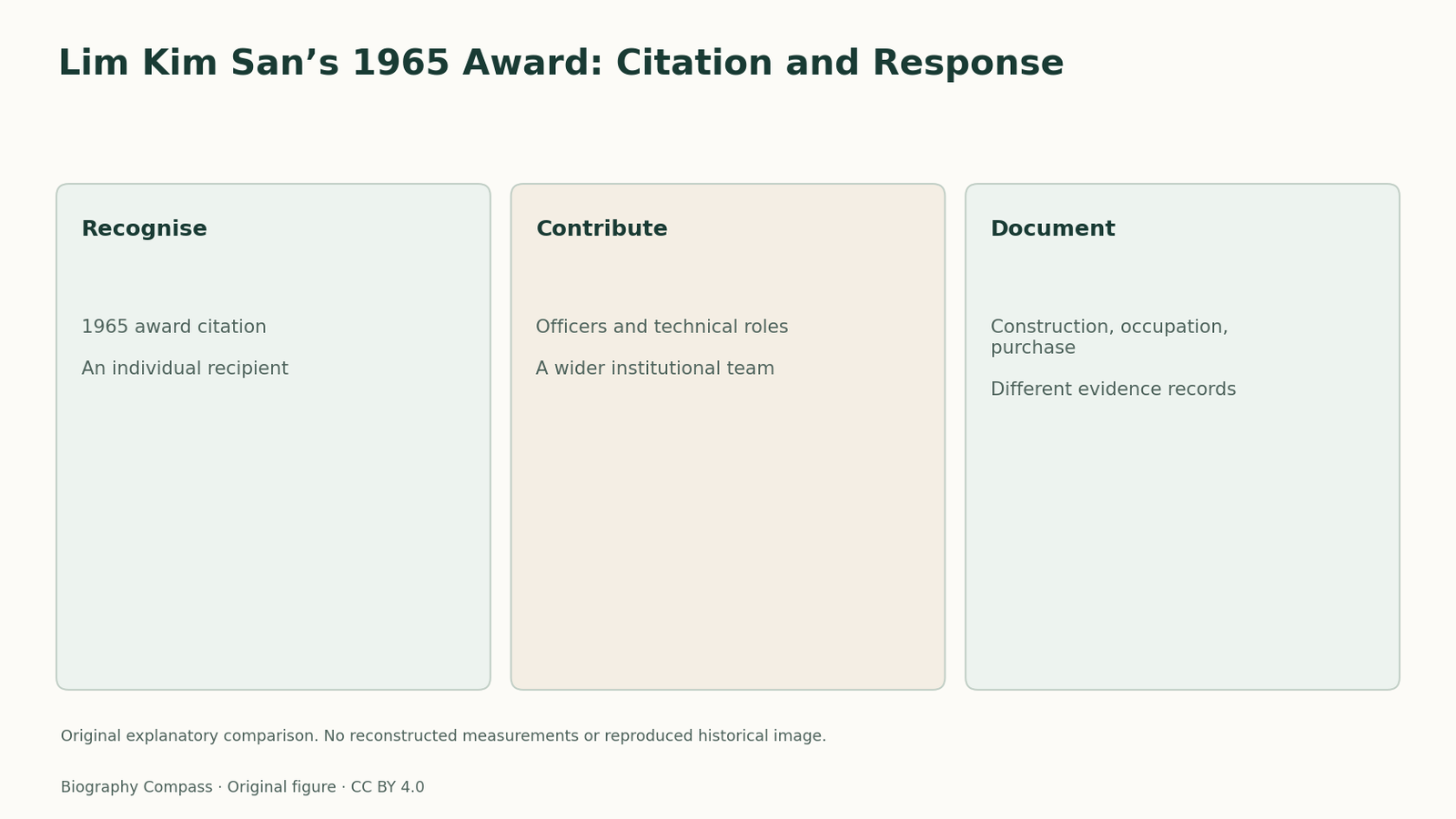
An award citation recognises an individual
The Ramon Magsaysay Award Foundation records Lim Kim San as a 1965 Community Leadership recipient. Its citation connects his HDB chairmanship and ministerial work with the early housing programme. The text is an award-giving body’s assessment, with a purpose different from an annual housing return. Its praise and selected achievements should be identified as part of that contemporary act of recognition. A reader can use the record to establish the award and its stated rationale without treating every commemorative claim as an independently tested statistic.
Sources for this section: [3]
The response changes the scale of credit
Lim’s acceptance response redirects attention to officers who had implemented the programme. Lee Kuan Yew’s later speech provides a complementary record by naming Howe Yoon Chong and Teh Cheang Wan in addition to Lim. Together they support a question about the organisation of achievement: which responsibilities attach to a chairman, which to a senior administrator and which to an architect or technical team? The texts do not supply a complete employment ledger, but they do prevent a story in which one recognised individual appears to have carried out all the work alone.
Institutional chronology supplies separate context
HDB’s history distinguishes its initial rental-building programme from the Home Ownership for the People Scheme introduced in 1964. That distinction is useful when reading the award: the availability of a newly built flat, a tenancy and the purchase of a home are different outcomes. The existing Singapore Public Housing History guide supplies the broader timeline. This focused comparison instead asks how the citation and response distribute credit and which additional institutional records are needed before assessing an outcome. It does not repeat a general history of the entire housing system.
Original credit-and-evidence exercise and answer
Imagine four fictional documents: an award citation naming a chairperson, an acceptance response thanking staff, a construction completion return and a register of household tenancies. Which establishes the award, which shows how its recipient publicly shared credit, which counts completed units and which documents occupation? Assign those functions in that order. Now a student says the citation proves that the chairperson personally designed every building. That conclusion is unsupported. Another says a completion total proves the same number of households bought homes. That also confuses records: completion, occupation and ownership require distinct evidence. Add a fifth card for a purchase agreement to test the last claim. These cards are original teaching devices, not HDB documents or reconstructed statistics. The reference answer names both the person or institution credited and the specific outcome documented. A strong account of collective achievement can recognise leadership while remaining precise about what other people did and what the available records actually establish.
Continue the chronology
Related history guides
Singapore Public Housing History
Follow the wider history of construction, rental housing and home ownership alongside the focused 1965 award records.
Read the timeline1857–1882Tan Kim Seng’s Water Gift and Memorial Fountain
Separate Tan Kim Seng’s 1857 donation, subsequent waterworks and 1882 memorial, comparing heritage records with an original gift-versus-service exercise.
Read the timeline1973Singapore’s 1973 Stadium: Opening and Public Use
Compare the 1973 National Stadium opening speech with SEAP Games preparations, distinguishing public participation, event hosting and the wider institutional team.
Read the timelineBiography context
Explore Singapore through connected lives
Lim Kim San
Lim Kim San was a public administrator, housing-board chairman and minister, known for hDB’s early construction programme and a public career spanning ministries, statutory boards and corporate leadership.
Explore the biographiesWider contextGoh Keng Swee
Read Goh Keng Swee’s deputy prime minister and economic architect of singapore career as a separate contextual comparison.
Explore the biographiesConnected biographies
People and wider context
1916–2006
Lim Kim San
Public administrator, housing-board chairman and ministerLim Kim San was a public administrator, housing-board chairman and minister, known for hDB’s early construction programme and a public career spanning ministries, statutory boards and corporate leadership.Read biography
1918—2010
Goh Keng Swee
Deputy Prime Minister and economic architect of SingaporeA founding-generation minister whose institution-building shaped Singapore’s industrial economy, armed forces, monetary system and education policy.Read biographyQuick answers
Common questions
- Why compare the citation and response?
- They illuminate individual recognition and collective contribution from different positions.
- Does a completed flat automatically represent a purchased home?
- No. Construction, tenancy and ownership are distinct outcomes.
Primary and institutional sources
How this history was checked
Primary records, institutional catalogues and historical interpretation answer different questions. The comparison and worked example are original editorial analysis. This article was reviewed on 8 November 2026.
- ISEAS–Yusof Ishak InstituteLim Kim San: Biographical Notes
- National Heritage Board / Peranakan MuseumLim Kim San: Peranakan gallery guide
- Ramon Magsaysay Award FoundationLim Kim San: 1965 Citation and Response
- Housing and Development BoardOur History
- Lee Kuan Yew / National Archives of SingaporeSpeech, 12 August 1982