
The short answer
Before comparing a collection’s size, decide whether you are counting physical copies, distinct titles or titles newly added to an existing catalogue.
Compare the evidence
Four quantities, four questions
Separate the source’s claim from the result of the invented exercise.
| Record or model | Unit | Question |
|---|---|---|
| Copies received | Physical instances. | How many arrived? |
| Incoming titles | Distinct identities in this accession. | Which entries refer to the same title? |
| Newly held titles | Identities absent from prior holdings. | What did the catalogue already contain? |
| Coverage | Matched titles / stated eligible list. | Are both lists complete and comparable? |
Chronology
A timeline of the turning points
A historical copy rule
The institutional history reports six copies.
A change in copy requirement
The same history reports five copies.
A later arrangement
It reports two copies, both retained.
Read the unit in each account
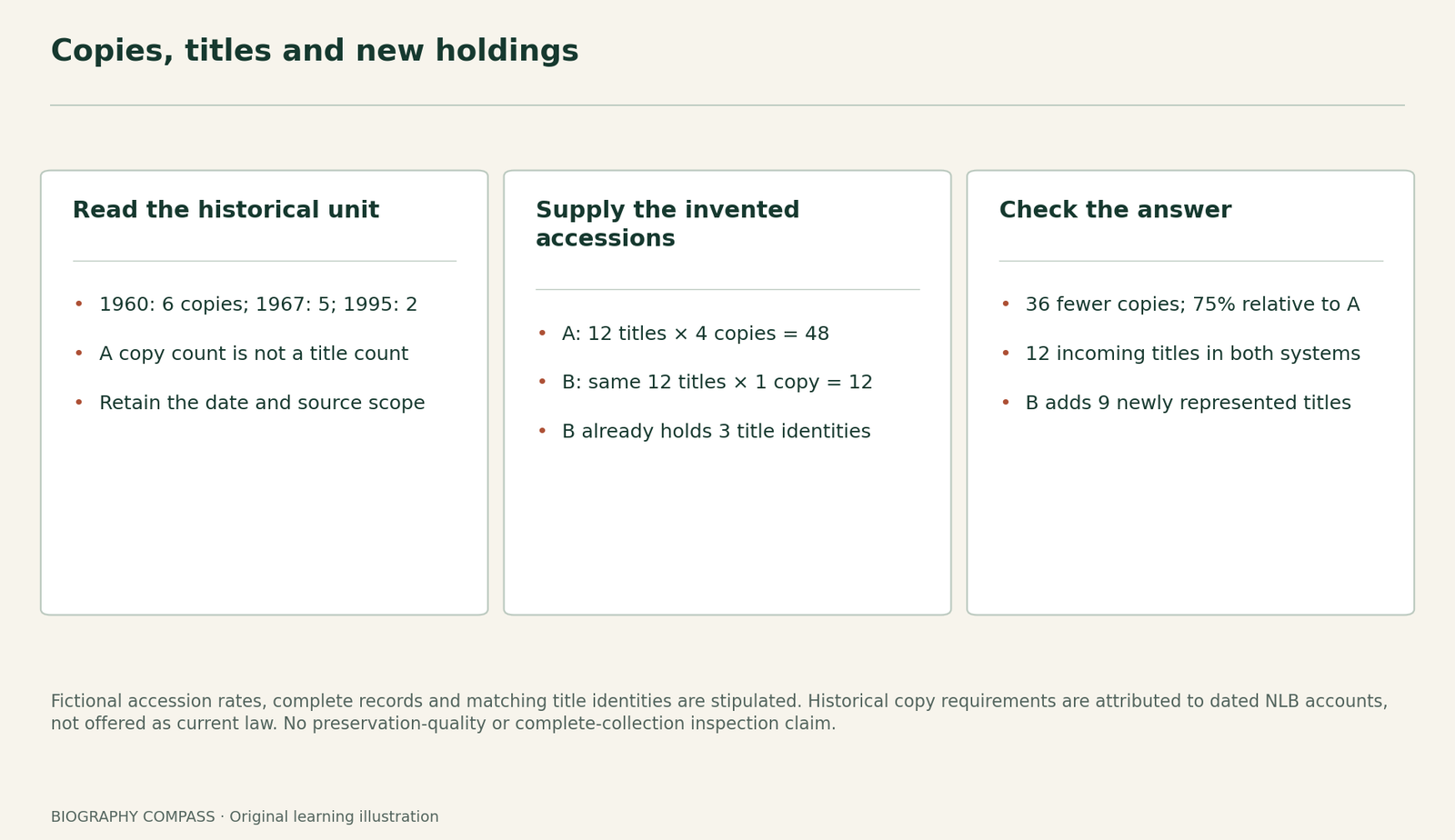
NLB’s 2025 history describes six deposit copies in 1960, five after the 1967 amendment, and two under the 1995 legislation. Under the five-copy arrangement, two were preserved at the library; the remaining copies had other destinations.
Its 2016 account explains the collection’s preservation purpose and notes that publications without international standard numbers can also be collected. It includes such formats as theatre programmes and exhibition catalogues. A copy requirement is not itself a count of distinct titles or proof that every eligible title arrived.
Exercise: two fictional accession systems
Archive A receives 12 different titles, with 4 copies of each. Archive B receives the same 12 titles, with 1 copy of each. Assume the records are complete and the title identities match exactly across the two systems. Calculate physical copies and represented titles for each archive.
These rates are invented and are not the historical rules described above. Do not apply them to a publisher today. We are changing multiplicity while holding the set of titles fixed, so that the effect of the unit can be observed without other changes.
Reference answer: count each object once
A receives 12 × 4 = 48 copies; B receives 12 × 1 = 12 copies. B has 36 fewer physical copies, a 75% reduction relative to A’s 48. Both represent 12 distinct titles. A decrease in the copy count can therefore coexist with an unchanged title count under the stated assumptions.
Now suppose B already holds 3 of those 12 titles. Its accession contains 9 titles new to its catalogue, although it still receives 12 physical copies and represents 12 incoming title identities. The existing 3 are not erased merely because another copy arrives. “Received” and “newly represented” require different checks.
An additional coverage question
Suppose a list shows 20 eligible titles for the same fictional period, but B’s 12-title accession record is all that has been checked. If identities align and the list is complete, those 12 represent 60% of that stated list. Without those assumptions, even that coverage calculation is not established.
The exercise does not measure preservation quality. A catalogue entry cannot tell us whether a copy is intact, stored suitably, accessible, duplicated elsewhere or still usable. Those questions need different observations. Count carefully, but do not ask one count to do the work of an entire collection assessment.
Sources for this section: [2]
Use institutional history without turning it into present advice
The two NLB accounts were published in different years and address preservation as well as administration. They are evidence of how the institution explains its history. This guide does not claim an independent reading of the statutes, every annual report, the underlying deposit forms or the current complete rules.
For another archive, first write the period, material types, unit and inclusion rule. Then ask how incoming records were matched to existing holdings. If that matching is unknown, a large accession total cannot establish the number of titles newly preserved.
Continue the chronology
Related history guides
What a planning ratio can tell you
Try another source-comparison worksheet with a different kind of evidence.
Read the timeline2012 production records · original provenance exerciseDoes an arranged dialogue prove a conversation?
Try another source-comparison worksheet with a different kind of evidence.
Read the timelineBiography context
Explore Singapore through connected lives
Connected biographies
Careers and institutions
Born 1928
Hedwig Anuar
Librarian and literacy advocateHedwig Anuar expanded opportunities to read and learn.Read biographyBorn 1939
Koh Seow Chuan
Architect and cultural patronKoh Seow Chuan connected collecting with cultural institutions.Read biographyQuick answers
Common questions
- Can fewer copies prove fewer titles were preserved?
- Not by itself. The fictional systems preserve the same title set with different numbers of copies.
- Are these current publisher instructions?
- No. The discussion compares dated institutional histories and an invented archive model.
Primary and institutional sources
How this history was checked
Selected records and reading limits are identified in the text. Fictional tasks are labelled; no complete book, performance or archive inspection is implied. This article was reviewed on 30 October 2026.
- BiblioAsia, 7 July 2025Legal Deposit Legislation in Singapore
- BiblioAsia; Ivy Lee, 1 January 2016Preserving Our Published Heritage
- BiblioAsia; Timothy PweeHedwig Anuar: First Lady of the National Library
- Singapore Council of Women’s OrganisationsHedwig Anuar — Singapore Women’s Hall of Fame
- Library Association of SingaporeLAS70 commemorative volume: Hedwig Anuar biography
- DP ArchitectsOur Founders
- Esplanade – Theatres on the BayKoh Seow Chuan — TributeSG
- Ministry of Culture, Community & Youth; Lawrence WongAn art collector’s journey, speech, 13 October 2015
- BiblioAsia; Mazelan AnuarBehind Street Names: Koh Seow Chuan Collection