
The short answer
Putting two statements next to each other can create a compelling exchange. Before treating the second as a reply, ask what record establishes that relationship.
Compare the evidence
Source order and stage order are separate
Separate the source’s claim from the result of the invented exercise.
| Record or model | What is established? | What remains open? |
|---|---|---|
| Fictional source card | A supplied statement and publication year. | Any actual reply relationship. |
| Stage sequence | An arranged B → A → C order. | A shared historical meeting. |
| A stronger historical caption | Preserve each source’s provenance. | Obtain evidence before calling one a reply. |
Chronology
A timeline of the turning points
A production record
Rant & Rave at Esplanade Theatre Studio.
A stated method
Archival quotations arranged as dialogue.
Keep provenance
Reconstruct source order separately.
Compare the two production records
The Finger Players’ record credits Chong Tze Chien as director, playwright and set designer for the 14 October 2012 production of Rant & Rave. Its synopsis describes discussions created from newspaper materials.
The original programme states that quotations from printed archival sources were arranged into dialogue, and explicitly warns that the conversations did not happen in actuality. That distinction is part of the production’s own description, not a discovery made by watching a recording.
Exercise: an invented montage
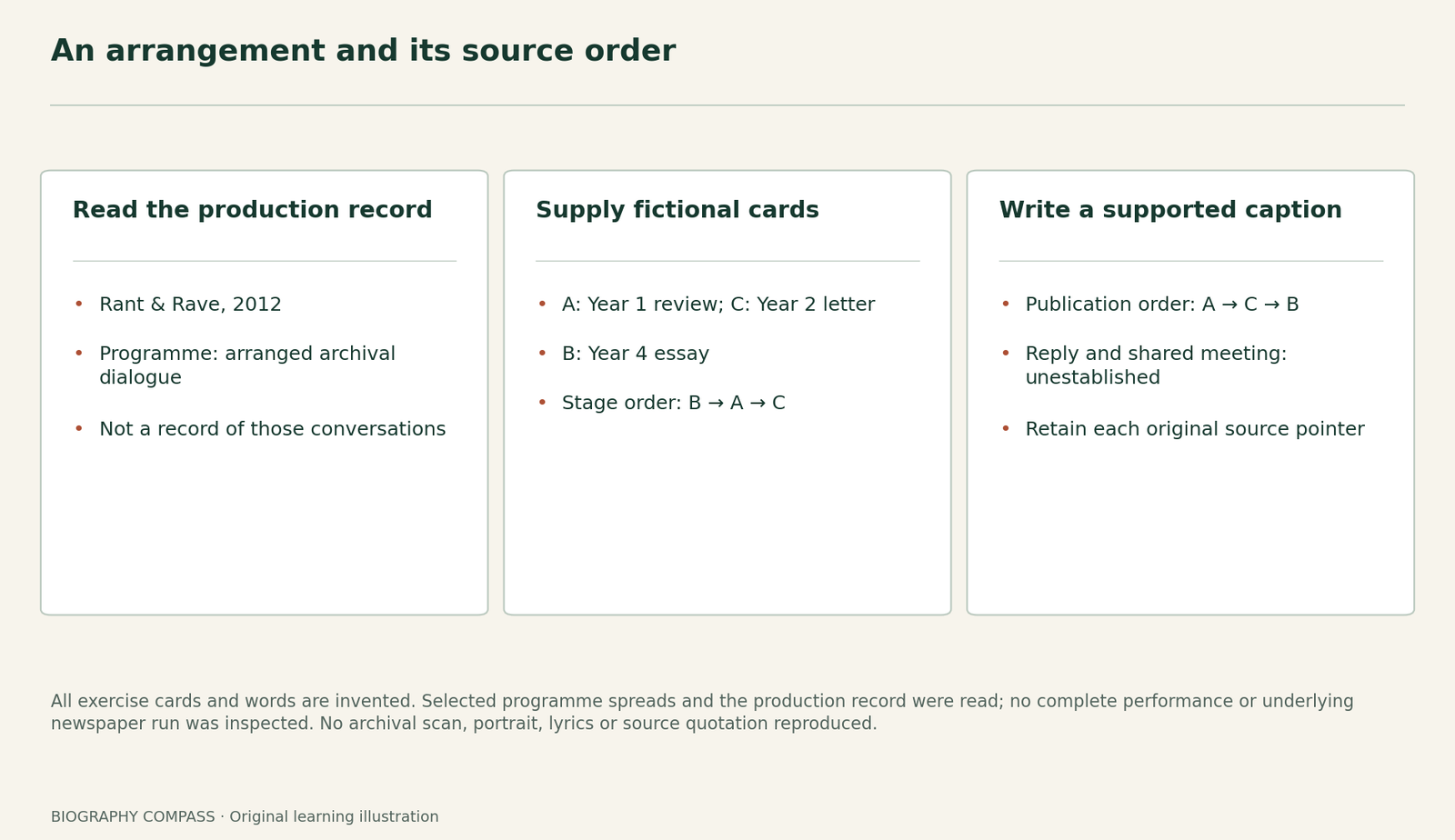
Three fictional source cards survive. A is a review published in Year 1: “I would shorten the opening.” B is an essay from Year 4: “The slower opening creates room to listen.” C is a letter from Year 2 asking whether a new audience could follow the story. No card identifies another as its addressee or names a shared meeting.
A stage montage uses the order B → A → C. Write its source chronology, identify what has changed, and assess three proposed captions: “A replies to B”; “three people disagree at one meeting”; and “three separately recorded statements have been arranged into a new sequence”. All people, words and dates in these cards are invented.
Sources for this section: [1]
Reference answer: keep two orders
The publication chronology is A → C → B. The stage order is B → A → C. Moving A after B changes the audience’s immediate context but does not change the supplied dates. The cards do not establish that A knew B’s essay or intended to answer it.
Neither the reply caption nor the shared-meeting caption is supported. The third caption describes the stated construction. Even apparent disagreement about an opening does not prove that the writers discussed the same production: the supplied cards contain no matching title or event identifier. That missing link should remain visible.
Sources for this section: [1]
What would strengthen a historical claim?
To investigate a reply, seek a dated letter, a reference to the earlier statement, a transcript or another record of the exchange. To claim a shared meeting, seek evidence of attendance and an account of what was said there. These are questions to pursue, not records supplied by the fictional exercise.
A useful citation chain preserves the original publication, date and location of each extract, then identifies the later arrangement. A stage programme can establish the arranger’s stated method while leaving the accuracy, completeness and context of each earlier quotation open for separate checking.
Read the work without inventing an inspection
The selected programme spreads and production page were read for this guide. No complete performance was watched and no complete run of the cited newspapers was inspected. The example is therefore about the inferential boundary between an arrangement and its sources, not a review of acting or a reconstruction of audience reaction.
That boundary need not diminish the work. An arranged exchange can invite comparison across time. A reader simply needs to distinguish that artistic purpose from the different historical claim that particular people actually spoke to one another in the order presented.
Continue the chronology
Related history guides
What a planning ratio can tell you
Try another source-comparison worksheet with a different kind of evidence.
Read the timeline2016 and 2025 institutional accounts · original accession exerciseDo fewer deposit copies mean fewer titles?
Try another source-comparison worksheet with a different kind of evidence.
Read the timelineBiography context
Explore Singapore through connected lives
Connected biographies
Careers and institutions
1939–2002
Kuo Pao Kun
Playwright and theatre educatorKuo Pao Kun built institutions for theatre across languages.Read biographyBorn 1940
Robert Yeo
Poet, playwright and educatorRobert Yeo linked literary writing with teaching.Read biographyQuick answers
Common questions
- Does archival material make a staged conversation a transcript?
- No. This programme explicitly distinguishes its arranged dialogue from conversations that actually occurred.
- Are the exercise quotations historical quotations?
- No. They were written for this fictional task and are not attributed to the real practitioners.
Primary and institutional sources
How this history was checked
Selected records and reading limits are identified in the text. Fictional tasks are labelled; no complete book, performance or archive inspection is implied. This article was reviewed on 30 October 2026.
- The Finger Players; Esplanade commission; Centre 42 archiveRant & Rave programme, 14 October 2012
- The Finger PlayersRant & Rave (2012): production record
- Esplanade – Theatres on the BayKuo Pao Kun — TributeSG
- The Theatre Practice; Centre 42 archive1999 theatre programme: artistic director profile
- Intercultural Theatre InstituteHistory & Milestones
- C. J. W.-L. Wee; Inter-Asia Cultural StudiesIntroduction: art, culture, capitalist development and Kuo Pao Kun
- Esplanade – Theatres on the BayRobert Yeo — TributeSG
- poetry.sg; Ryan How, 4 November 2015Robert Yeo: Critical Introduction
- Robert Yeo; BiblioAsia, 1 March 2012Tell It Slanted: An Approach to Writing My Memoir