
The short answer
How did genetic mapping and homeotic transformations relate gene order to segment identity without constituting a complete DNA sequence?
Read the evidence
Different records within the same investigation
The following comparison distinguishes the specific questions answered by the inspected records.
| Record or test | What it establishes | What remains different |
|---|---|---|
| Segment identity | Concerns the character of a body region. | Differs from the mere presence of repeated units. |
| Genetic map | Orders inherited relationships and effects. | Does not itself provide a complete DNA sequence. |
| Physical molecular map | Connects a region with isolated DNA. | Still leaves regulatory mechanisms to test. |
The question concerned which segmental identity appeared
A repeated body unit can be present yet develop structures characteristic of another region. Lewis’s bithorax work used such transformations to investigate segment identity. The 1978 review related mutant effects to levels of thoracic and abdominal development. This differs from a screen concerned primarily with missing alternating segments or a contiguous gap. A clear comparison starts by naming the phenotype being explained, so that different developmental questions are not merged merely because both involve the word segmentation.
Genetic relationships could constrain an organisational model
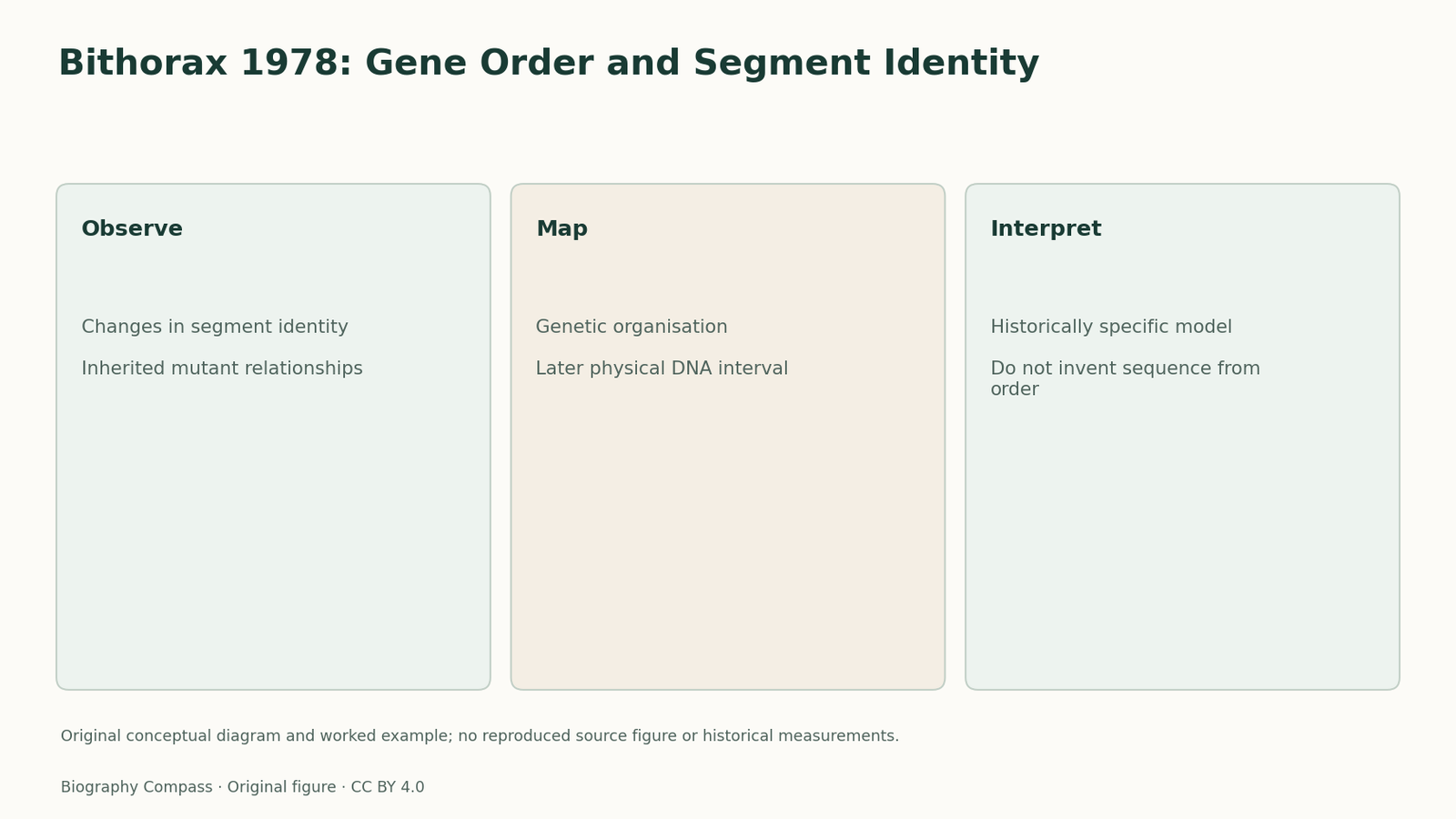
Lewis’s review connected the arrangement of genetic functions with the body regions affected and proposed a regulatory explanation. A genetic map can order relationships inferred from inheritance without already giving the complete physical sequence. That distinction is central to the historical achievement. The map supplied a framework for testing how the complex’s organisation related to developmental outcomes. It did not mean that every proposed function was already one independently sequenced protein-coding gene with a completely known molecular product.
Sources for this section: [1]
The 1978 model retained historically specific hypotheses
The paper’s abstract proposed repression-related gradients and a minimum gene count within the framework then available. Those are statements about the 1978 interpretation, not an unchanged present-day inventory to copy into a modern fact box. The appropriate lesson is how patterns constrained hypotheses and created questions for later molecular work. A reader can recognise the importance of the model without treating every early regulatory detail as directly observed or assuming that an influential review cannot contain proposals later refined by additional evidence.
Sources for this section: [1]
Molecular isolation added a different kind of map
The 1983 Bender and colleagues paper reported isolated DNA and a physical region covering part of the complex. Its title and opening describe a molecular-genetics stage distinct from the 1978 review. Connecting mutant locations with physical material made further questions accessible, but even a large cloned region is not automatically a complete account of regulation. The Nobel award later joined Lewis with Nüsslein-Volhard and Wieschaus. That recognition connects developmental programmes while leaving the original measurements and collaborators attached to their respective contributions.
An original map exercise and answer
Imagine a fictional genetic study that orders inherited effects A, B and C and links them with changes in successive body regions. A student writes down a complete nucleotide sequence from that order. What information is missing? Ordering genetic relationships does not supply the nucleotide identities or every physical distance between them. These letters are invented and no fly map or sequence is copied. A second study that isolates a physical interval can help connect the maps, but it still must identify what has been measured and how regulatory claims were tested. The answer should distinguish an inherited-effect map, a physical-DNA map and a complete mechanism. The first can be a major discovery without already containing the other two.
Continue the chronology
Related history guides
Segmentation 1980: Mutants and Pattern Classes
Examine the 1980 Wieschaus–Nüsslein-Volhard screen through gap, alternating and within-segment patterns, with an original classification exercise and its limits.
Read the timeline1981–2007Embryonic Stem Cells 1981: Testing Potential
Compare Evans and Kaufman’s 1981 cell-culture result with later germ-line evidence, using an original exercise to separate appearance, potential and inheritance.
Read the timelineBiography context
Explore United States through connected lives
Connected biographies
Researchers and related approaches
1918–2004
Edward B. Lewis
Geneticist and developmental researcherEdward Lewis investigated the bithorax complex in fruit flies, connecting genetic organisation with body-segment identity through developmental genetics.Read biography1866–1945
Thomas Hunt Morgan
Experimental zoologist and geneticistThomas Hunt Morgan moved from embryology to fruit-fly genetics, using inherited mutations and crosses to investigate the chromosome basis of heredity.Read biographyQuick answers
Common questions
- Was the 1978 review a complete DNA-sequence report?
- No. It used genetic and developmental relationships to develop a model.
- Should its early gene-count proposal be treated as an unchanged modern inventory?
- No. It must retain its historical context.
Primary and institutional sources
How this history was checked
The references below distinguish the original study from later explanations. The worked exercise and comparison are newly written for this article. This article was reviewed on 8 November 2026.
- Edward B. Lewis, Nature, 1978A gene complex controlling segmentation in Drosophila
- Bender, Akam, Karch, Beachy, Peifer, Spierer, Lewis and Hogness, Science, 1983Molecular Genetics of the Bithorax Complex in Drosophila melanogaster
- Nobel Prize OutreachEdward B. Lewis — Facts
- Nobel Prize OutreachEdward B. Lewis — Biographical