
The short answer
How did a genetic screen organise embryonic pattern defects without treating every abnormal embryo as the same developmental failure?
Read the evidence
Different records within the same investigation
The following comparison distinguishes the specific questions answered by the inspected records.
| Record or test | What it establishes | What remains different |
|---|---|---|
| Adjacent-region loss | Affects a contiguous spatial domain. | Is different from alternating loss. |
| Alternating-unit defect | Reveals a repeated two-unit relationship. | Is not merely a severity score. |
| Within-unit polarity change | Retains units but changes internal pattern. | Requires its own organisational explanation. |
The screen asked a more specific question than why embryos fail
Many mutations can prevent successful development. The Heidelberg investigation focused on mutations whose larval cuticle patterns revealed altered segmentation. Its 1980 report identified fifteen relevant loci through systematic searches. The concrete question was whether the resulting defects all represented one generic failure or instead exposed different levels of pattern organisation. A classification can be explanatory when the compared features are specific enough to distinguish alternatives, rather than simply grouping every nonviable embryo under one label.
Sources for this section: [1]
Three pattern classes made spatial scale visible
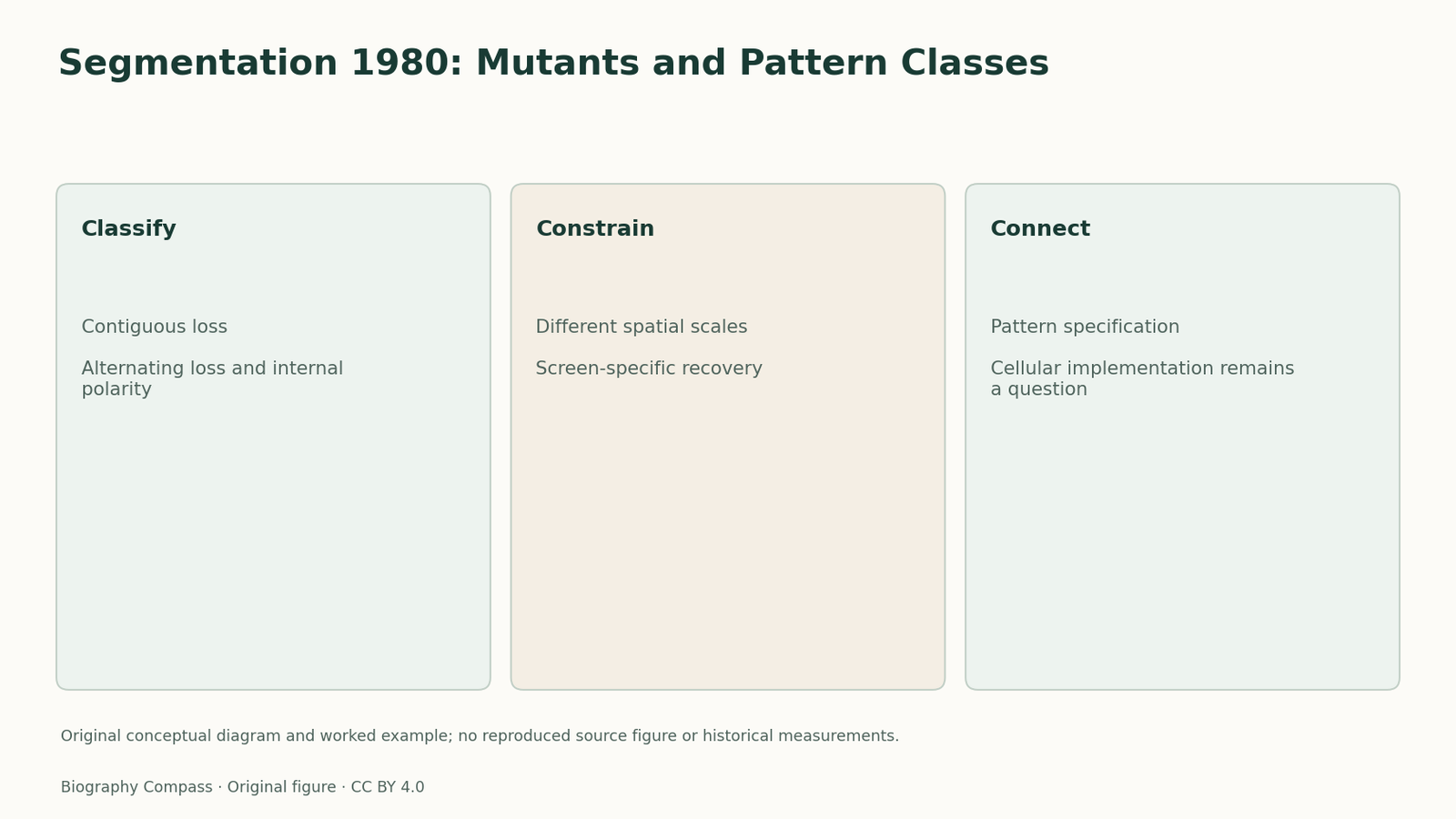
The original report distinguishes adjacent-segment losses, alternating-segment deletions and alterations repeated within segments. Those classes became known as gap, pair-rule and segment-polarity patterns. Their value lies in the relationship among affected and retained structures. A contiguous missing region asks a different organisational question from a repeated every-other-unit defect. The classification therefore supplied constraints on how segmentation was organised. It was not simply a severity ranking from slightly abnormal to very abnormal, nor a direct image of all the molecular interactions responsible.
Sources for this section: [1]
A recovered class reflects the screen’s design
Wieschaus’s autobiography describes the effort required to handle many flies, obtain suitable preparations and interpret repeatedly surprising phenotypes. A screen recovers mutations accessible to its genetic scheme and observable endpoint. The original paper’s estimate about the represented genes should not be enlarged into a claim that every gene in development had been found. The important inference is bounded: particular recurring defects revealed distinguishable requirements for the segment pattern examined. Other developmental processes or undetected classes could require different ways of looking.
Pattern specification did not finish the problem of form
Wieschaus’s lecture separates assigning cell fates from the movements and shape changes that implement them. The Nobel recognition concerned genetic control of early development, but a list of patterning loci does not independently explain every physical step of morphogenesis. Connecting those levels is a further scientific problem. The work’s location also matters: the screen discussed here was conducted at EMBL in Heidelberg, while Wieschaus’s subsequent American career provides the associated country-archive link. No new national archive or biological experiment is implied by that editorial association.
An original pattern exercise and answer
Consider an invented sequence of six repeated units. Mutant A lacks three neighbours; mutant B lacks every second unit; mutant C retains all six but repeats a polarity defect within each. Which is simply the most severe version of the same spatial pattern? The description does not justify that conclusion. The three changes concern different spatial relationships. These fictional units are not fly drawings or source measurements. Classifying them separately can motivate distinct organisational hypotheses, but it does not reveal their molecular identities or establish that each visible class corresponds to only one biochemical pathway. The answer should name the pattern first, then separate that observation from the causal model proposed to explain it. This is the gain of a meaningful phenotype classification.
Continue the chronology
Related history guides
Bithorax 1978: Gene Order and Segment Identity
Read Lewis’s 1978 bithorax model beside later molecular mapping, distinguishing segment identity, genetic relationships and complete DNA-sequence claims.
Read the timeline1981–2007Embryonic Stem Cells 1981: Testing Potential
Compare Evans and Kaufman’s 1981 cell-culture result with later germ-line evidence, using an original exercise to separate appearance, potential and inheritance.
Read the timelineBiography context
Explore Heidelberg, Germany through connected lives
Connected biographies
Researchers and related approaches
1947–
Eric F. Wieschaus
Developmental geneticistEric Wieschaus investigated embryonic development with Christiane Nüsslein-Volhard, using systematic fly-mutant comparisons to distinguish levels of segment patterning.Read biography1866–1945
Thomas Hunt Morgan
Experimental zoologist and geneticistThomas Hunt Morgan moved from embryology to fruit-fly genetics, using inherited mutations and crosses to investigate the chromosome basis of heredity.Read biographyQuick answers
Common questions
- Did fifteen loci explain every part of fly development?
- No. The paper concerned a defined segmentation endpoint and screen.
- Are gap and alternating defects just different severities?
- No. Their spatial relationships differ.
Primary and institutional sources
How this history was checked
The references below distinguish the original study from later explanations. The worked exercise and comparison are newly written for this article. This article was reviewed on 8 November 2026.