
The short answer
How did radioligand binding help identify receptors without making binding equivalent to cell signalling?
Read the evidence
Three claims within a receptor assay
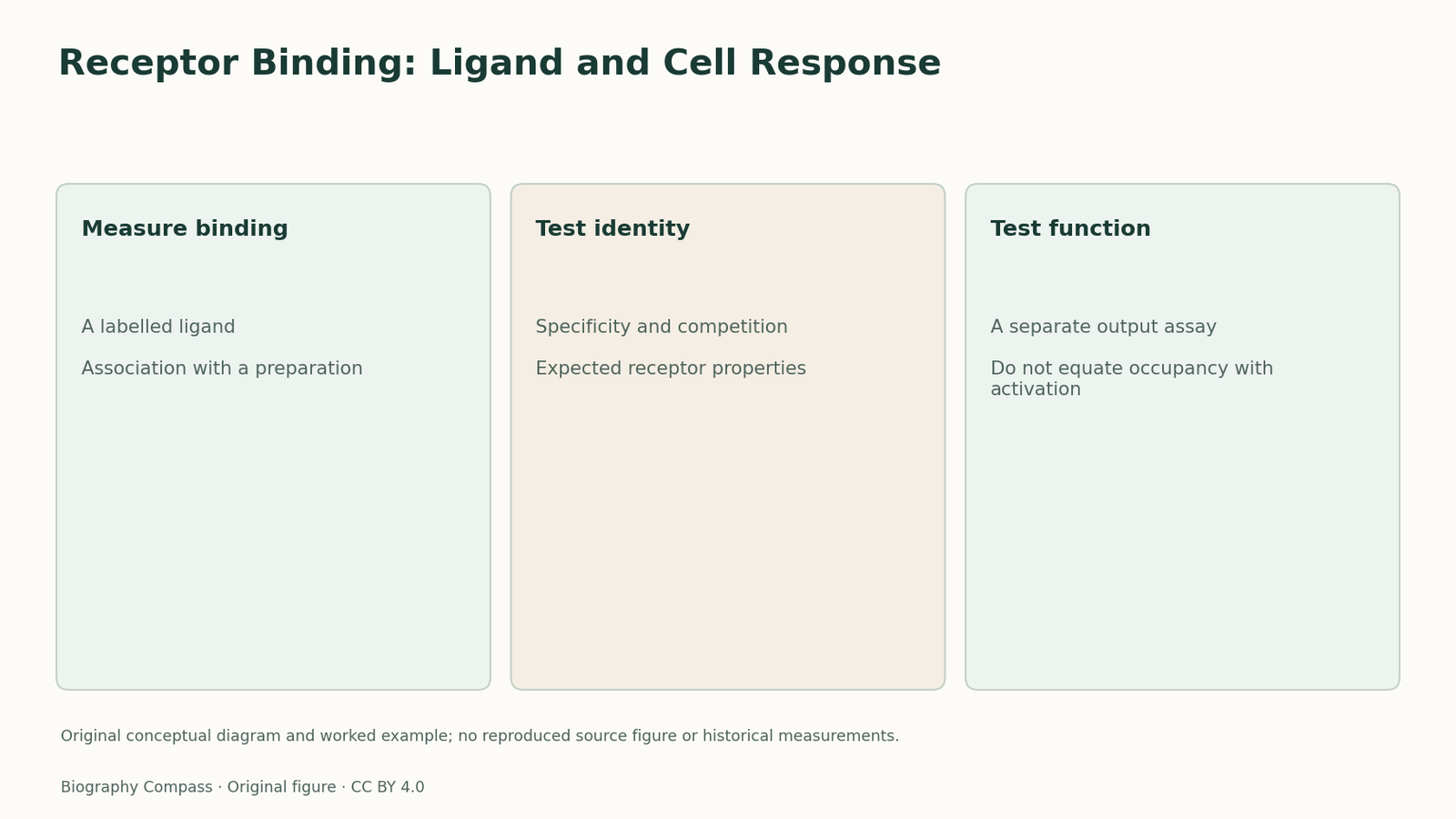
Binding, identifying a receptor and measuring a signal are connected tasks, not synonyms.
| Record or test | What it establishes | What remains different |
|---|---|---|
| Labelled-ligand association | Provides a measurable binding signal. | Does not alone identify a unique receptor or prove activation. |
| Specificity and competition tests | Help relate the signal to an expected receptor. | Still require functional comparisons for downstream claims. |
| Functional response | Measures a defined biological output. | Is not interchangeable with ligand occupancy. |
A radioactive signal is a starting observation
The radioligand approach used labelled molecules to identify receptor-like binding sites. In the 1975 frog-erythrocyte paper, the agent was tritiated alprenolol, a β-adrenergic antagonist. The important question was not simply whether radioactivity remained associated with a membrane preparation. The sites needed properties consistent with the receptor being investigated. This distinction separates a physical signal from its biological interpretation: labelling supplies a way to measure association, but additional comparisons determine what the association means.
Sources for this section: [1]
Compare binding behaviour with functional expectations
The frog-membrane study examined sites whose properties matched those expected of β-adrenergic receptors coupled to adenylate cyclase. A separate 1975 cardiac paper examined binding in a canine-heart preparation and compared drug affinities with known β-receptor behaviour. These studies connect biochemical binding with functional pharmacology, but they do not make the two quantities identical. An antagonist can bind without activating the downstream response in the way an agonist does. Naming the ligand and preparation therefore matters when interpreting an assay.
The model system limits the claim
Frog erythrocyte membranes and canine myocardium are different preparations. Their agreement on specified receptor properties was useful, but it was not a direct measurement of every human tissue or a clinical outcome. Lefkowitz’s autobiography places these assays within a longer programme of developing tools, purifying receptors and relating molecular findings to cell behaviour. That programme explains the significance of the papers without requiring either to stand for all its subsequent discoveries. A strong historical account makes the experimental object more explicit rather than replacing it with the generic word receptor.
An original assay-interpretation exercise
Imagine a membrane preparation that retains a labelled compound. A student labels the finding receptor activation. Ask what evidence is missing. First, the binding must be shown to have appropriate specificity rather than indiscriminate association. Second, the functional response must be measured separately if activation is claimed. Now imagine a binding competitor that occupies the site but does not trigger the same response. That outcome is not paradoxical: occupation and activation are different properties. These are original reasoning cards, not new drug-affinity values or a recreated experiment. The supported answer is to keep binding, identity and downstream function as separate boxes that can be connected by appropriate evidence.
Continue the chronology
Related history guides
A GPCR Complex: Capturing Activation
Read the 2011β2 receptor–Gs structure asacaptured molecular state, distinguishing its interface and conformational changes from whole-cell signalling output.
Read the timeline2000–2001RNA Polymerase II: Structure and Transcription
Compare the 2001 ten-subunit polymerase structure with a separate elongation complex, and distinguish structural proposals from functional transcription evidence.
Read the timelineBiography context
Explore United States through connected lives
Connected biographies
Researchers and related approaches
1943–
Robert Lefkowitz
Physician and receptor biochemistRobert Lefkowitz moved from clinical medicine into hormone-receptor research, building a Duke programme that connected radioligand binding with cell signalling.Read biography1941–2015
Alfred G. Gilman
Pharmacologist and G-protein researcherGilman's group used S49 lymphoma-cell variants with defective signalling as experimental material.Read biographyQuick answers
Common questions
- Why can an antagonist bind without producing the agonist’s response?
- Binding and activation are different properties; occupying a site does not guarantee the same downstream effect.
- Why name the frog and canine preparations?
- They define the experimental systems; the papers do not directly measure every human receptor or a clinical outcome.
Primary and institutional sources
How this history was checked
The two 1975 abstracts are kept distinct by their preparations.The exercise separates binding evidence from claims about activation or clinical effects. This article was reviewed on 7 November 2026.
- Mukherjee, Caron, Coverstone and Lefkowitz / Journal of Biological ChemistryIdentification of adenylate cyclase-coupled β-adrenergic receptors in frog erythrocytes with[3H]alprenolol
- Alexander, Williams and Lefkowitz / PNASIdentification of cardiac β-adrenergic receptors by[3H]alprenolol binding
- Nobel Prize OutreachRobert Lefkowitz — Facts
- Nobel Prize OutreachRobert Lefkowitz — Biographical