
The short answer
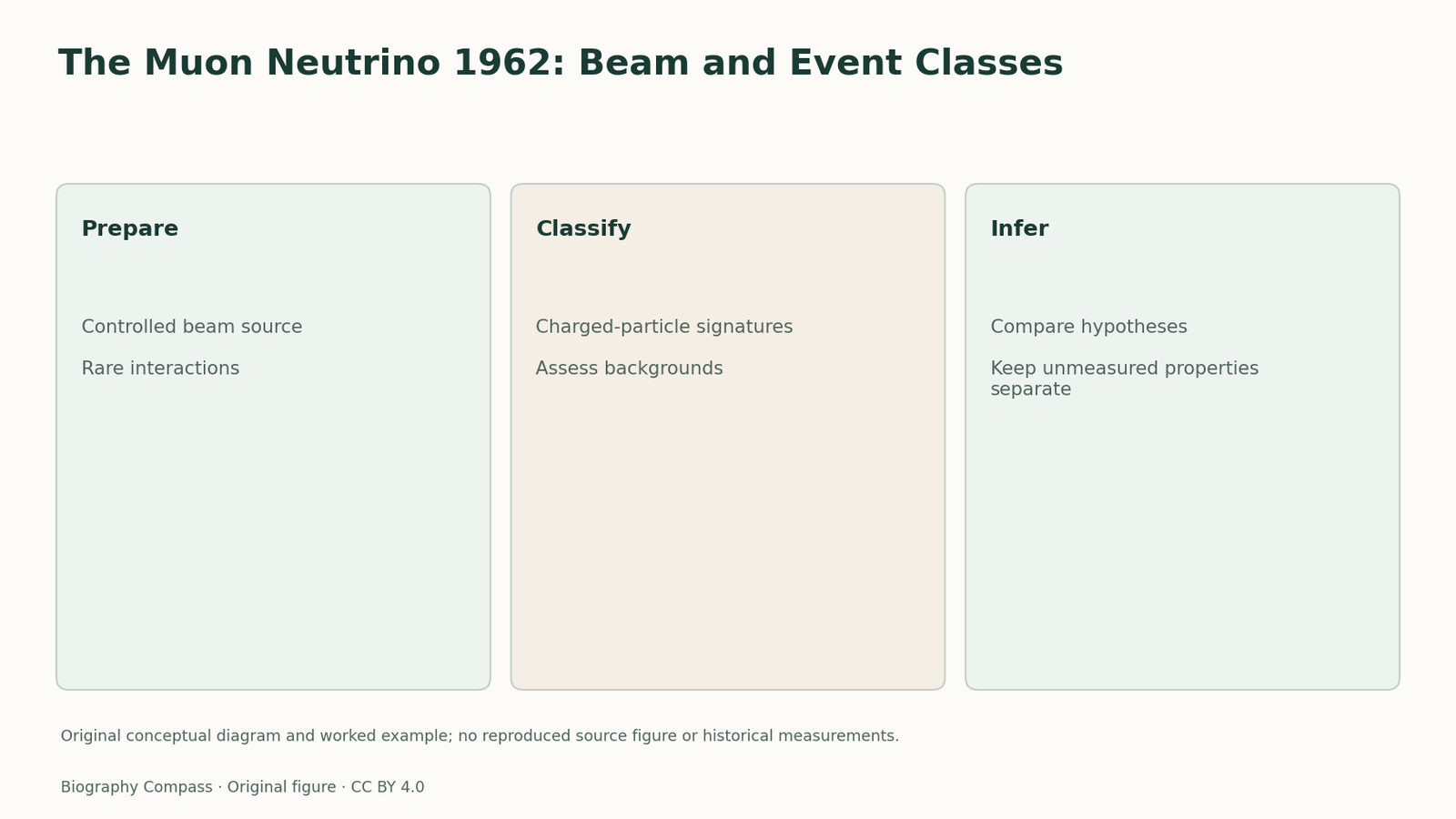
How did a prepared neutrino beam and the observed charged leptons distinguish neutrino flavours?
Read the evidence
Records that answer different questions
Compare the research record, the explanatory model and the original learning exercise.
| Record or test | What it establishes | What remains different |
|---|---|---|
| Publication record | Lists seven collaborating authors and the 1962 paper. | Not identical to the later Nobel recipient list. |
| Selected event classes | Separate track/shower observations and stated backgrounds. | Raw categories are not automatically particle identifications. |
| 1988 award | Recognises the beam method and muon-neutrino discovery. | Does not turn the 1962 experiment into a complete neutrino theory. |
A prepared beam made a rare interaction testable
Brookhaven’s account places the 1962 muon-neutrino discovery at the Alternating Gradient Synchrotron. The experimental question was whether the neutrinos associated with muons behaved like the already identified electron-associated type. Beam preparation and event identification served different purposes. A usable beam supplied opportunities for interactions; the charged particles produced in selected events carried the discriminating evidence. The discovery should therefore be explained as more than seeing an unfamiliar track appear in a detector.
The original authorship is broader than the award
The 1 July 1962 paper names G. Danby, J.-M. Gaillard, K. Goulianos, L. M. Lederman, N. Mistry, M. Schwartz and J. Steinberger, with Columbia and Brookhaven affiliations. This credit record is directly accessible even where the article’s full text is not. The later Nobel recognition names Lederman, Schwartz and Steinberger. These are records with different functions: publication authorship identifies the collaborating investigators on the paper, while an award selects recipients under its own arrangements. Neither list should be silently substituted for the other.
Event classes must retain their background assessment
A Brookhaven scientific presentation summarises 34 single-muon events, with 5 consistent with cosmic-ray background, and 6 shower events assessed against several possible backgrounds. These figures describe different selected classes and qualifications, not 34 unqualified discoveries plus 6 proven electron-neutrino events. The useful comparison is between the event types expected under competing explanations and what remained after the background assessment. The selected slide does not provide a full modern likelihood analysis or a licence to infer every later neutrino property. Its contribution is to preserve the link between the detector record and the proposed distinction.
Sources for this section: [5]
Original evidence exercise: identify the missing comparison
Consider a fictional detector log with columns labelled “penetrating track”, “shower” and “control-run background”. A student proposes that every shower proves a second neutrino type. What is missing? The event classification needs a comparison with the expected backgrounds and with the interaction signatures relevant to the hypothesis. Another student says a penetrating track proves the incoming neutral particle had exactly the same mass as a muon. That also exceeds the record: identifying a charged product and determining the incident particle’s mass are different tasks. A better conclusion states which hypothesis the classes help discriminate, what backgrounds must be assessed and which properties were not measured. These examples are newly written reasoning cases with no invented historical event counts. Their answer concerns the structure of the inference; the actual Brookhaven totals remain in the preceding source-linked discussion.
Continue the chronology
Related history guides
Biography context
Explore United States through connected lives
Connected biographies
Researchers and related approaches
1922–2018
Leon Lederman
Experimental particle physicist and laboratory directorLeon Lederman combined particle experiments with laboratory leadership and public teaching, working in collaborations that established new kinds of elementary particle.Read biography
1918–1988
Richard Feynman
Theoretical physicist and physics educatorRichard Feynman combined quantum research with physics teaching, moving from MIT and Princeton through wartime Los Alamos, Cornell and a long Caltech career.Read biography1927–2014
Martin Perl
Experimental particle physicistMartin Perl moved from chemical engineering into particle physics and led the search that turned unusual electron–muon events into evidence for the tau lepton.Read biographyQuick answers
Common questions
- Does every shower prove an electron-neutrino event?
- No. Background explanations must be assessed before drawing that conclusion.
- Was the full 1962 paper read for this article?
- The publisher’s authorship and publication record were inspected; the accessible technical evidence is the specifically identified Brookhaven presentation passage.
Primary and institutional sources
How this history was checked
Read scopes distinguish original papers, selected lecture passages, institutional biographies and editorial teaching models. This article was reviewed on 8 November 2026.
- Fermilab History and ArchivesLeon Lederman: corrected obituary
- American Physical SocietyLeon Lederman 1922–2018
- Danby and colleagues / Physical Review LettersObservation of High-Energy Neutrino Reactions and the Existence of Two Kinds of Neutrinos
- Brookhaven National LaboratoryBrookhaven Neutrino Research
- Brookhaven National Laboratory scientific presentationHistory of BNL Neutrino Research: results slide