
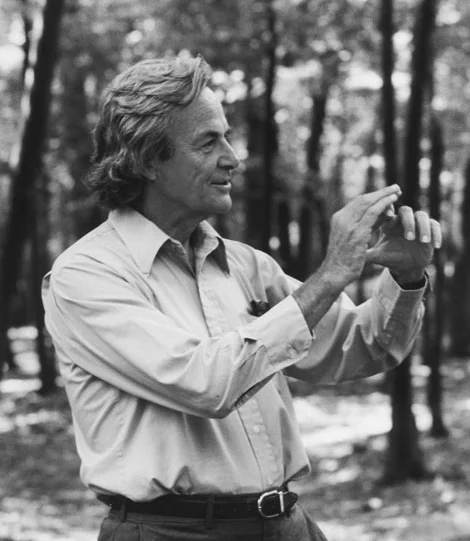
In this biography
Quick facts
- Born
- 11 May 1918
- Died
- 15 February 1988
- Birthplace
- New York City, United States
- Country
- United States
- Nationality
- Not independently established
- Known for
- Developing quantum-electrodynamics methods, path-integral quantum mechanics and influential physics lectures
Why this life matters
His work made quantum calculations more workable while his lectures exposed the reasoning behind physical models.
Timeline
Key moments
Born in New York
Feynman was born on 11 May.
Path-integral paper
Published the space-time formulation of non-relativistic quantum mechanics.
Shared physics Nobel
Recognised with Julian Schwinger and Sin-Itiro Tomonaga.
A physicist trained through several institutions
Richard Phillips Feynman was born in New York in 1918. He studied at the Massachusetts Institute of Technology, graduating in 1939, and received his doctorate from Princeton in 1942. During the Second World War he worked at Los Alamos on the Manhattan Project. After the war, Cornell provided the setting for a renewed concentration on theoretical physics. These institutions mark different phases of his life: undergraduate training, doctoral research, military work and the development of a postwar scientific programme.
New ways to organise quantum calculations
Feynman’s 1948 space-time paper offered a formulation of non-relativistic quantum mechanics equivalent to the established theory. Instead of assigning a probability separately to each alternative and adding the results, it combined complex contributions before calculating a probability. His later quantum-electrodynamics work introduced the diagrammatic methods associated with his name. The diagrams became computational tools, not miniature photographs of particle events. In 1965 he shared the Nobel Prize in Physics with Julian Schwinger and Sin-Itiro Tomonaga, whose approaches also transformed quantum electrodynamics.
Caltech research and a collaborative set of lectures
Feynman moved to Caltech in 1950 and worked across particle physics, superfluid helium and other problems. His teaching became a separate part of his influence. The Feynman Lectures on Physics emerged with Robert Leighton and Matthew Sands; attributing the volumes only to a charismatic lecturer obscures the work of organising, recording and developing the course. Caltech’s author account also records his work with Murray Gell-Mann on weak interactions. His scientific and educational output thus contains several different collaborations, rather than one permanent research partnership.
A public role beyond the blackboard
Late in his life, Feynman served on the commission investigating the Challenger disaster. His demonstration of how cold affected an O-ring became a memorable example of bringing a testable physical question into public discussion. He died in Los Angeles on 15 February 1988. His reputation rests on both research and explanation, but they should not be collapsed into personality alone. Reading a technical paper beside the lectures reveals a recurring concern: choose a representation that helps a reader calculate or reason, then keep that representation distinct from the physical event itself.
Quick answers
Frequently asked questions about Richard Feynman
- What did Richard Feynman receive the Nobel Prize for?
- He shared the 1965 physics prize with Julian Schwinger and Sin-Itiro Tomonaga for fundamental work in quantum electrodynamics.
- Who helped create The Feynman Lectures on Physics?
- Robert Leighton and Matthew Sands were central collaborators in developing the Caltech course and its published volumes.
Keep exploring
Lives connected to this story
- Sin-Itiro Tomonaga
Compare a co-recipient’s independent quantum-electrodynamics research, rather than treating the 1965 award as one jointly written theory.
- Murray Gell-Mann
Explore Murray Gell-Mann’s related research on quark model.
- Burton Richter
Explore Burton Richter’s related research on spear.
- Frederick Reines
Explore Frederick Reines’s related research on neutrino detection.
- Leon Lederman
Read this separate research history for muon-neutrino research, the 1977 bottom-quark discovery and leadership of fermilab and science education. A contextual comparison does not imply that the scientists worked together.
- Walter Kohn
Read this separate research history for density-functional theory, collaboration with pierre hohenberg and lu jeu sham, and theoretical-physics institution building. A contextual comparison does not imply that the scientists worked together.
- John Pople
Read this separate research history for quantum-chemical model chemistries, the gaussian programme and systematic comparisons of computational predictions. A contextual comparison does not imply that the scientists worked together.
Sources and further reading
Explore the evidence
These references support the biography and offer further reading. Official records, first-person accounts and independent reporting provide different perspectives; image records document attribution and licensing.
- 1. Nobel Prize OutreachRichard P. Feynman — Facts
- 2. Nobel Prize OutreachRichard P. Feynman — Biographical
- 3. California Institute of TechnologyThe Feynman Lectures on Physics: About the Authors
- 4. The Open UniversityThe restless Universe: Richard Feynman
- 5. R.P. Feynman / Caltech AUTHORSSpace-Time Approach to Non-Relativistic Quantum Mechanics
The 1948 non-relativistic path formulation and the QED interaction diagrams are related contributions but should not be described as the same drawing method.
- 6. California Institute of TechnologyQuantum Behavior, The Feynman Lectures on Physics III, Chapter1