
The short answer
A sequence has an order even when its objects live in different buildings. Designing a display starts by distinguishing that order from ownership and from the path a visitor is offered.
Read the production record
Different objects, different decisions
Compare the stated evidence before applying the original task.
| Record or task | Sequence record | Display plan |
|---|---|---|
| Original position | Retain the number. | Show it even when rearranging. |
| Collection | Record who holds the object. | Identify loans and gaps. |
| Interpretation | Do not invent missing source text. | State the reason for the selection. |
Chronology
A timeline of the turning points
The paintings
A sixty-panel narrative was made.
Split holdings
Alternate numbered panels entered two collections.
A temporary display
Distinguish order, ownership and access.
The historical arrangement
Lawrence made The Migration Series as sixty equal-size panels and developed its captions before painting.
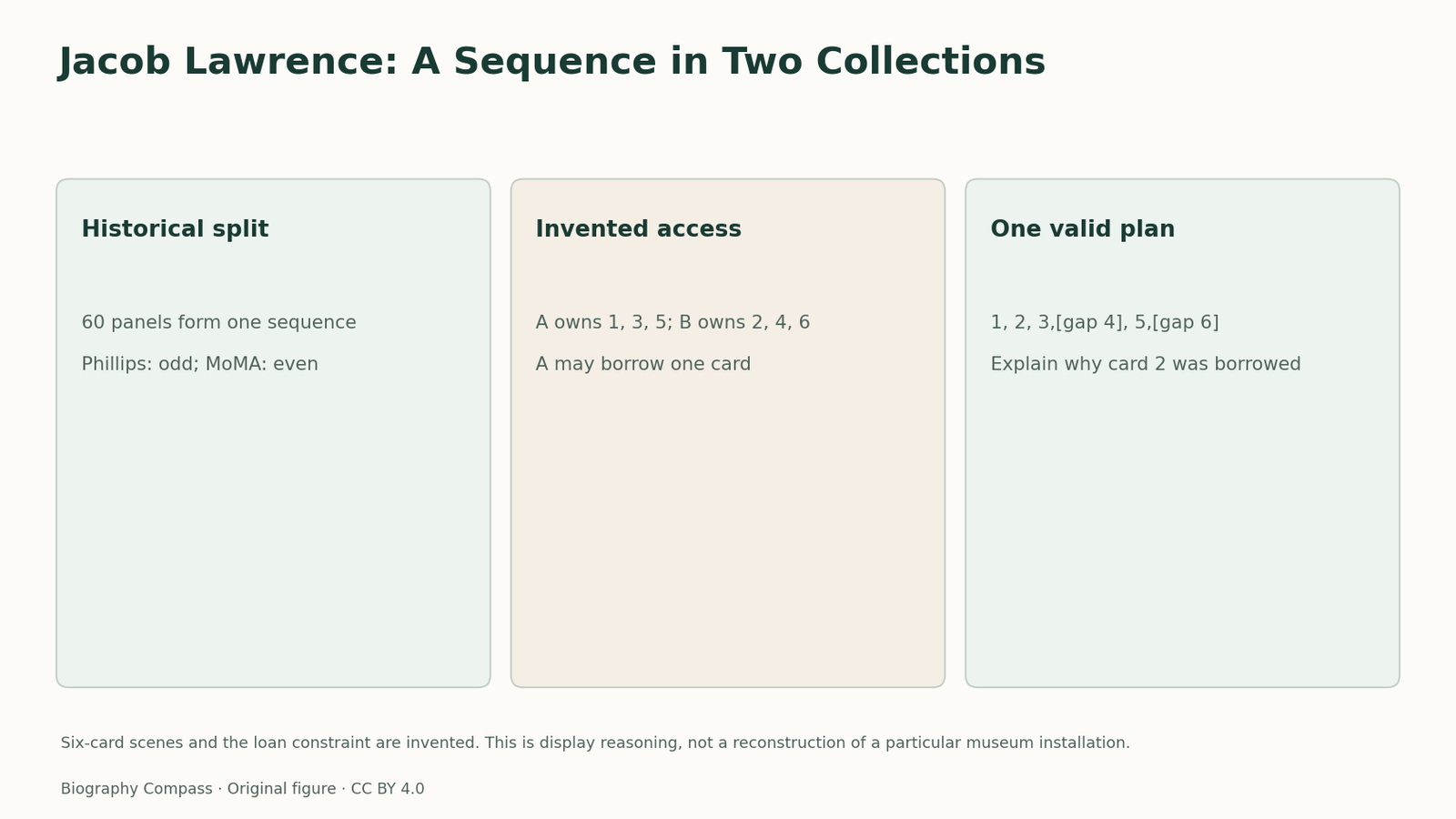
In 1942 the Phillips Collection acquired the odd-numbered panels and MoMA the even-numbered ones. The split therefore follows alternating positions within a single sequence.
MoMA’s label also explains that Lawrence worked across the panels together for a consistent palette.
Reading only one holding in numerical order is a particular selection, not an equivalent way of encountering every step. A display can make that selection useful if it states what is absent. Ownership is a practical fact about access; it does not itself supply a new narrative order.
Design an invented six-card exhibition
Use these original cards: 1, a family packs; 2, a train leaves; 3, a worker reads a notice; 4, an interview takes place; 5, neighbours prepare a room; 6, the family shares a meal. These are invented scenes, not Lawrence captions. Collection A owns 1, 3, 5; Collection B owns 2, 4, 6. A can borrow only one card. Choose a layout that clearly states its aim.
Produce two plans: a chronological route using all six numbered positions, and a three-card thematic group drawn only from A’s holding. For the first plan mark unborrowed positions as gaps rather than filling them with invented quotations. For the second write a heading that describes the selection without claiming it is the complete story.
Reference answer: access changes the experience
One defensible chronological plan borrows 2 and displays 1, 2, 3,[gap 4], 5,[gap 6]. The departure is now continuous, while the interview and concluding meal remain identified absences. Borrowing 4 instead would privilege the notice/interview pair. The task has no uniquely best loan: explain the intended reading experience.
A thematic group of 1, 3, 5 might be headed Preparing, Seeking, Welcoming. It can connect three forms of anticipation, but that is the student curator’s argument. It must retain the original numbers and disclose that these are alternate positions. A new grouping should add a reason to look, not silently erase the sequence it selects from.
A display note worth keeping
Write separate fields for original position, current collection and display order. If a loan arrives, update the last two fields as appropriate while preserving the first. This modest record design makes later changes reversible. It also lets a reader distinguish a genuine missing object, an absent loan and a deliberate curatorial omission.
Continue the chronology
Related history guides
Biography context
Explore United States through connected lives
Connected biographies
Artist and working context
1917–2000
Jacob Lawrence
Painter and teacherA painter and teacher who made the relation between individual images and an extended sequence unusually compelling.Read biographyQuick answers
Common questions
- Does a thematic display have to follow chronology?
- No. State the new argument and retain original positions so the change remains visible.
Primary and institutional sources
How this history was checked
Selected museum and archival records underpin the comparison; the exercise and reference answer are original. This article was reviewed on 31 October 2026.