
The short answer
A print’s label can hold several different clocks. Understanding those clocks makes it easier to describe what survives and to design a relief image whose dark and light areas will actually read.
Read the production record
Different objects, different decisions
Compare the stated evidence before applying the original task.
| Record or task | Design or matrix | Printed impression |
|---|---|---|
| Date | When the image or block was made. | When this sheet was printed. |
| Count | Original designs or surviving blocks. | Edition size and impression number. |
| Credit | Image-maker. | Retain the stated printer too. |
Chronology
A timeline of the turning points
Original series
Fifteen linocuts were designed.
Later printing
The consulted records distinguish a later edition.
Paper plan
Test negative space before making any block.
Two dates and a changed surviving set
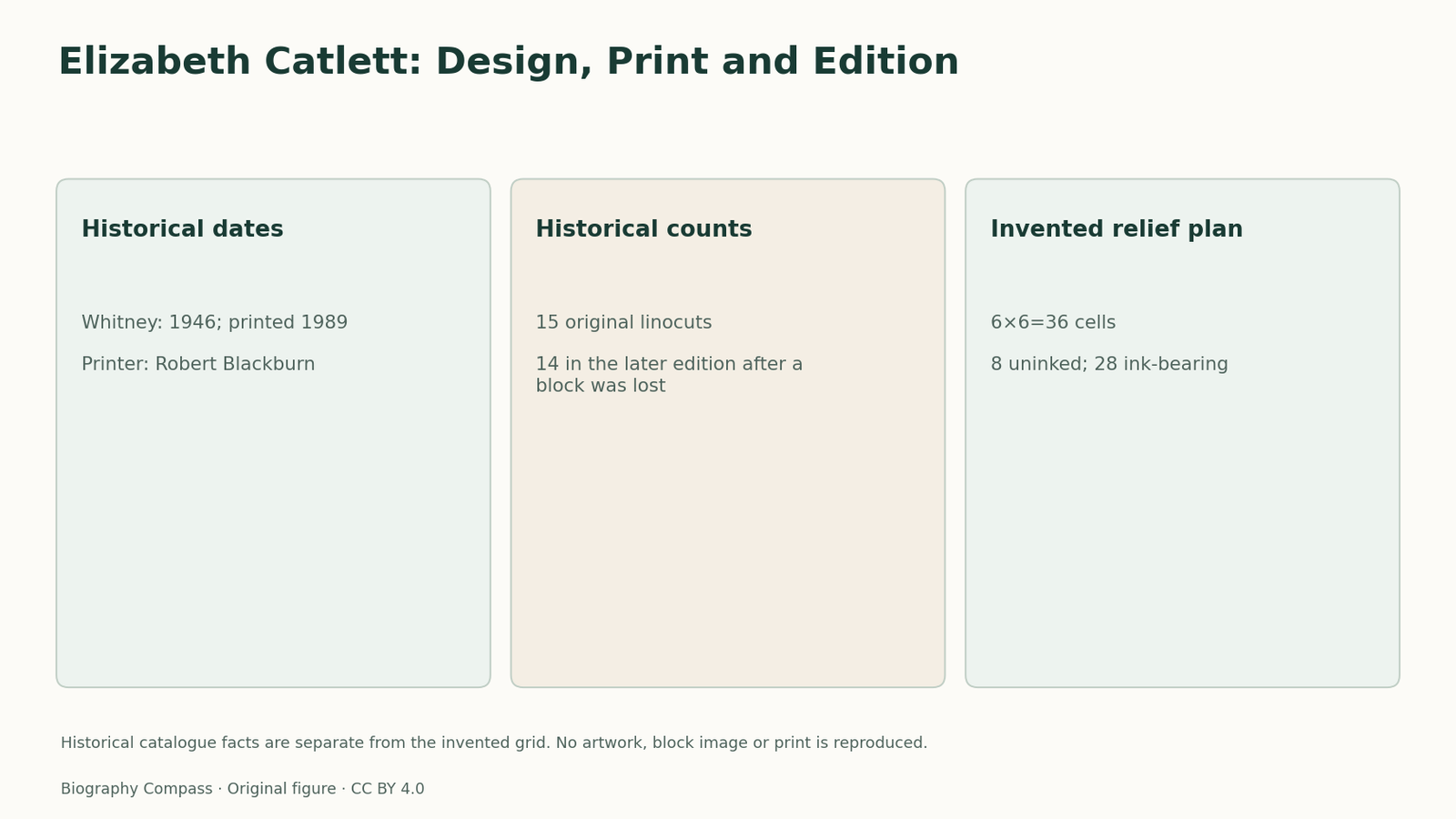
The Whitney dates I have always worked hard in America to 1946, printed 1989. It identifies a linoleumcut from the second print run, numbered 13/20 and printed by Robert Blackburn.
MoMA’s essay describes fifteen original linocuts in the series and explains that one block was lost before the 1989 edition, leaving fourteen prints in that edition.
Thus a later impression need not be a later invention of its image. A lost block can alter what a later edition contains without changing the number originally designed. The series total, edition denominator and particular impression number answer different questions; none can substitute for the others.
A relief-print decision
In a linocut, gouged areas and raised areas do different jobs: the raised surface takes the roller’s ink and transfers it to the paper.
For an original paper exercise, draw a six-by-six grid and reserve a two-by-two central square as uninked. Mark two one-square-wide uninked paths from that square to opposite edges. Keep the paths straight and non-overlapping outside the centre. Shade the remaining cells as the proposed raised, ink-bearing area. This is a schematic design, not an instruction to cut a real block.
Sources for this section: [3]
Reference answer: count and test readability
The central square uses 4 cells. With the square centred in the six-by-six grid, each outward path adds 2 cells, so 8 cells are uninked and 28 are ink-bearing. A sample placement puts the square in rows 3–4, columns 3–4, with a left path along row 3 and a right path along row 4. Other placements need their own counts.
The count does not determine which arrangement reads best. Ask a partner whether the central opening appears connected to the outside. If they miss a path, change its placement or width and recount. A plausible catalogue exercise is equally explicit: if an invented series began with 8 designs but only 7 blocks remained for a later run of 10, a label 7/10 identifies an impression within that run, not seven original designs.
Write a label that keeps the distinctions
Use separate lines for design date, printing date, surviving matrix and impression identifier. Leave an unknown line unknown. When a printer is credited, keep that name: making the design and producing a later impression are connected contributions, not the same event. The grid and invented edition numbers above are teaching inputs, not Catlett’s working notes.
Continue the chronology
Related history guides
Biography context
Explore United States through connected lives
Connected biographies
Artist and working context
1915–2012
Elizabeth Catlett
Sculptor, printmaker and teacherA sculptor and printmaker whose images ask viewers to connect individual lives with a broader social world.Read biographyQuick answers
Common questions
- Does 13/20 tell us the original number of designs?
- No. An impression identifier and a series total describe different counts.
Primary and institutional sources
How this history was checked
Selected museum and archival records underpin the comparison; the exercise and reference answer are original. This article was reviewed on 31 October 2026.