
The short answer
A hollow mesh and a spray of branches may share a material while asking the maker to solve different problems. Two documented structures offer a starting point for a small, original design experiment.
Read the production record
Different objects, different decisions
Compare the stated evidence before applying the original task.
| Record or task | Continuous mesh | Divided bundle |
|---|---|---|
| Question | What can be seen through a surface? | How do strands continue through splits? |
| Original task | Mark three sightlines. | Conserve 24 strands across each level. |
| Unresolved | Stability and exact fabrication. | Balance and safe suspension. |
Chronology
A timeline of the turning points
S.114
Continuous outer mesh in the selected object description.
S.184
Repeated division in the retrospective description.
Two pencil plans
Test sightlines separately from strand conservation.
Two structures, not one recipe
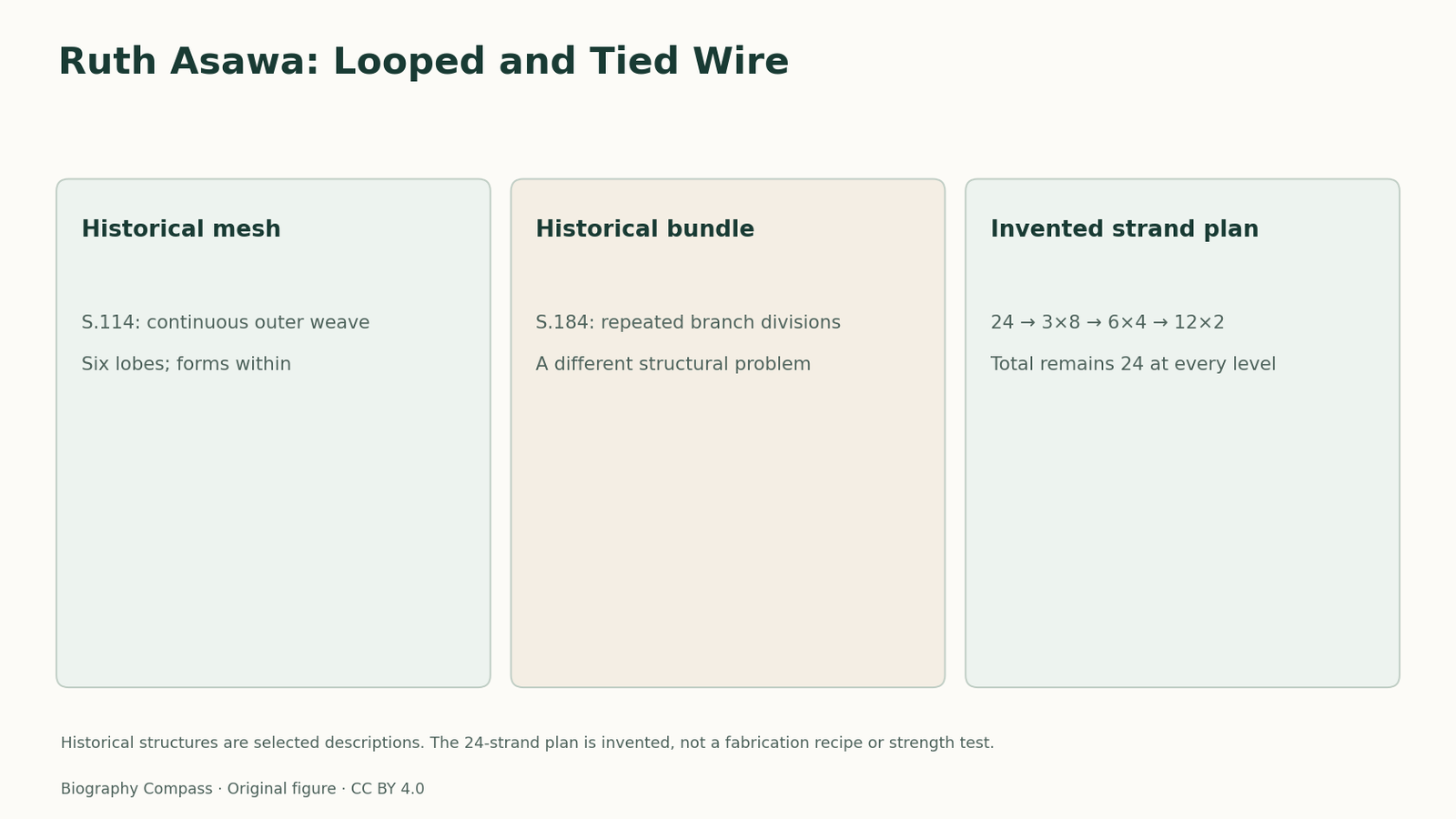
SFMOMA describes Asawa’s S.114 as a continuous outer weave forming six lobes, with additional forms inside. The mesh permits views through its surface.
Its retrospective describes tied-wire S.184 as a bundled stalk divided repeatedly into branches. The 1962 encounter with a dried desert plant helped prompt this direction.
The first description directs attention to an enclosing surface and its openings; the second to how many strands travel along each branch. Neither requires the viewer to identify a botanical species. These are different structural questions, even when both results seem organic.
Choose what the drawing must preserve
Make two pencil plans. In Plan A, draw a closed outline around an empty centre, then indicate three places where a viewer could see one layer through another. In Plan B, begin with a bundle labelled 24 and split it equally into three branches. Split each of those into two equal branches, then split each again into two. These numbers are invented and are not measurements of Asawa’s work.
Ask a partner to explain each plan without using the word plant. Can they identify enclosure and transparency in A, and continuation and division in B? If not, add an arrow or a line-weight key. The purpose is to make the organisation legible rather than to imitate an artwork.
Reference answer and a useful failure
In Plan B the successive strand counts are 24, then three branches of 8, then six of 4, then twelve of 2. Every level preserves a total of 24. A next equal two-way division would produce 24 branches of 1. A request to split each of those into two positive whole strands cannot be satisfied without changing the assumptions.
Plan A has no corresponding strand-count answer: its task is about a readable surface and sightlines. A diagram that gives it a branching total has changed the question. The contrast teaches a practical habit: decide what must stay continuous, what can divide, and what the diagram intentionally leaves unspecified.
Take the experiment back to making
Try the plans with paper strips or string, using loose joins and no sharp wire. Record one thing the material does that the pencil plan did not predict. A sagging strip might call for support; a dense centre might hide a view. Revise the plan around that observation. The arithmetic checks a stipulated distribution, not balance, safe suspension, strength or artistic success.
Continue the chronology
Related history guides
Biography context
Explore United States through connected lives
Connected biographies
Artist and working context
1926–2013
Ruth Asawa
Sculptor and arts educatorA sculptor whose open forms invite close attention to material, space and the act of making.Read biographyQuick answers
Common questions
- Is the 24-strand plan an Asawa design?
- No. Its inputs are invented to test a stated branching rule.
Primary and institutional sources
How this history was checked
Selected museum and archival records underpin the comparison; the exercise and reference answer are original. This article was reviewed on 31 October 2026.