
The short answer
What did the 1990 chromosome 17 linkage result establish before BRCA1 itself was cloned?
Read the evidence
Three records in a gene-discovery history
Family linkage, molecular identification and individual risk answer different questions.
| Record or test | What it establishes | What remains different |
|---|---|---|
| Linkage result | Supports a relationship between susceptibility and a chromosome region. | Does not itself supply the causal gene’s sequence. |
| Gene isolation | Identifies a molecular candidate for further characterisation. | Is a later stage than mapping a marker. |
| Individual risk analysis | Addresses a particular probability under specified evidence. | Is not the same quantity as a linkage likelihood ratio. |
A family pattern becomes a mapping question
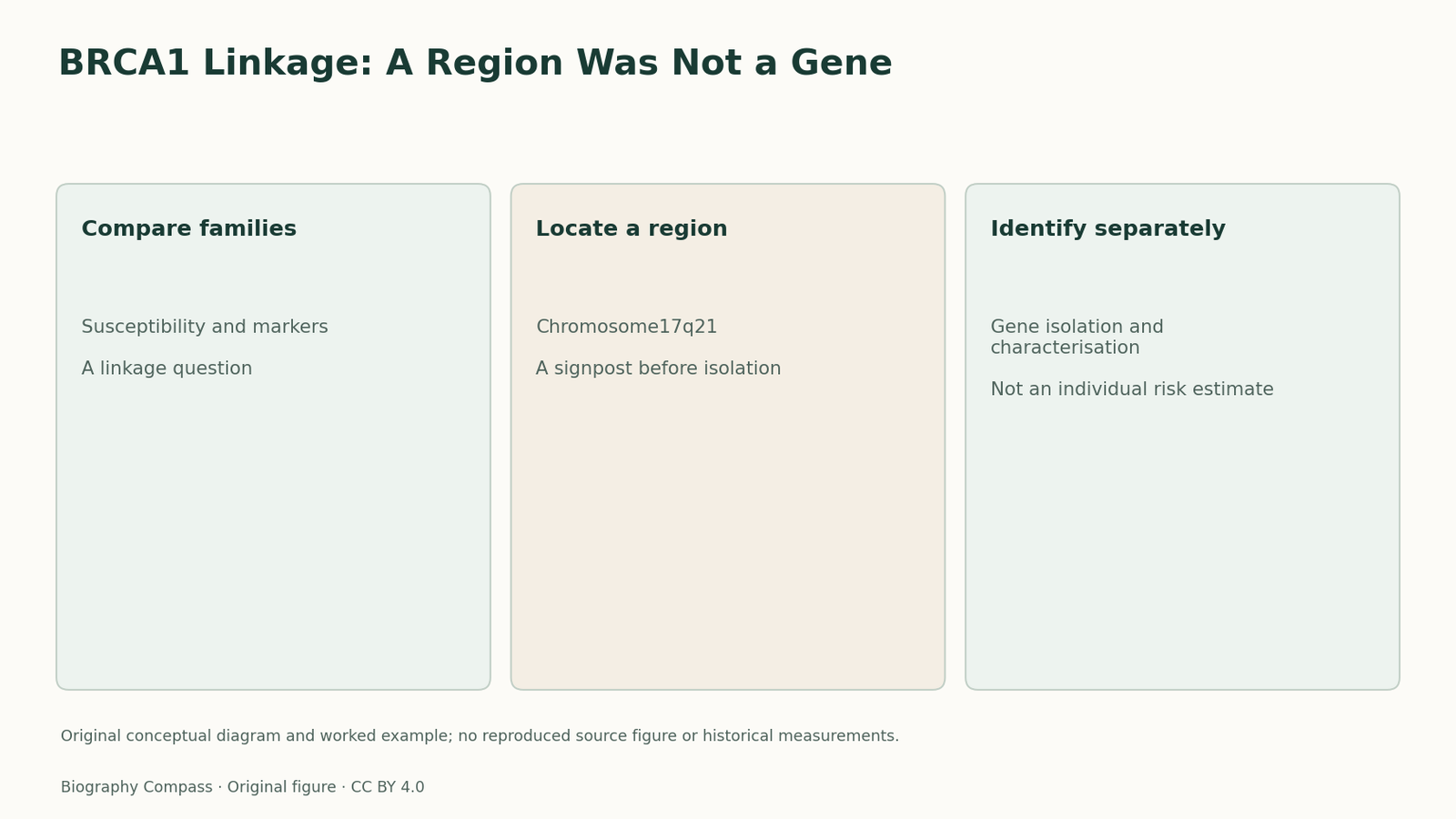
The 1990 study examined whether inherited breast-cancer susceptibility travelled with genetic markers in particular families. It reported evidence for linkage to a region on chromosome17q21 in early-onset families, while other family groups gave different evidence. The study’s achievement was therefore a statistically supported location for further investigation. It did not present an isolated BRCA1 DNA sequence or identify a single explanation for every case of breast cancer.
Sources for this section: [4]
A marker is a signpost, not the final identity
A linked marker can help locate inherited susceptibility because nearby genetic features tend to be transmitted together. The marker is not automatically the causal gene. King’s 1991 review described the chromosome region while efforts to isolate the gene remained under way. This contemporary distinction is particularly useful: it shows that the mapping result was already important even though the responsible molecular entity had not yet been fully identified. A region narrowed the search rather than completing every stage of it.
Sources for this section: [5]
Later isolation answered an additional question
The Lasker history distinguishes the 1990 regional finding from the gene’s isolation four years later. These stages produced different records: linkage evidence from families and a molecular identification that could support subsequent characterisation. Keeping them separate improves the account of scientific credit as well as the explanation of method. It allows King’s mapping contribution to be stated precisely without attributing every later cloning experiment to the same paper. The University of Washington bibliography similarly lists mapping and later confirmation studies as distinct publications. A precise history can recognise both achievements without assigning them the same endpoint.
An original likelihood exercise
Imagine a simplified mapping analysis in which one proposed linkage model fits the observations one thousand times as well as an unlinked model. Its base-ten log likelihood ratio is3. Does that mean a particular person has a one-in-one-thousand chance of disease, or that the gene has been sequenced? Neither follows. The number compares models for specified data; it is not an individual risk estimate or a molecular sequence. This fictional arithmetic example does not reproduce the 1990 study’s score or family data. Its supported answer separates statistical support for a location from two different endpoints: identifying the gene and estimating a person’s disease risk. The exercise also shows why an impressive number needs its underlying question stated.
Continue the chronology
Related history guides
The Worm Lineage: Map Versus Genome
Compare the 1983 C. elegans lineage map with the 1998 genome sequence, using a worked exercise on cell ancestry, DNA information and experiments.
Read the timeline1955Benzer’s rII Map: Recombination and Function
Read Benzer’s 1955 rII experiments through two questions: where mutations map and whether their genomes complement, with an original worked example.
Read the timelineBiography context
Explore United States through connected lives
Connected biographies
Researchers and related approaches
1946–
Mary-Claire King
Geneticist and human-rights researcherMary-Claire King combined mathematical training with human genetics, investigating inherited disease and helping families establish biological relationships.Read biography
1902–1992
Barbara McClintock
Cytogeneticist and maize researcherBarbara McClintock connected chromosome observation with the inheritance of visible traits in maize. Her long research career made mobile genetic elements central to genetics and shows why an experiment’s observations, interpretation and later recognition need separate histories.Read biographyQuick answers
Common questions
- Why was the 1990 result important before cloning?
- It supplied a region and evidence directing a difficult search toward a specific part of chromosome 17.
- Is a LOD score an individual disease probability?
- No. It is a logarithmic likelihood comparison used in linkage analysis, not a direct personal-risk percentage.
Primary and institutional sources
How this history was checked
The 1990 primary abstract and 1991 review preserve the mapping-before-isolation chronology. The worked example uses newly written arithmetic, not historical family data. This article was reviewed on 7 November 2026.
- University of Washington Division of Medical GeneticsMary-Claire King: biography and research
- Lemelson–MITMary-Claire King
- Lasker FoundationBreast cancer genetics and human rights
- Hall and colleagues, including Mary-Claire King / ScienceLinkage of early-onset familial breast cancer to chromosome17q21
- Mary-Claire King / Hospital PracticeLocalization of the early-onset breast cancer gene