
The short answer
The title African Socialism did not describe a plan to nationalise everything. The original paper made a more specific argument about growth, public control, African participation and how limited investment should be allocated.
Original comparison
What the paper proposed and what it could not prove
The same policy can have stated aims, proposed instruments and contested outcomes.
| Country | 1965 argument | Evidence needed to assess results |
|---|---|---|
| Ownership | Multiple forms; control need not require state title | Performance, access and distribution in actual enterprises |
| Africanisation | Skills, new investment and broadened participation | Who gained capital, training and durable opportunity |
| Regional investment | Higher net output can finance support elsewhere | Budgets, delivery and benefits in less favoured regions |
| Welfare | Expand services within revenue and staffing constraints | Access, quality and equity over time |
Chronology
A timeline of the turning points
Early development planning
Independence left major resource and skill constraints.
Sessional Paper No. 10
Government set out its approach to African Socialism and planning.
Ownership and control
The paper defended multiple forms of ownership under public guidance.
Regional priorities
Paragraphs 133–135 joined growth-first investment with welfare and redistribution claims.
TJRC assessment
The commission criticised the framework’s role in economic marginalisation.
Identify a government argument and its authorship
Sessional Paper No. 10 of 1965 was issued by the Republic of Kenya as African Socialism and Its Application to Planning in Kenya. The original scan opens with a presidential statement explaining that the government sought a common policy approach. Kenyatta thanks the minister for economic planning and development and his Cabinet colleagues, and records unanimous Cabinet support. Tom Mboya was a central minister and advocate; the Presidential Library identifies Mwai Kibaki as a contributor to the planning work. Those roles can be recognised without attributing an entire collective government paper to either man alone.
The objective was growth with a social purpose
The introductory objectives include political equality, social justice, dignity, freedom from deprivation, equal opportunities and rising incomes with equitable distribution. The paper treats capital, skilled people and public revenue as constraints on achieving them. It argues that a poor country must expand production and savings to finance development. That is a policy justification, rather than a demonstrated forecast. Readers should keep the document’s intended mechanism separate from later economic results. The stated aims help explain why social language accompanied market activity, foreign investment and the attempt to expand African participation in the monetary economy.
Sources for this section: [1]
Ownership and control were different instruments
The paper rejects the assumption that public control always requires public ownership. It envisages state enterprises, joint ventures, cooperatives, companies, partnerships and individual farms. It also proposes instruments such as taxation, regulation and price or wage controls. In its treatment of Africanisation, it warns that spending scarce funds only to buy existing assets changes ownership without necessarily creating new productive resources. Skills, finance and new investment therefore matter alongside transfer. This argument does not establish that every government intervention was efficient or equitable. It explains why the document cannot accurately be summarised as either unrestricted private capitalism or universal nationalisation. Its treatment of foreign investment also expects training and the employment of qualified Africans in management. Foreign capital is presented as supplementing scarce domestic resources, while regulation and social obligations are supposed to align it with national objectives. Those expectations are conditions of the argument, not recorded compliance results.
Sources for this section: [1]
Regional policy contained a crucial distributive assumption
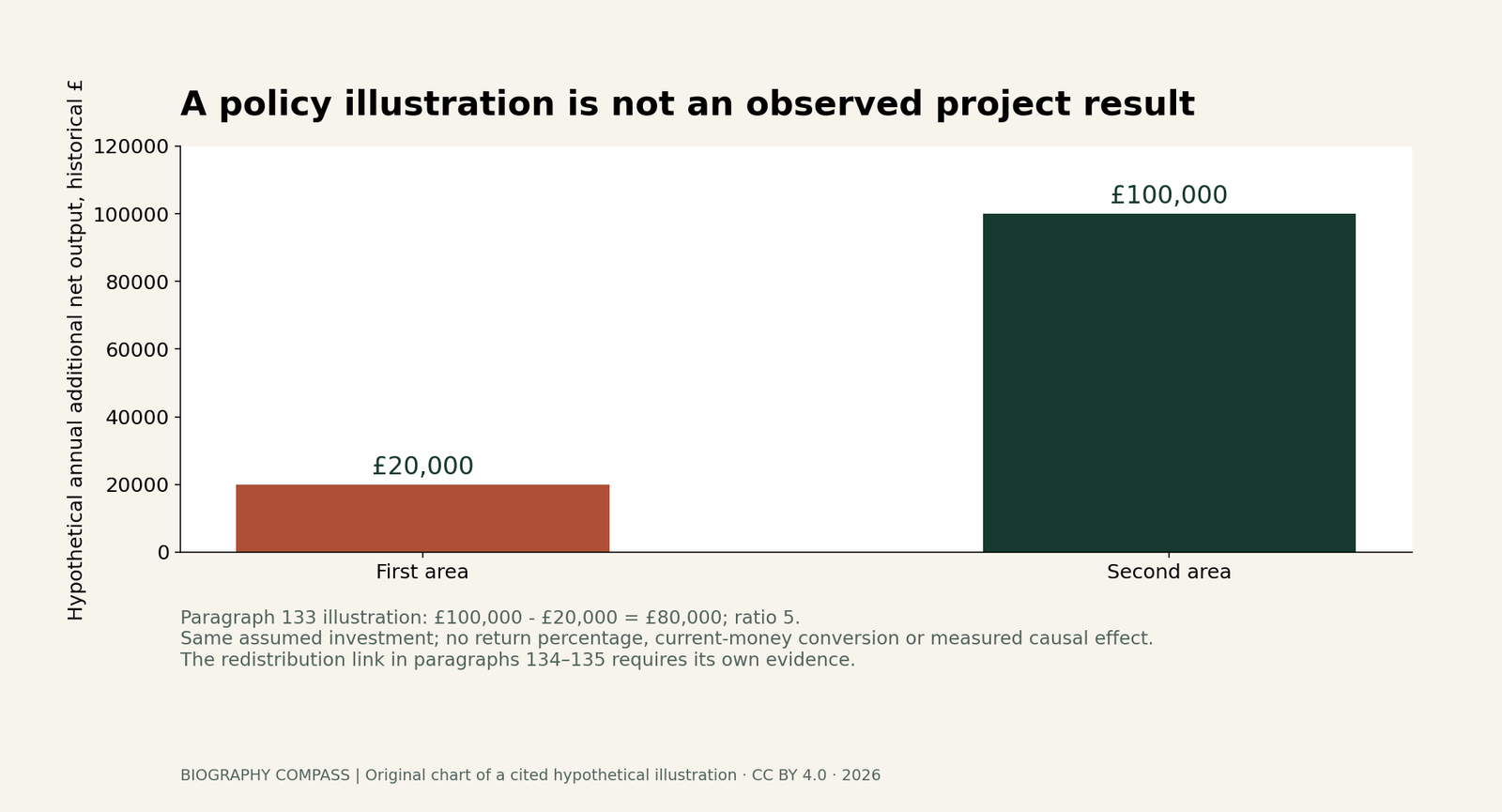
Paragraph 133 favours development investment where it produces the greatest increase in net output, identifying advantages such as rainfall, land, infrastructure and resources. It argues that a larger national surplus can then support less productive areas through grants or subsidised loans. Paragraphs 134–135 add education, health, mobility and minimum welfare provision, warning against treating poor and richer provinces on identical financial terms. An accurate reading must retain both parts. The proposal assumes that the growth gains and redistributive support will connect in practice. The text alone cannot show whether that connection occurred, who controlled allocations or which communities benefited.
Sources for this section: [1]
Later inquiry tested the policy’s distributive consequences
The TJRC’s 2013 economic marginalisation report criticised the priority given to areas labelled high potential. It drew attention to the narrow agricultural conception of potential and the neglect experienced in pastoralist and other regions. The commission also warned that benefits were uneven within favoured regions: describing a whole province as a beneficiary could hide excluded groups. These are the commission’s findings and interpretations, distinct from the intentions announced in 1965. The Presidential Library’s Kibaki account likewise acknowledges the subsequent efficiency-versus-equity debate. The guide does not infer a precise share of later inequality caused by one paper from those assessments.
Worked exercise: a larger output is not a distribution result
Paragraph 133 illustrates two uses of the same investment: annual additional net output of £20,000 in one area or £100,000 in another. The original calculation is £100,000 minus £20,000, or £80,000 more annual output. The second is five times the first; neither figure describes an actual named district or observed project. Ask whether that proves residents of the first area become better off. The reference answer is no: a redistributive mechanism, its implementation and evidence of benefits are still needed. Reading paragraphs 134–135 identifies the proposed channels, while the TJRC supplies a later critical assessment rather than confirming the hypothetical example as a measured outcome.
Continue the chronology
Related history guides
Connected biographies
People connected with this policy
1930–1969
Tom Mboya
Trade union organiser, nationalist and economic planning ministerTom Mboya rose through Kenya’s labour movement, built international links and helped organise overseas education for African students. He became a Cabinet minister and a leading advocate of Kenya’s economic policy before his assassination in 1969.Read biography
1931–2022
Mwai Kibaki
Economist, finance minister and Kenya’s third presidentMwai Kibaki moved from university economics into KANU, Cabinet and opposition politics before winning the presidency in 2002. His administration expanded primary education and later governed through a coalition after the disputed 2007 election.Read biography
c. 1894–1978
Jomo Kenyatta
Nationalist leader, prime minister and Kenya’s first presidentJomo Kenyatta emerged from colonial imprisonment to lead KANU, became prime minister in 1963 and president in 1964. His government combined nation building with growing central control and repression of opposition.Read biographyQuick answers
Common questions
- Was the paper written by Mboya alone?
- No. He was a central minister and advocate, but the presidential introduction credits Cabinet colleagues and collective approval.
- Did it demand nationalisation of all enterprises?
- No. It proposed several ownership forms and multiple public-control instruments.
- Is the £80,000 example an observed result?
- No. It is the difference within a hypothetical illustration in paragraph 133.
Primary and institutional sources
How this history was checked
Original records anchor the chronology and policy explanation. The comparison, calculation and evidence exercise are original reader aids; the source notes explain limits. This article was reviewed on 27 October 2026.
- Republic of Kenya; Parliament of Kenya Library repositorySessional Paper No. 10 of 1965: African Socialism and Its Application to Planning in Kenya, original scan
- Kenya Presidential Library and ArchivingHE Emilio Mwai Kibaki: institutional biography
- Truth, Justice and Reconciliation Commission, Kenya; CSVR historical report collectionFinal Report, Volume IIB, 2013: economic marginalisation