In this biography
Quick facts
- Born
- c. 1894; exact date uncertain
- Birthplace
- Not established precisely in the reviewed records
- Country
- Kenya
- Nationality
- Not independently established
- Known for
- KANU leadership, independence and Kenya’s early presidency
- Born
- Approximately 1894; exact date uncertain
- LSE study
- Anthropology in the 1930s; an earned doctorate is not established
- Prime minister
- 1963–1964
- President
- 12 December 1964–22 August 1978
Why this life matters
His career links anticolonial mobilisation and constitutional negotiation with the difficult record of power, land, dissent and state violence after independence.
Timeline
Key moments
Anthropology at LSE
Studied with Bronisław Malinowski; Facing Mount Kenya appeared in 1938.
Colonial imprisonment process
Arrested with the leaders commemorated as the Kapenguria Six.
Released from restrictions
Returned to open political leadership.
Prime minister
Led KANU into self-government and December independence.
Republican president
The presidency began on 12 December.
Opposition break
Oginga Odinga left and formed KPU.
Kisumu violence
The TJRC later documented security-force killings and subsequent repression.
Death in office
Died on 22 August.
An uncertain birth date, a documented intellectual career
Jomo Kenyatta’s birth is generally placed around 1894; the LSE identifies him with an approximate date rather than a verified birthday. In London during the 1930s he studied social anthropology under Bronisław Malinowski. His research became Facing Mount Kenya in 1938, bringing an African author’s account of Kikuyu society into a discipline closely connected with empire. LSE’s historical work describes him as a doctoral student; that is not confirmation of a completed doctorate. Its institutional register also lists ADA 1936. The distinction between study, a recorded award and an earned PhD should remain visible.
Colonial imprisonment made him a symbol
Kenyatta’s anticolonial prominence preceded his executive offices. National Museums of Kenya commemorates him alongside Bildad Kaggia, Paul Ngei, Achieng Oneko, Fred Kubai and Kungu Karumba as the Kapenguria Six, detained during the colonial emergency beginning in 1952. The case and imprisonment helped make his release a central demand of nationalist politics. They do not establish that he personally directed every part of the Mau Mau insurgency. Accounts of independence must include fighters, organisers, trade unionists, women, other detainees and negotiators whose actions cannot be reduced to one imprisoned leader’s story.
KANU’s victory and self-government
After release in 1961 Kenyatta assumed leadership of the Kenya African National Union, or KANU. The 1963 elections prepared the way for internal self-government on 1 June. His party’s major rival, KADU, favoured entrenched regional safeguards, while KANU sought stronger central authority. Constitutional negotiations and electoral organisation involved such figures as Oginga Odinga, Tom Mboya, James Gichuru and Ronald Ngala. The House of Commons debate on the Independence Bill describes the transition from the June constitution to the independence settlement. It records a process of negotiation involving government and opposition, rather than a single personal declaration.
Prime minister and president were successive roles
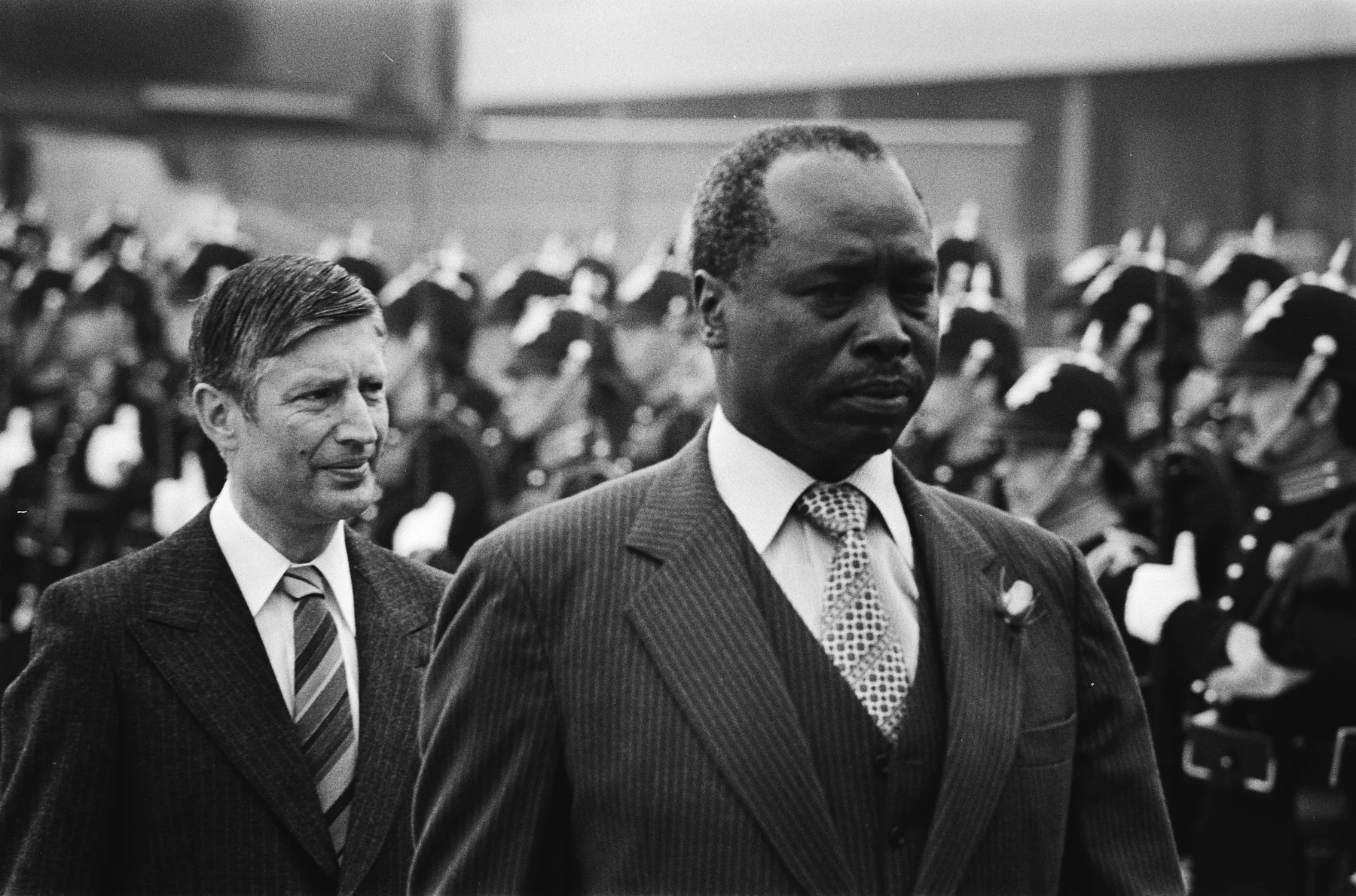
On 12 December 1963 Kenya became independent with Kenyatta as prime minister. The Independence Order retained the Queen and a governor-general, alongside a Cabinet and parliamentary institutions. Kenyatta was therefore not yet president on independence day. Kenya became a republic on 12 December 1964 and he became its first president. This distinction changes how his power is described: the parliamentary independence settlement and the later republican executive were different arrangements. The transition also took place within a society still shaped by colonial landholding, coercive laws and unequal access to political and economic resources.
Opposition and state violence qualify the founding narrative
Kenyatta’s authority grew as opposition space contracted. Odinga left the government and KANU in 1966 and formed the Kenya People’s Union. The Truth, Justice and Reconciliation Commission’s 2013 report describes the administration’s retention of repressive colonial laws and increasing intolerance of dissent. Its account of the 25 October 1969 Kisumu hospital opening records shootings by presidential security and the subsequent detention of Odinga and other opponents without trial, together with the banning of KPU. These are commission findings about state conduct. They should not be converted into an unsupported claim that a court found Kenyatta personally ordered a particular shooting or assassination.
A long presidency with a contested inheritance
Kenyatta died in office on 22 August 1978. Kenya’s Presidential Library preserves that date and a collection documenting the funeral and succession. His presidency left institutions, a powerful nationalist symbolism and a centralised political system. LSE’s anthropology account also draws attention to unequal gains from economic development and the concentration of wealth, while the TJRC insists that independence be examined through the experiences of people excluded or harmed by state power. A useful assessment holds these records together: his place in dismantling colonial rule is substantial, and the record of the government he subsequently led requires its own scrutiny.
Quick answers
Frequently asked questions about Jomo Kenyatta
- Was Kenyatta president in 1963?
- He was prime minister at independence in December 1963 and became president when Kenya became a republic on 12 December 1964.
- Did he complete a PhD at LSE?
- The reviewed LSE accounts establish doctoral study, not a completed PhD.
- Did he alone secure independence?
- No. Independence involved mass resistance, party organisation, elections and constitutional negotiations involving many people.
Keep exploring
Lives connected to this story
- Oginga Odinga
Follow a nationalist ally who became vice-president and later a detained opposition leader.
- Daniel arap Moi
Read the vice-president who succeeded him in 1978.
- Tom Mboya
Explore a minister’s labour organisation, student airlifts and economic planning.
- Ronald Ngala
Read the rival KADU leader’s regional arguments, negotiations and later Cabinet service.
- Uhuru Kenyatta
Compare the founding president with his son’s route through multiparty elections and the 2010 constitutional presidency.
- Dedan Kimathi
Compare a forest resistance leader’s weapons prosecution with a different anticolonial career and trial.
- Achieng Oneko
Read another Kapenguria defendant whose successful appeal had a different outcome from executive detention.
Sources and further reading
Explore the evidence
These references support the biography and offer further reading. Official records, first-person accounts and independent reporting provide different perspectives; image records document attribution and licensing.
- 1. London School of Economics and Political ScienceWorld leaders who studied or taught at LSE
Institutional register read: c.1894, ADA 1936 and presidency 1964–1978. No invented precise birthday or earned doctorate.
- 2. LSE History / LSE archives researchLSE Anthropology: the colonial project, 13 November 2024
- 3. LSE Department of AnthropologyAncestors, October 2025: Jomo Kenyatta entry
Relevant Kenyatta entry actually read via indexed institutional text. The complete large PDF was not successfully opened in the web reader; no full-volume reading is claimed.
- 4. National Museums of KenyaKapenguria Museum
- 5. UK House of Commons, HansardKenya Independence Bill, 22 November 1963, second reading
Actual contemporary ministerial speech and surrounding constitutional chronology read; historical official statements are evidence of the negotiation and speakers’ positions, not neutral proof of every political claim.
- 6. UK House of Commons, HansardKenya (Independence), 2 July 1963
- 7. Kenya Yearbook Editorial BoardOginga Odinga, Doyen of opposition politics
- 8. UK Government / The National ArchivesKenya Independence Order in Council 1963, SI 1963/1968, historical text
- 9. Truth, Justice and Reconciliation Commission of KenyaFinal Report, Volume IIA, 2013, especially chapter 1, paragraphs 52–70
Full original report mirror acquired; relevant chapter 1 passages read in extracted text. Commission account is attributed and no individual criminal judgment is inferred.
- 10. Kenya Online Presidential Library and ArchivingDeath of Kenyatta (1978)