
The short answer
When does a quantity divided by a rate tell us an age? Compare Joly’s published explanation with a contemporary objection and a later historical assessment, then test how starting conditions and losses change a deliberately invented reservoir calculation.
Original source comparison
Which claim is each record able to support?
Keep a historical proposal distinct from a numerical check and a later evaluation.
| Country | What the evidence supports | What it does not establish |
|---|---|---|
| Departmental biography | Identifies the 1899 method and career context. | The full original paper has been independently audited. |
| Joly’s later essay | Shows his numerical argument and stated assumptions. | A current measured flux or accepted Earth age. |
| Hunt 1901 abstract | Documents a contemporary objection about a pathway. | An independently quantified correction to every input. |
| Historical study 2001 | Places adoption and rejection within the wider debate. | A new physical experiment or modern dating result. |
| Invented reservoir ledger | Demonstrates sensitivity to starting stock and output. | A reconstruction of the ocean’s actual history. |
Chronology
A timeline of the turning points
Sodium estimate
Joly presents the method associated with his geological-time work.
Published objection
Hunt’s article raises a question about seawater pathways.
Participant explanation
Joly sets out a stock-rate calculation and defends its assumptions.
Historical study
Wyse Jackson assesses the changing age-of-Earth debate.
Separate the original paper from later accounts
Trinity’s short download filename for the age-of-Earth study can be misleading: the acquired scan is Patrick Wyse Jackson’s 2001 historical article, not Joly’s 1899 paper. The original contribution is also described in the departmental biography. For a participant’s explanation this guide uses selected sodium-method paragraphs from Joly’s later Birth-Time essay, available in a public-domain transcription. The layers are kept distinct. We have not acquired and audited the complete 1899 paper. The purpose is to examine the structure of the argument and its limitations, not to claim a newly reconstructed original dataset.
The stock-and-rate argument had identifiable assumptions
Joly treated sodium in the ocean as an accumulated stock and the river contribution as a rate that could be estimated. Dividing a stock by a rate produces a time unit, but the physical interpretation needs more. What was the initial stock? How much material left the reservoir? Did the rate remain similar through the period? His later essay strongly defended approximate retention of sodium and the usefulness of existing rates. Those are historical premises to evaluate, not modern facts adopted by this guide. A correct division cannot establish the truth of every premise that made the division seem appropriate.
Read the later numerical example in its own setting
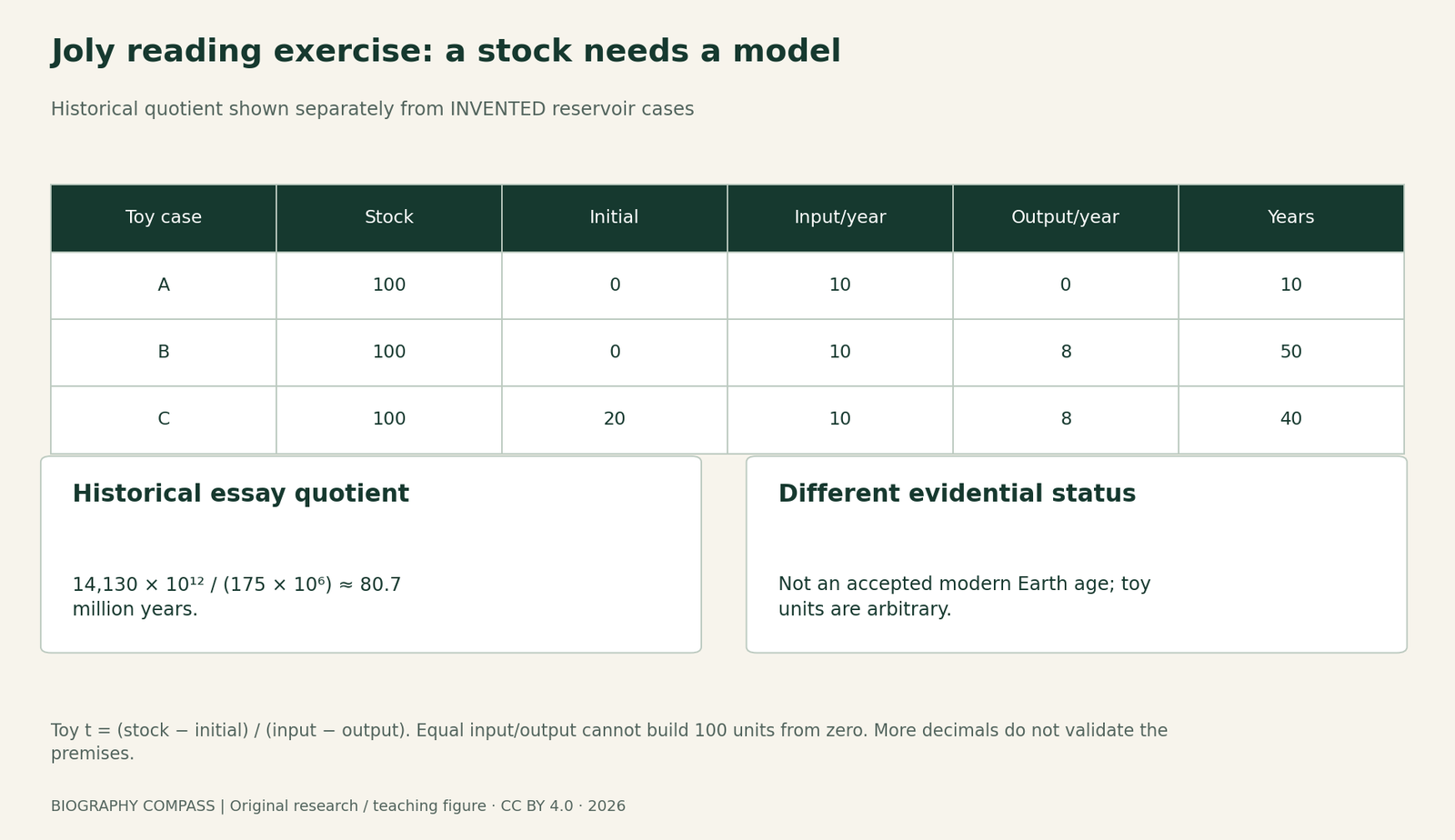
The selected essay gives 14,130 million million tonnes of oceanic sodium and approximately 175 million tonnes supplied annually. Their quotient is about 80.7 million years before the corrections discussed in the text. These are Joly’s historical figures in that later presentation, not newly measured values or necessarily an exact transcription of every 1899 input. Other estimates and corrections appear in his discussion. The guide does not select one confident sentence as a final solution. A reader should keep the edition, units, unadjusted result and subsequent modifications together rather than attach a single timeless number to the scientist’s name.
Sources for this section: [1]
A contemporary objection and a later history ask different questions
Arthur Hunt’s 1901 publisher extract questions whether absorption of seawater by surface rocks was sufficiently considered. This guide inspected that abstract and its publication metadata, not the complete article behind the PDF-labelled link. It records a contemporary concern about material pathways; it does not independently quantify their effect. Wyse Jackson’s later study explains how the sodium method challenged other age estimates and was superseded, while noting Joly’s reluctance to accept larger radiometric ages. An objection, a participant’s reply and a historian’s retrospective assessment are different kinds of evidence, all useful when their scope is clear.
Exercise: compare a closed-input clock with a reservoir that loses material
Use arbitrary units and an invented constant-rate model. The current stockM is 100, the starting stockM₀ is 0 and annual input I is 10. First assume no output and calculate elapsed time using t=(M−M₀)/(I−O). Then set annual output Oto 8 and calculate again. In a third case retain input 10 and output 8 but start atM₀=20. What happens if input and output are both 10 while the model still starts at 0 and must reach 100? All rates are stipulated. None is a measured sodium flux or a proposed age of the Earth.
Reference answer: the same current stock can accompany different ages
With no output, t=100/10=10 years. With output 8, net accumulation is 2 per year and t=100/2=50 years. Starting at 20 instead gives(100−20)/2=40 years. Equal constant input and output give zero net accumulation; starting from 0, this model never reaches 100 in a finite time. The last case does not prove that a real reservoir has no age. It shows that the specified model cannot generate the specified state. If a system begins with a nonzero stock at steady state, its present stock and gross flow alone do not reveal how long it has existed.
A second check keeps arithmetic precision separate from evidence
For the historical quotient, write 14,130 million million as 14,130×10¹² tonnes and 175 million as 175×10⁶tonnes per year. Division gives approximately 80.742857 million years. Rounding to 80.7 is arithmetically consistent with the selected text. Reporting more digits would not justify greater confidence in the inputs, retention assumptions or rate history. The invented reservoir cases show why: changing a structural assumption can shift an answer far more than a decimal-place change. The teaching figure therefore labels the historical quotient separately from the invented ledger. Neither is offered as an accepted modern estimate of geological time.
Sources for this section: [1]
Use an unsuccessful clock to ask a better research question
Joly’s work remains useful for learning because its reasoning can be followed and challenged. A stronger investigation would seek independent constraints on initial conditions, pathways in and out and changes in rates, rather than simply reuse the same division with a more precise calculator. The biography places this debate beside his instruments and collaborations, which were not all successful or unsuccessful for the same reasons. Scientific value can include making an important question more testable even when a proposed answer is later rejected. The source comparison below preserves that distinction without treating historical confidence as current consensus.
Continue the chronology
Related history guides
Boyle’s Air Experiments: Pressure, Volume and What a Table Measures
Compare another research record, its measurement assumptions and limits.
Read the timeline1805–1838The Beaufort Scale: Diary Versions, Naval Logs and Later Tables
Compare another research record, its measurement assumptions and limits.
Read the timelineConnected biographies
People behind the work
1857–1933
John Joly
Physicist, geologist and instrument inventorJohn Joly worked across physics, geology and photographic technology at Trinity College Dublin. His attempts to estimate geological time through ocean chemistry are historically important precisely because their measurements, assumptions and later limitations can be examined separately.Read biographyQuick answers
Common questions
- Is 80.7 million years the accepted age of the Earth?
- No. Here it is a historical unadjusted quotient from Joly’s later explanation, explicitly separated from modern conclusions.
- Does dividing a stock by a rate always reveal an age?
- No. Initial stock, losses, recycling and rate history can change or undermine that interpretation.
Primary and institutional sources
How this history was checked
The article distinguishes original records, catalogue descriptions and later interpretations. Comparisons, exercises and reference answers are original editorial work. This article was reviewed on 27 October 2026.
- John Joly; Project Gutenberg transcription of historical bookThe Birth-Time of the World and Other Scientific Essays: selected first-essay text
- Patrick N. Wyse Jackson; Geological Society, London Special Publications 190; TCD hosted scanJohn Joly(1857–1933) and his determinations of the age of the Earth,2001,107–119
- Trinity College Dublin Department of GeologyJohn Joly: departmental biography
- Arthur R. Hunt; Geological MagazineThe Age of the Earth and the Sodium of the Sea,March 1901,125–128: publisher extract
- Patrick N. Wyse Jackson; Trinity College Dublin hosted copyJohn Joly: Irish Rock Stars,2007 biographical article