
The short answer
What does a force number in an old ship’s log mean? Compare the early diary, later naval instructions and institutional explanations before treating different versions of the Beaufort scale as interchangeable measurements.
Original source comparison
What does each record prove?
Version and purpose matter before a number can be interpreted.
| Country | What the evidence supports | What it does not establish |
|---|---|---|
| Private diary | A particular recorded scheme and observation practice. | Immediate use by every ship in the navy. |
| Revised categories | The numbering and criteria changed. | An exact universal conversion from every early entry. |
| Ship-performance criterion | A vessel’s behaviour under specified conditions. | Automatically the speed of the air itself. |
| Admiralty memorandum | An instruction about columns and reporting frequency. | A complete audit of compliance or instrument quality. |
| Fictional recoding | Shows how merging labels can discard information. | A recovered historical concordance or weather forecast. |
Chronology
A timeline of the turning points
Formulation
The Met Office dates the early scheme to Beaufort’s Woolwich command.
Private diary
The reproduced page records the early numbering and weather notation.
Revision
A changed scheme and sailing criteria develop.
Admiralty order
The memorandum specifies regular log entries.
An early notation and a service-wide standard have different dates
The Met Office factsheet distinguishes formulation in 1805, a dated private entry in January 1806, revision in 1807 and an Admiralty memorandum in December 1838. These are stages in a record-making system. The diary establishes what one observer wrote; an order establishes what a service expected its officers to record. Neither date alone describes all later practice. The guide uses selected factsheet pages and the reproduced diary page, together with the archive overview and biographical account. It does not claim to have inspected every original log or the complete sequence of surviving diaries.
Check the endpoints as well as the category names
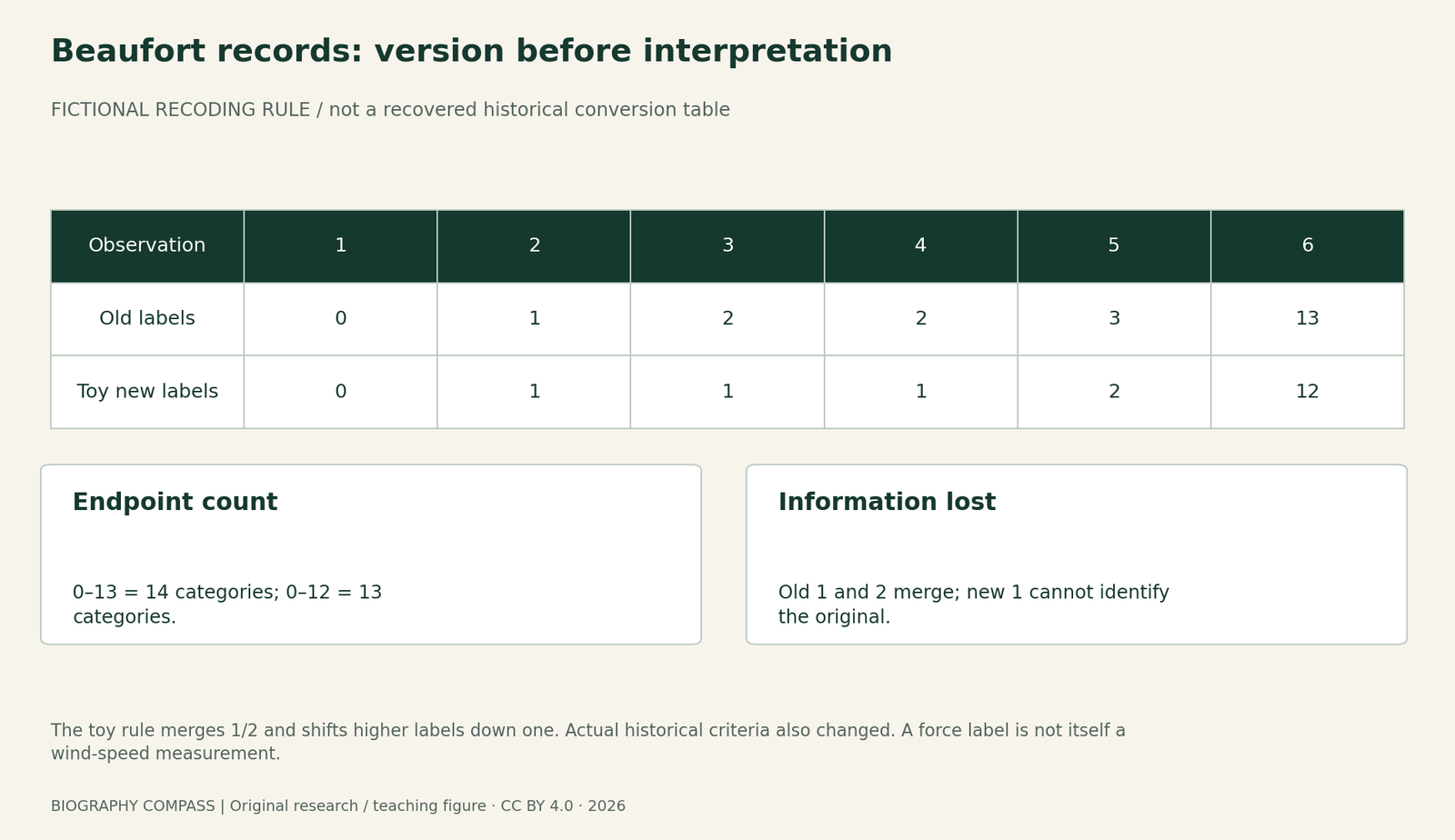
The early reproduced scale is numbered 0 through 13. That is fourteen numbered categories, because zero counts as a category too. The later 0 through 12 version has thirteen. The factsheet explains a revision combining categories and changing the scheme. This is a small but revealing trap: an article can call a scale thirteen-point while silently counting only its highest numeral. A responsible transcription should retain the version and the original label. It should not silently replace an early term with the word found next to the same number in a later table.
Sources for this section: [1]
A ship’s performance criterion is not a direct wind-speed reading
The later naval table describes what a specified ship could do or what canvas it could carry. Under its lower-force criteria, a number of knots can refer to the vessel’s progress under stated conditions. It is therefore a mistake to read every appearance of knots as a modern atmospheric wind speed. Hull, rig, sea conditions and the wording of the criterion are part of its meaning. The example shows why a unit alone is insufficient: a velocity still needs its object. Later wind-speed equivalents belong to another stage in the system’s development.
Sources for this section: [1]
The 1838 memorandum made observation a routine
The reproduced Admiralty memorandum directs hourly entries for wind force and atmospheric appearance in designated columns. Instrument readings were also to be entered when instruments were available. This is more than an announcement of a clever scale. It connects a classification scheme to a frequency of observation, a record format and an organisation. A log could then support comparison across time and ships, subject to actual compliance and observer judgement. An order to record hourly is not proof that every ship produced a complete, accurate observation at every scheduled hour.
Sources for this section: [1]
Exercise: test an explicitly fictional recoding rule
This is a bookkeeping exercise, not a complete historical conversion table. Suppose an old scheme runs 0–13 and a new scheme runs 0–12. For this exercise only, merge old 1 and 2 into new 1, keep 0, and reduce every old number 3 or higher by 1. Apply the rule to 0,1,2,2,3,13. How many categories does each scheme contain? Which different original observations become indistinguishable after recoding? Can a new 1 be uniquely converted back? Finally explain why adding the recorded force numbers cannot by itself produce a total wind speed.
Sources for this section: [1]
Reference answer: recoding can lose information
The schemes contain 14 and 13 numbered categories. The recoded list is 0,1,1,1,2,12. Old 1 and 2 both become new 1, so the original value cannot be recovered uniquely from that recoded number. The exercise illustrates information loss; it does not establish a complete correspondence between every historical label. Adding category numbers supplies a sum of labels, not a physical wind speed. Nor does force 6 mean twice the physical speed or pressure of force 3. To investigate a real early log, preserve its original entry and consult the applicable version rather than overwrite it with a convenient modern number.
Sources for this section: [1]
Design a record that preserves what a later reader needs
A useful research worksheet would include observation date, ship, observer when known, original force, original wording, scale version and any separate instrument reading. Add a field for missing or uncertain information. If a later interpretation is supplied, keep it in another field with its source and rule. That is preferable to replacing the original because future research may show that the conversion assumed the wrong criterion. The same principle applies outside meteorology: preserving the initial observation and the transformation separately makes an analysis easier to examine and revise. This proposed worksheet is new editorial material, not a discovered naval form.
Standardisation had predecessors and continuing limits
The factsheet documents wind classifications before Beaufort and later changes after his early diary. His importance lies partly in refinement, adoption and a sustained culture of recording. It need not be supported by a first-ever claim. The biography links this work with his hydrographic responsibilities while acknowledging the British naval setting. The comparison below separates a private entry, an institutional requirement and a later explanatory table. This is a history and source-reading exercise, not a current weather forecast or a guide for deciding whether a voyage is safe.
Continue the chronology
Related history guides
Boyle’s Air Experiments: Pressure, Volume and What a Table Measures
Compare another research record, its measurement assumptions and limits.
Read the timeline1899–early twentieth centuryJohn Joly’s Sodium Clock: Inputs, Recycling and Geological Time
Compare another research record, its measurement assumptions and limits.
Read the timelineConnected biographies
People behind the work
1774–1857
Francis Beaufort
Hydrographer, naval officer and weather observerFrancis Beaufort was an Irish-born naval officer whose surveying and administrative work helped standardise the recording of seas and weather. His wind-force scale developed through several versions before wider naval adoption, rather than appearing at once as a modern wind-speed table.Read biographyQuick answers
Common questions
- Does 0 to 13 mean thirteen numbered categories?
- No. Including zero gives fourteen. The later 0 to 12 version gives thirteen.
- Should an early log be rewritten using a modern scale?
- Preserve the original first. Any later conversion needs its own explicit version, rule and uncertainty.
Primary and institutional sources
How this history was checked
The article distinguishes original records, catalogue descriptions and later interpretations. Comparisons, exercises and reference answers are original editorial work. This article was reviewed on 27 October 2026.