
The short answer
Why does a pressure reading need a reference point? Read selected evidence from Boyle’s 1662 defence alongside institutional histories, then use a declared ideal example to distinguish atmospheric pressure, added pressure and a pressure–volume relationship.
Original source comparison
Which quantity is the record actually describing?
A value needs its measurement reference and experimental role.
| Country | What the evidence supports | What it does not establish |
|---|---|---|
| Air-pump response | An effect under changed surrounding conditions. | One universal explanation of every gas property. |
| Added mercury contribution | One component of the pressure accounting. | Automatically the total pressure on enclosed air. |
| Aggregate pressure | Includes the atmospheric contribution. | Proof that temperature and gas quantity were controlled. |
| Reciprocal hypothesis | A relationship compared with observations. | A reason to discard inconvenient readings without investigation. |
| Synthetic P×V ledger | Checks a stated ideal relationship. | A newly validated transcription of the 1662 table. |
Chronology
A timeline of the turning points
Air-pump publication
New Experiments presents a programme of pneumatic investigations.
Published defence
Boyle responds to objections and presents further quantitative discussion.
Modern notation
The worksheet uses specified absolute and gauge pressures, not historical table values.
Identify which publication and experiment you are reading
Boyle’s 1660 air-pump investigations and his 1662 defence are connected, but they are not one undated event. Wellcome’s catalogue identifies the latter as a response to Franciscus Linus. The archive item supplies a microfilm scan and OCR. This guide reads selected OCR passages and the museum and research-project accounts; it does not claim a complete visual transcription of the book or its numerical tables. That distinction matters because the OCR is visibly unreliable in places. A modern formula should not be smuggled into a historical table and then presented as though every printed number had been checked.
Changing the surroundings and compressing a parcel are different tests
An air pump can change the air surrounding an object and make its response observable. The selected 1662 discussion also describes air retained in a tube and compressed by mercury. These arrangements answer related questions about air, but the instruments and comparisons differ. Before interpreting either, ask what quantity of air remains, what moves, and what reading is being taken. A surviving account can describe a convincing effect without being a modern laboratory report. The point of distinguishing the setups is to understand the inference, rather than choose one famous image to stand for all of Boyle’s work.
Read the column definitions before calculating a relationship
The selected compression-table explanation identifies the mercury-height contribution, an atmospheric-pressure equivalent and their aggregate. The author then compares the result with a reciprocal hypothesis. These are not five interchangeable observations of one quantity. An instrument reading relative to the surroundings differs from total pressure on the enclosed air. The new worksheet translates that distinction into modern, specified units without copying the historical numbers. This preserves a useful idea from the record while avoiding the pretence that a poor microfilm OCR is a sufficiently accurate source for a fresh fit to the original experiment.
Sources for this section: [1]
State the conditions of the teaching model
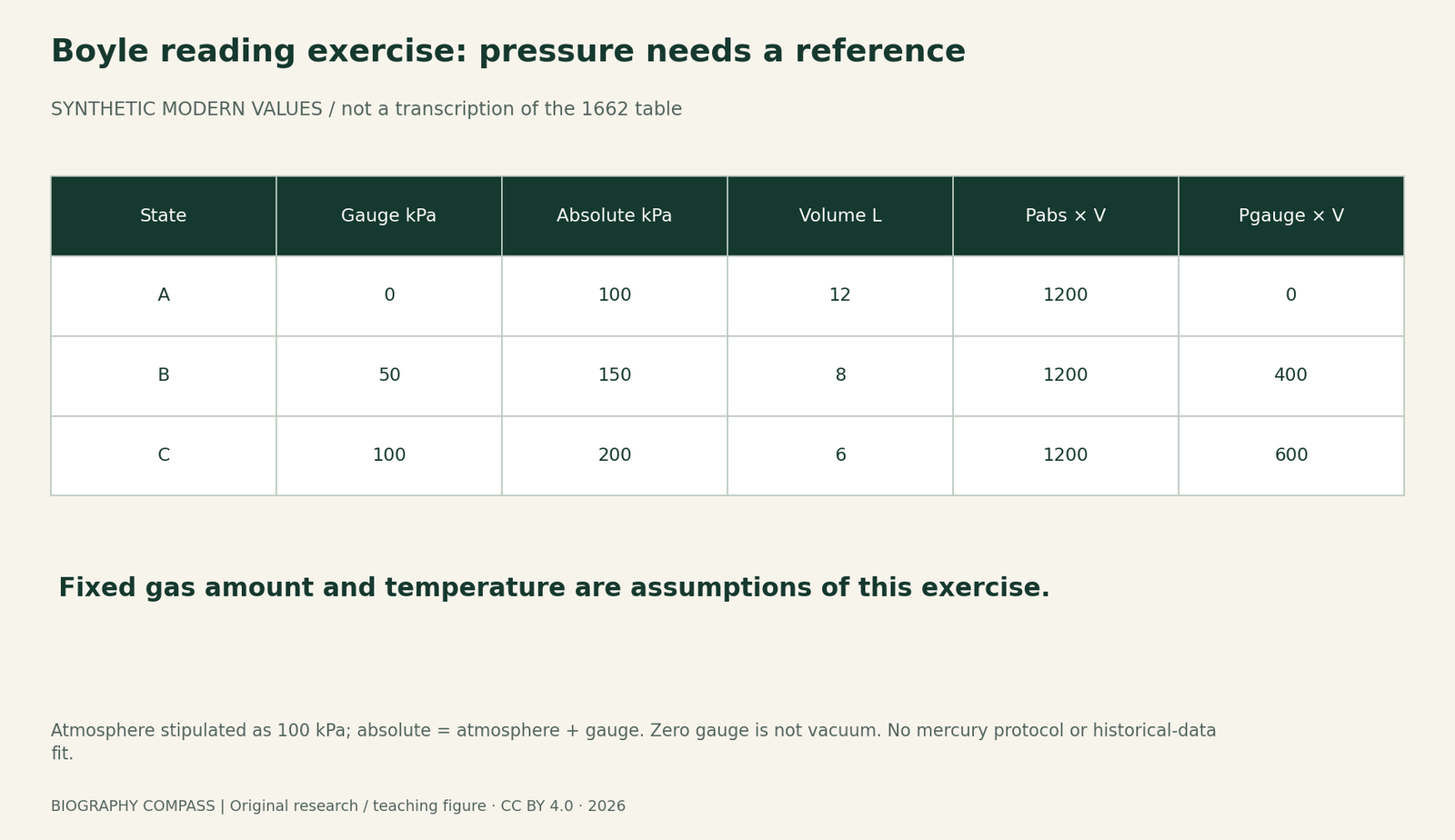
For this exercise only, assume a fixed amount of gas at constant temperature and use P×V=constant. Let atmospheric pressure be 100 kPa. Define gauge pressure as the additional pressure above that atmosphere, so absolute pressure equals 100 plus the gauge reading. These are chosen teaching conditions, not reconstructed seventeenth-century weather observations. The formula does not license changing temperature or allowing gas to escape while pretending the same constant must remain. It also does not make zero gauge pressure a vacuum: in this setup zero gauge still leaves the gas under 100 kPa absolute pressure.
Exercise: complete a three-state pressure ledger
State A has volume 12 litres and gauge pressure 0 kPa. State B has gauge pressure 50 kPa. State C has gauge pressure 100 kPa. Calculate the absolute pressure in each state, then the volumes in B andC and the three absolute-pressure–volume products. Next calculate the three products using gauge pressure instead. Do both sets give a constant? Finally decide whether any row shows a vacuum, whether the volumes alone prove that temperature was controlled in a real experiment, and what observation would be needed to establish that the amount of gas remained fixed.
Reference answer: the reference point changes the arithmetic
Absolute pressures are 100,150 and 200 kPa. The initial product is 100×12=1,200 kPa-litres, soB has volume 8 litres andC 6 litres. All three absolute products equal 1,200. The gauge products are 0,400 and 600, which are not constant. No row represents a vacuum. The worksheet stipulates a constant temperature and gas quantity; its arithmetic does not independently verify either condition in an actual apparatus. A real investigation would need evidence about temperature, sealing and measurement, not just three convenient numbers. This is an original ideal example, not a transcription of Boyle’s table or a new experiment.
An explanation should remain open to a discriminating test
Boyle’s published defence addresses an alternative account of the observed effects, rather than presenting experiment as a list of facts without disagreement. Birkbeck’s project places his work in an experimental and religious intellectual setting; the museum explains the later significance of the pressure–volume relation. Those perspectives differ from the words of the original controversy. A useful extension question is to propose an observation that two explanations predict differently. The answer should say what would be measured and which alternatives it discriminates, rather than assume that repeating a familiar name has already resolved the argument.
Credit and uncertainty belong in the same reading
Hooke’s instrument work and the wider Oxford community belong beside Boyle’s publications. The selected original discussion also names Townely in connection with a hypothesis, a reminder that the printed author was in conversation with others. This guide has not inspected every source needed to reconstruct that full priority history. Its narrower contribution is an auditable reading method: label the apparatus, the pressure reference, the model conditions and the source scope. The comparison and reference answers make those distinctions usable without turning the article into a procedure for handling mercury or building a pressure vessel.
Continue the chronology
Related history guides
The Beaufort Scale: Diary Versions, Naval Logs and Later Tables
Compare another research record, its measurement assumptions and limits.
Read the timeline1899–early twentieth centuryJohn Joly’s Sodium Clock: Inputs, Recycling and Geological Time
Compare another research record, its measurement assumptions and limits.
Read the timelineConnected biographies
People behind the work
1627–1691
Robert Boyle
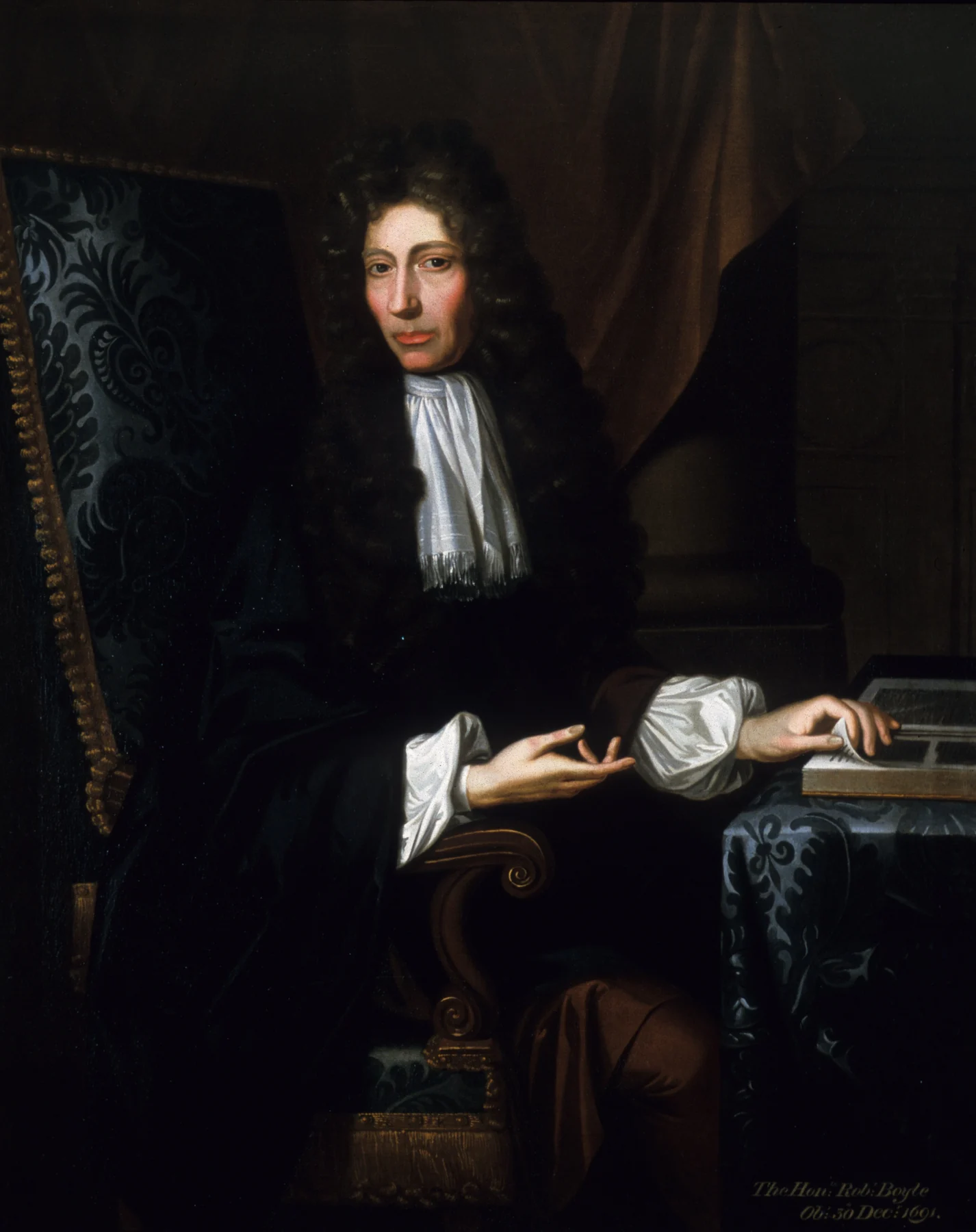
Natural philosopher and experimental researcherRobert Boyle investigated air, chemical change and the practice of experimental inquiry. Born into a wealthy family in Ireland, he worked chiefly in England, where assistants, instruments and an emerging scientific community helped turn observations into claims that others could examine.Read biographyQuick answers
Common questions
- Are the worksheet values Boyle’s original measurements?
- No. All three states use specified teaching values in modern units.
- Does the article provide a mercury experiment protocol?
- No. It explains records and arithmetic, without instructions for handling mercury or pressure equipment.
Primary and institutional sources
How this history was checked
The article distinguishes original records, catalogue descriptions and later interpretations. Comparisons, exercises and reference answers are original editorial work. This article was reviewed on 27 October 2026.
- Robert Boyle; Internet Archive microfilm collectionA Defence of the Doctrine Touching the Spring and Weight of the Air,1662: archive item and OCR
- Wellcome CollectionA Defence of the Doctrine Touching the Spring and Weight of the Air,1662: catalogue entry
- Michael Hunter; Birkbeck, University of LondonRobert Boyle Project: life and research resources
- Science History InstituteRobert Boyle: scientific biography