
The short answer
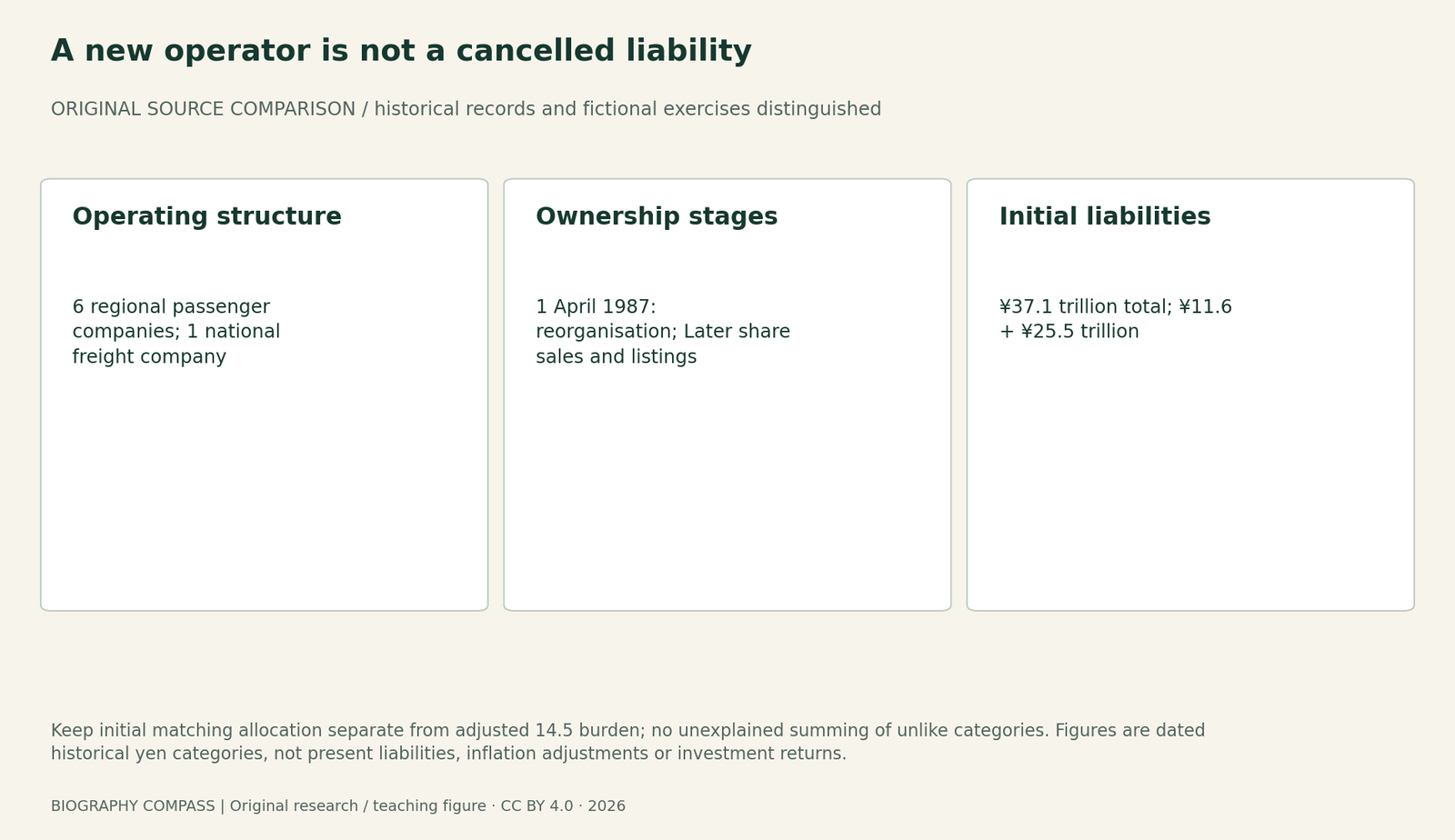
The 1 April 1987 reorganisation of Japanese National Railways created a new operating structure. It did not make every share privately owned that day or erase all inherited obligations. The government’s plan and later accounting categories show why those are three different questions.
Original documentary comparison
Structure, ownership and liability
Keep each record’s date, purpose and unit attached to the claim it supports.
| Record | Documented change | Limit |
|---|---|---|
| 1985 plan | Six passenger operators and separate freight company | A prospective design |
| 1987 implementation | Division and new companies | Not every later share sale |
| 1996 settlement account | 37.1 initial total allocated 11.6 +25.5 | Not proof of full repayment |
Chronology
A timeline of the turning points
Plan published
Regional operators, staged share sales and residual obligations described.
Reorganisation
Implementation followed eight reform-related laws.
JR East listing
A later stage of share disposal.
JR West listing
A later official account records the listing date.
Read the plan as a plan
The 1985 transport white paper described six regional passenger companies: three in Honshu and one each in Hokkaido, Shikoku and Kyushu. A separate company would handle freight. The planned Shinkansen holding arrangement added another institutional function, so “seven railway operators” should not be mistaken for a complete list of every reform body.
The paper also said the new special companies would initially receive assets and that stocks would be sold gradually. Its target date of 1 April 1987 therefore referred to a new management form, not necessarily the sale of every share. This prospective document establishes intended structure and responsibilities; later records are needed to show what happened.
Sources for this section: [1]
Implementation and later listings answer different questions
The 1997 white paper records eight reform-related laws and the division and privatisation of JNR on 1 April 1987. A 1996 account separately dates JR East’s stock-market listing to fiscal 1993 and JR West’s to 8 October 1996. It describes further sales as work still to be done at that time.
Those statements are consistent once the unit of change is specified. Creating companies, changing their management framework and selling their shares are related actions, but they do not have to occur together. None of these dated accounts should be silently updated into a claim about the ownership of every JR company today.
Use the broader liability total with its matching allocation
The 1996 account gives 37.1 trillion yen as the long-term debts and other liabilities to be settled at reform. It allocates 11.6 trillion to the new companies and 25.5 trillion to the Settlement Corporation. Those matching figures add to the reported total. They describe inherited obligations and their assignment, not the money earned by selling shares.
The same account gives an adjusted 14.5 trillion-yen burden for successor companies when certain Shinkansen lease-related obligations are included. It must not simply replace 11.6 while leaving the other side of the original allocation unchanged. Likewise, the 1997 section’s 25.1 trillion in end-FY 1986 long-term debt is a narrower category than 37.1 trillion in debt and other liabilities. Different scope can explain different numbers without making either a typographical error.
The plan left public and employment responsibilities
The 1985 plan anticipated substantial labour displacement and proposed retirement, transfers and reemployment measures. It also acknowledged that the successor companies and the old railway’s assets could not settle every obligation. Its argument for reform therefore contained its own recognition of continuing public responsibilities.
The later settlement account records a 1988 Cabinet decision that debt remaining after the Settlement Corporation’s efforts would be borne by the public. Asset disposal and share sales were intended to help, but they were processes with their own market and policy constraints. Organisational reform did not prove that workers found equivalent jobs or that the residual debt had already been repaid.
Exercise: audit a small historical data card
A student writes four claims. A: “Six passenger operators plus one freight operator means seven operating companies.” B: “All shares were sold on 1 April 1987.” C: “The initial allocation 37.1=11.6+25.5 is internally consistent.” D: “Substitute 14.5 for 11.6 and the same initial allocation still totals 37.1.” Mark each as supported or needing correction, using only these records. Then state which additional evidence would be needed to assess complete repayment.
Worked answer: A is supported for the operating-company categories, with other reform bodies separately noted. B needs correction because gradual share sales and later listings are explicit. C is arithmetically consistent in trillion yen. D produces 40.0, so it mixes the adjusted burden with the original allocation without reconciling categories. Complete repayment would require later settlement accounts tracing liabilities, interest and public transfers; a company’s creation or a listing date cannot establish it.
Continue the chronology
Related history guides
What Changed When Okinawa Reverted?
Okinawa’s reversion on 15 May 1972 changed who exercised governmental authority.
Read the timeline1993–1994Why Did the 1994 Electoral Formula Change?
A summary of Japan’s 1994 reform often begins with 300 single-member seats and 200 proportional seats.
Read the timelineBiography context
Explore Japan through connected lives
Connected biographies
People connected with these records

1918–2019
Yasuhiro Nakasone
Prime minister and administrative-reform advocateYasuhiro Nakasone spent decades in parliament and cabinet before becoming prime minister. He sought to recast the public sector and give Japan a more assertive international role during the final decade of the Cold War.Read biographyQuick answers
Common questions
- Can the figures 25.1 and 37.1 be used interchangeably?
- No. The cited accounts attach them to different debt and liability categories.
- Does a stock-market listing prove the old debt was repaid?
- No. Ownership changes and the settlement of inherited obligations require different records.
Primary and institutional sources
How this history was checked
Compare the dated records while distinguishing proposed policy, enacted terms and later implementation. This article was reviewed on 27 October 2026.