
The short answer
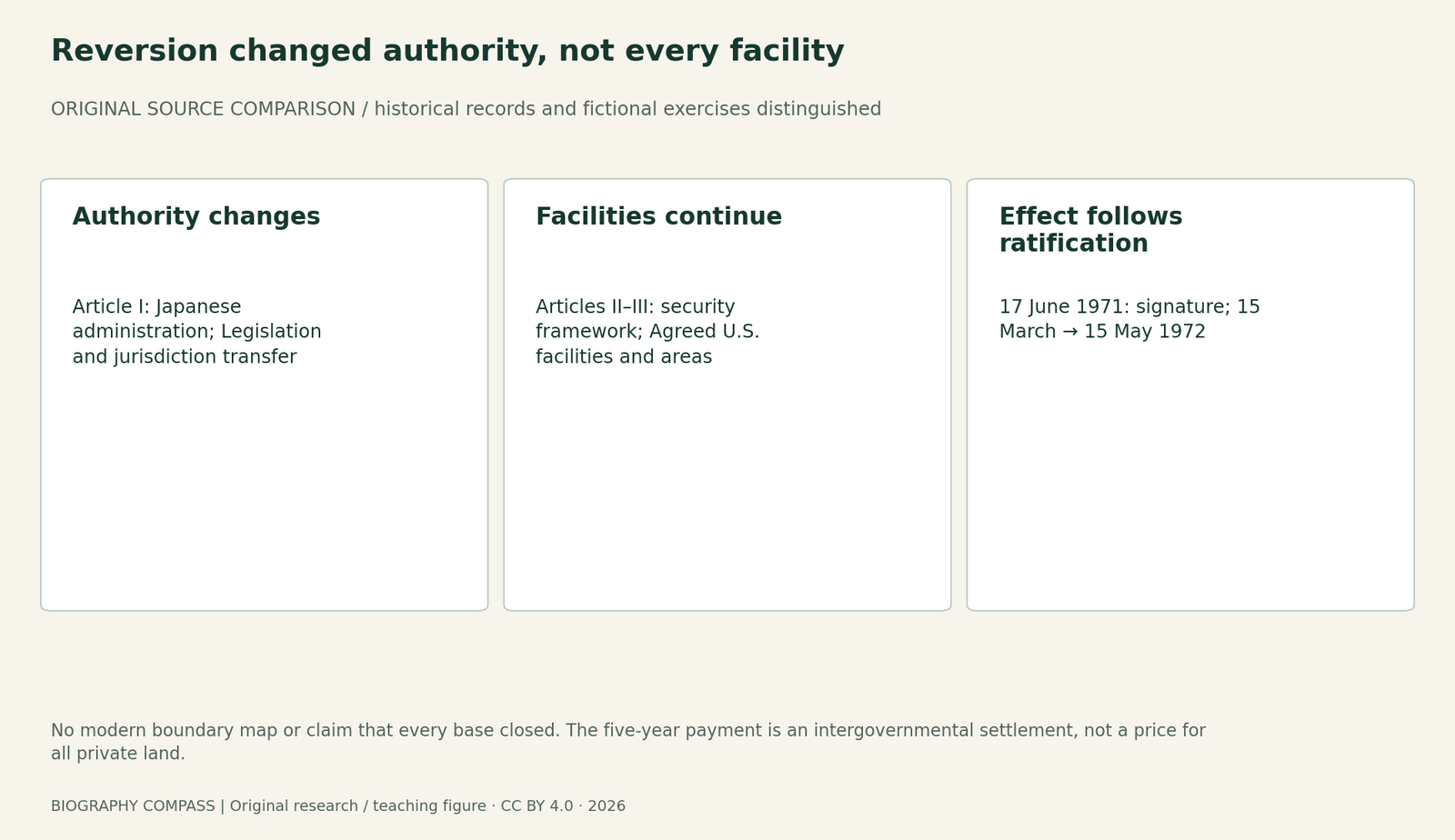
Okinawa’s reversion on 15 May 1972 changed who exercised governmental authority. It did not require every American military facility to close. The treaty’s separate provisions make that distinction visible and explain why reversion could be both a major achievement and an incomplete answer to local demands.
Original documentary comparison
A transfer of authority with continuing arrangements
Keep each record’s date, purpose and unit attached to the claim it supports.
| Record | What it establishes | What it does not establish |
|---|---|---|
| Article I | Japan assumes administrative, legislative and jurisdictional authority | A deed to all private land |
| ArticlesII–III | Security arrangements and agreed facilities continue | Removal of every American base |
| Article IX | Ratification exchange plus two months | Immediate effect on signature |
Chronology
A timeline of the turning points
Agreement signed
Aichi and Rogers signed for their governments.
Ratifications exchanged
The two-month interval began.
Entry into force
Japan resumed administration under the agreement.
Begin with authority rather than a flag alone
Article I of the agreement relinquished the United States’ rights and interests under article 3 of the 1951 peace treaty in favour of Japan. Japan assumed responsibility and authority over administration, legislation and jurisdiction in the defined islands. Those are governing powers over territory and inhabitants; the wording does not describe a private purchase of every parcel of land.
The English treaty text is preserved as attachment 1 to a June 1971 State Department press release in an archival file. The department’s report to the president separately explains the same transfer. Reading an operative clause beside its official explanation helps establish what the negotiators meant by reversion, while keeping the explanation distinct from the binding text.
The security arrangements were part of the settlement
Article II made existing U.S.–Japan treaties and agreements applicable to the islands at entry into force. Article III then committed Japan to grant the United States use of facilities and areas under the 1960 security treaty and related arrangements. These clauses are compatible with the transfer in article I: administration could change while military facilities continued under a different legal framework.
A caption saying that reversion expelled all American forces would therefore contradict the document. A caption saying that nothing changed would miss the transfer of governing authority. The agreement combined changes and continuities, and the distinction matters more than choosing one celebratory or dismissive label for the whole event.
Sources for this section: [1]
Signature, exchange and effect have separate dates
The instrument was signed in Tokyo and Washington on 17 June 1971 by Foreign Minister Kiichi Aichi and Secretary of State William Rogers. Article IX required ratification and exchange of the instruments at Tokyo, followed by a two-month interval before entry into force. The signature line therefore does not by itself date the end of American administration.
The Diplomatic Archives account records exchange on 15 March 1972 and entry into force on 15 May. Sato’s political role belongs in this sequence, but he was not the minister whose name signed the instrument for Japan. Attributing the negotiations, signatures and implementation to their actual actors makes the chronology more useful than a single “Sato returned Okinawa” sentence.
The payment clause does not settle every grievance
Article VII specified a total Japanese payment of 320 million U.S. dollars over five years, considering transferred assets, the agreed manner of reversion and additional American costs. It required 100 million within one week after entry, with the remainder in four equal annual June instalments. This was a specified intergovernmental financial arrangement, not a complete ledger of every person’s losses or compensation.
The Okinawa Prefectural Archives places the agreement within local movements for reversion and the continuing base problem. That institutional perspective supplies a question the diplomatic clauses alone cannot answer: how far did the settlement meet the expectations of the people living with the facilities? The agreement establishes commitments; claims about everyday consequences require further local records.
Exercise: correct three incompatible labels
An exhibition proposes three labels. A: “Japan bought every private property in Okinawa for 320 million dollars.” B: “All U.S. bases were required to disappear on 17 June 1971.” C: “The signature date and the start of Japanese administration were the same event.” For each, identify an article that requires a correction. Then write a two-sentence replacement that can acknowledge both restored administration and continued military use.
Worked answer A: article I concerns governmental authority, while articlesVI–VII distinguish public assets and the financial settlement; the price label overstates what changed ownership. B: article III expressly provided facilities under the security framework. C: article IX separates signature from ratification exchange and the two-month interval. A defensible replacement is: “Japanese administration resumed on 15 May 1972 under the reversion agreement. The same settlement provided for continued American use of facilities under the security treaty, leaving local disputes over the base burden unresolved.”
Continue the chronology
Related history guides
Did Privatisation Remove the Old Railway Debt?
The 1 April 1987 reorganisation of Japanese National Railways created a new operating structure.
Read the timeline1993–1994Why Did the 1994 Electoral Formula Change?
A summary of Japan’s 1994 reform often begins with 300 single-member seats and 200 proportional seats.
Read the timelineBiography context
Explore Japan through connected lives
Connected biographies
People connected with these records
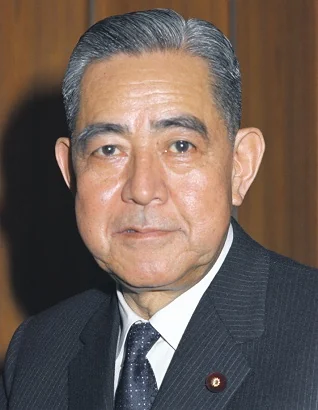
1901–1975
Eisaku Sato
Prime minister and career railway administratorEisaku Sato moved from the railway bureaucracy into the centre of postwar conservative government. His long premiership joined economic development, alliance diplomacy and negotiations to end American administration of Okinawa.Read biographyQuick answers
Common questions
- Does reversion mean every base closed?
- No. Article III expressly provided for facilities under the security treaty.
- Is this a statement about present base law?
- No. It compares the 1971 instrument with the 1972 implementation sequence.
Primary and institutional sources
How this history was checked
Compare the dated records while distinguishing proposed policy, enacted terms and later implementation. This article was reviewed on 27 October 2026.
- U.S. National Archives RG 59, reproduced by University of the RyukyusOkinawa agreement, State Department press release 133, 17 June 1971, attachment 1
- Worldwide Uchinanchu Business Network Hawaii, archival treaty transcriptDocument: Okinawa Reversion Agreement, 1971
- Diplomatic Archives, Ministry of Foreign Affairs of JapanSpecial exhibition: Okinawa Reversion Agreement
- Okinawa Prefectural ArchivesThe road to reversion