
The short answer
A constitutional text, an executive interpretation and legislation are different kinds of authority. Comparing the actual records helps explain a major policy change without treating its political description as a legal judgment.
Compare the evidence
Authority and claim
Match the conclusion to the record.
| Record | What it shows | What it does not show |
|---|---|---|
| Constitution | Text and amendment procedure | The outcome of later litigation |
| Cabinet decision | Government interpretation and direction | A constitutional amendment |
| Official overview | Legislative chronology and a framework | Every operational rule |
Chronology
A timeline of the turning points
What the constitutional text says
Article 9 renounces war and the threat or use of force for settling international disputes; its second paragraph addresses war potential and belligerency. Article 96 prescribes an amendment route: at least two-thirds of all members of each House, followed by a majority of votes cast in public ratification. Article 81 gives the Supreme Court final authority to determine constitutionality.
These selected provisions supply a textual baseline. An executive claim about consistency with that baseline is not itself an amendment under the stated procedure, nor is it the final judicial determination contemplated by the text.
Sources for this section: [1]
Read the executive argument as an argument
The Cabinet decision of 1 July 2014, in MOFA’s provisional English translation, argues for a changed interpretation while retaining what it calls the existing basic constitutional logic. It directs preparation of legislation.
Its author and purpose matter. The government was explaining why it believed a change could be made within the Constitution. That is significant evidence of policy reasoning, but accepting that it made the argument does not require the reader to adopt the argument as a court holding.
Sources for this section: [2]
What the later official summary adds
MOFA records Cabinet approval of bills in May and Diet approval on 19 September 2015. Its three conditions require an armed attack against Japan, or against a closely related foreign country resulting in a threat to Japan’s survival and clear danger to fundamental rights; no other appropriate means; and force limited to the minimum necessary.
The conditions belong together. A foreign attack alone is not the whole threshold, and a threat alone does not remove the restrictions on alternatives and force. The overview is not the full wording of every amended Act. Legislative approval also needs to be distinguished from promulgation, commencement and a particular operation.
Sources for this section: [3]
Exercise: classify a claim and test its conditions
Classify the three records above by institutional function. Then use the government’s stated framework for these invented cases, assuming facts only for teaching. A satisfies the attack-and-danger threshold, has no other appropriate means and uses only minimum necessary force. B has an armed attack against a closely related foreign country, but no threat to Japan’s survival or clear danger to the stated rights. C meets the first two conditions but proposes force beyond the minimum necessary. Which satisfies all three?
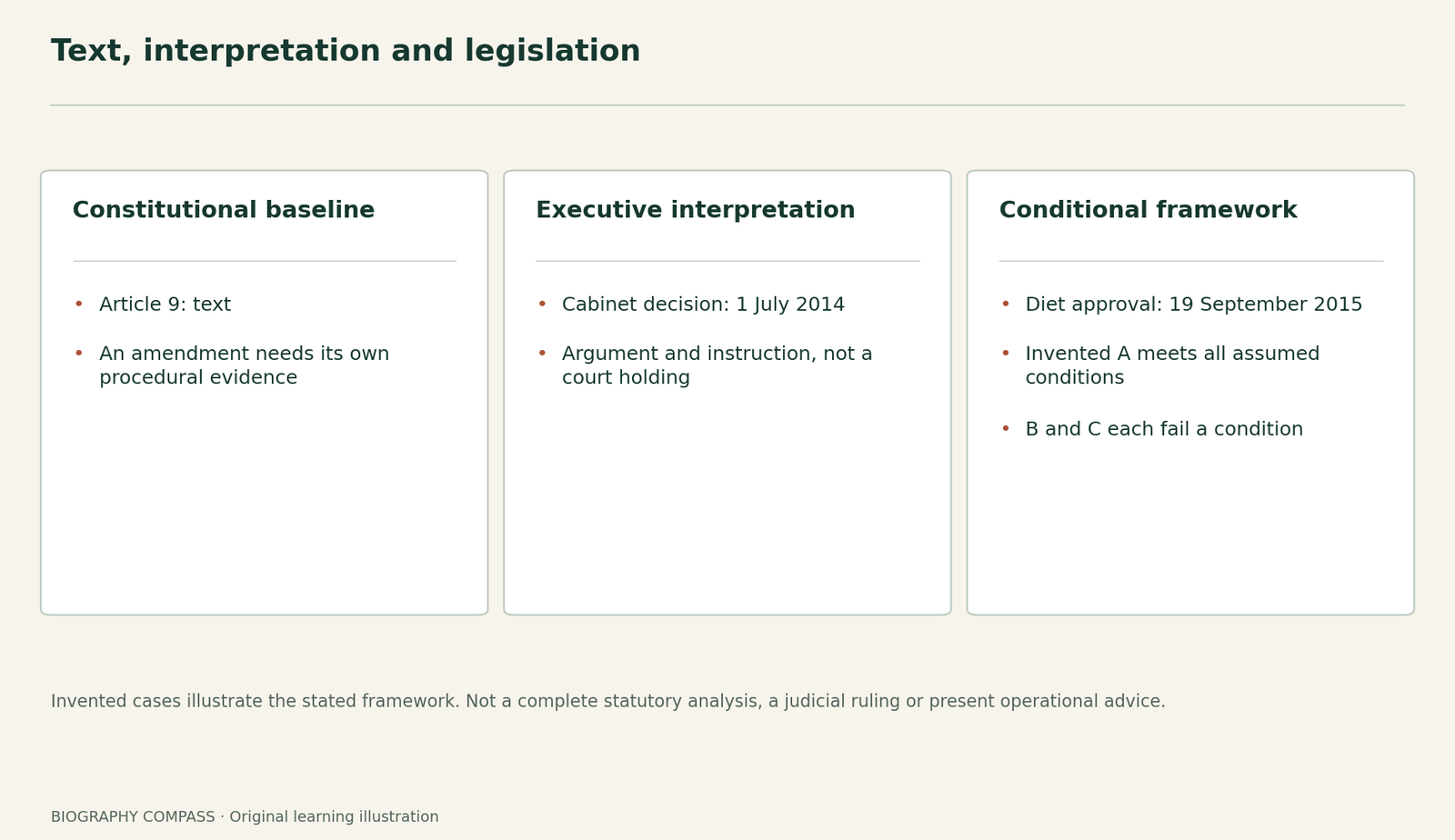
The text is the constitutional baseline; the decision is an executive interpretation and instruction; the summary describes a legislative development. Only A satisfies every assumed condition. B fails the first and C the third. This is a check of the published framework, not an assessment of a real operation or advice on present law. A claim that the Constitution itself was amended would require evidence of the amendment procedure, not simply these policy records.
Continue the chronology
Related history guides
A different institutional comparison
Compare how the author, object and document stage limit a historical conclusion.
Read the timelineMay 2010Continue the documentary research
Compare how the author, object and document stage limit a historical conclusion.
Read the timelineBiography context
Explore Japan through connected lives
Connected biographies
People and political choices

1954–2022
Shinzo Abe
Former prime ministerAbe returned to government with an agenda of economic revival and a larger security role.Read biography
Quick answers
Common questions
- Does reading an executive argument make it a court holding?
- No. The author, institutional role and type of claim must remain distinct.
Primary and institutional sources
How this history was checked
Selected constitutional articles, selected passages of the provisional Cabinet-decision translation and the complete short MOFA overview were read. The individual Acts and subsequent constitutional case law were not examined. This article was reviewed on 30 October 2026.