
The short answer
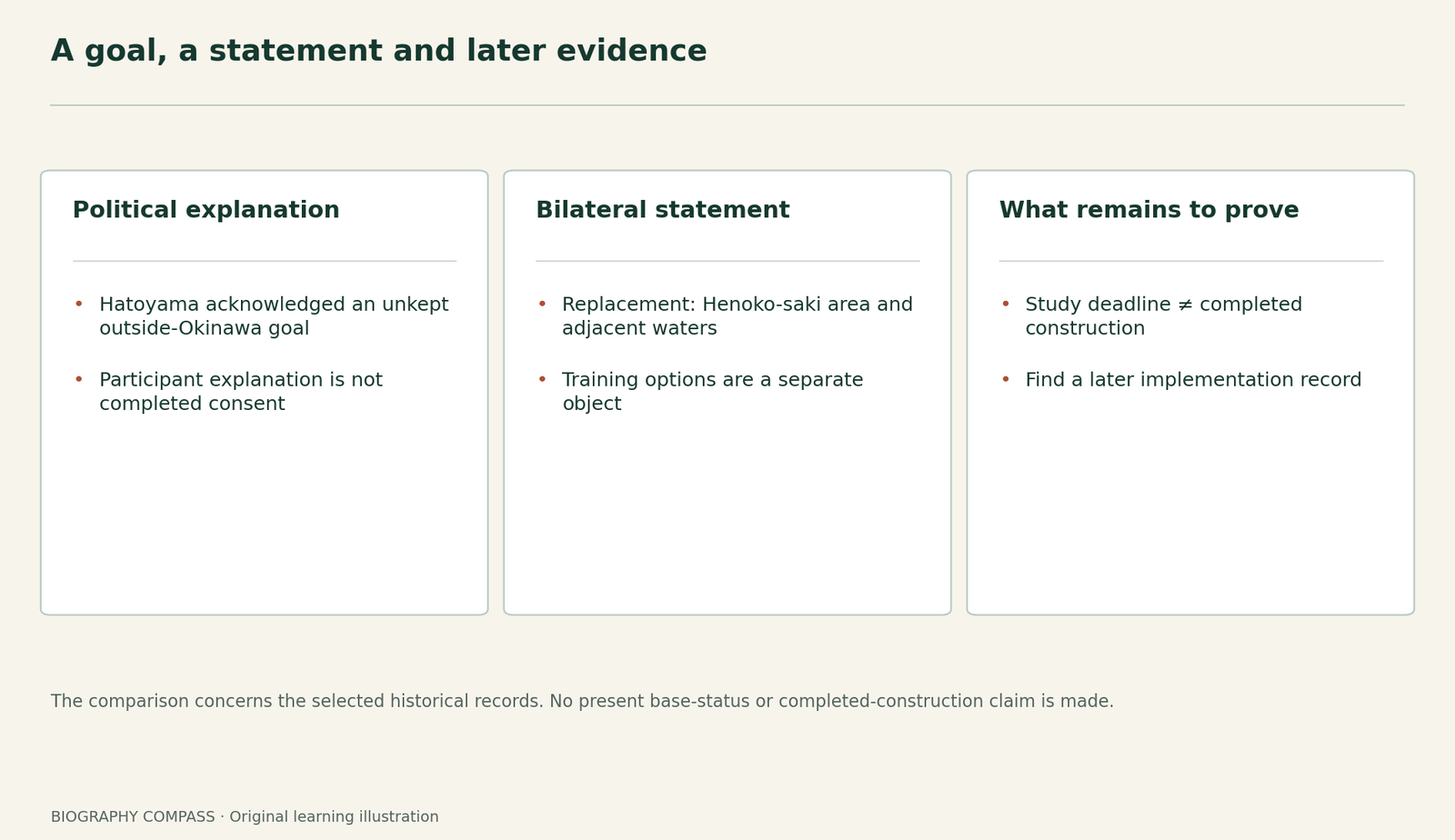
A bilateral statement may record intentions and future work while a political leader explains why an earlier goal was abandoned. Neither genre alone proves that the promised construction was completed.
Compare the evidence
Object, intention and result
Match the conclusion to the record.
| Record | What it shows | What it does not show |
|---|---|---|
| Press conference | Acknowledgment and explanation | Independent validation of every reason |
| Joint statement | Agreed intentions and tasks | Completed implementation |
| Later implementation record | Evidence needed for an outcome claim | A result established by a prior promise |
Chronology
A timeline of the turning points
Read the political acknowledgment
On 28 May 2010, Hatoyama acknowledged that he had sought a replacement outside Okinawa but had returned to the Henoko option. He apologised for failing to keep his word and conceded that Okinawan understanding had not been obtained.
The press conference is a participant’s explanation. It establishes his acknowledgment and reasons offered, not independent proof of every military assessment. His recognition of opposition also prevents the record from being paraphrased as completed local consent.
Sources for this section: [1]
Read the bilateral object carefully
The joint statement, issued by the two countries’ foreign and defence ministers, placed the replacement facility at the Camp Schwab Henoko-saki area and adjacent waters. It specified a 1,800-metre runway including overruns but excluding seawalls. Separately, it considered relocating training outside Okinawa, including Tokunoshima, subject to appropriate facilities.
The replacement facility and possible training locations are different objects. Collapsing them into a single “base moved outside the prefecture” claim would change the meaning of the agreement. The named ministers and institutional authorship also matter: this was a bilateral statement, not simply a personal announcement by the prime minister.
Sources for this section: [2]
A study deadline was not completion
Expert study of location, configuration and construction method was to be completed by the end of August 2010.
That deadline concerns a study. It cannot establish that a facility was constructed by then, that a later relocation occurred, or that every condition attached to wider realignment had been fulfilled. For those claims, seek later implementation records. The historical statement remains valuable precisely because it identifies what was intended and what work was still ahead.
Sources for this section: [2]
Exercise: edit four catalogue notes
Assess these invented notes against the selected records. A: “The statement places the replacement facility outside Okinawa.” B: “An option for moving training is the same as relocating the replacement facility.” C: “The specified runway length includes seawalls.” D: “The study deadline proves construction was completed.” Explain the smallest correction each needs.
A reverses the stated location. B conflates two different activities. C reverses the measurement boundary: the record excludes seawalls. D confuses a planned study with a completed structure. A sound note identifies the object, the unit or boundary, and whether the verb describes an intention, an agreed task or a demonstrated result.
The exercise does not decide whether the policy was desirable. It makes a narrower, reusable historical claim: the promise acknowledged in the press conference and the commitments in the bilateral statement can be compared without treating either as proof of subsequent completion.
Continue the chronology
Related history guides
A different institutional comparison
Compare how the author, object and document stage limit a historical conclusion.
Read the timeline2014–2015Continue the documentary research
Compare how the author, object and document stage limit a historical conclusion.
Read the timelineBiography context
Explore Japan and United States through connected lives
Connected biographies
People and political choices
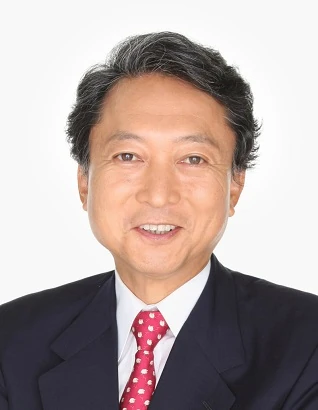
Born 1947
Yukio Hatoyama
Former prime ministerHatoyama helped build the Democratic Party of Japan.Read biographyQuick answers
Common questions
- Is an agreement a completion record?
- No. The described task, intended outcome and later evidence must be distinguished.
Primary and institutional sources
How this history was checked
The Japanese opening of the archived press conference and the complete substantive English joint statement were read. The English discussion paraphrases the Japanese record; the full Q&A and later construction record were not examined. This article was reviewed on 30 October 2026.
- Prime Minister’s Office record preserved by The World and Japan Database, GRIPS / University of TokyoPrime Minister Hatoyama press conference, 28 May 2010
- U.S. Secretaries Clinton and Gates; Japanese Ministers Okada and Kitazawa, via MOFAJoint Statement of the U.S.–Japan Security Consultative Committee