
The short answer
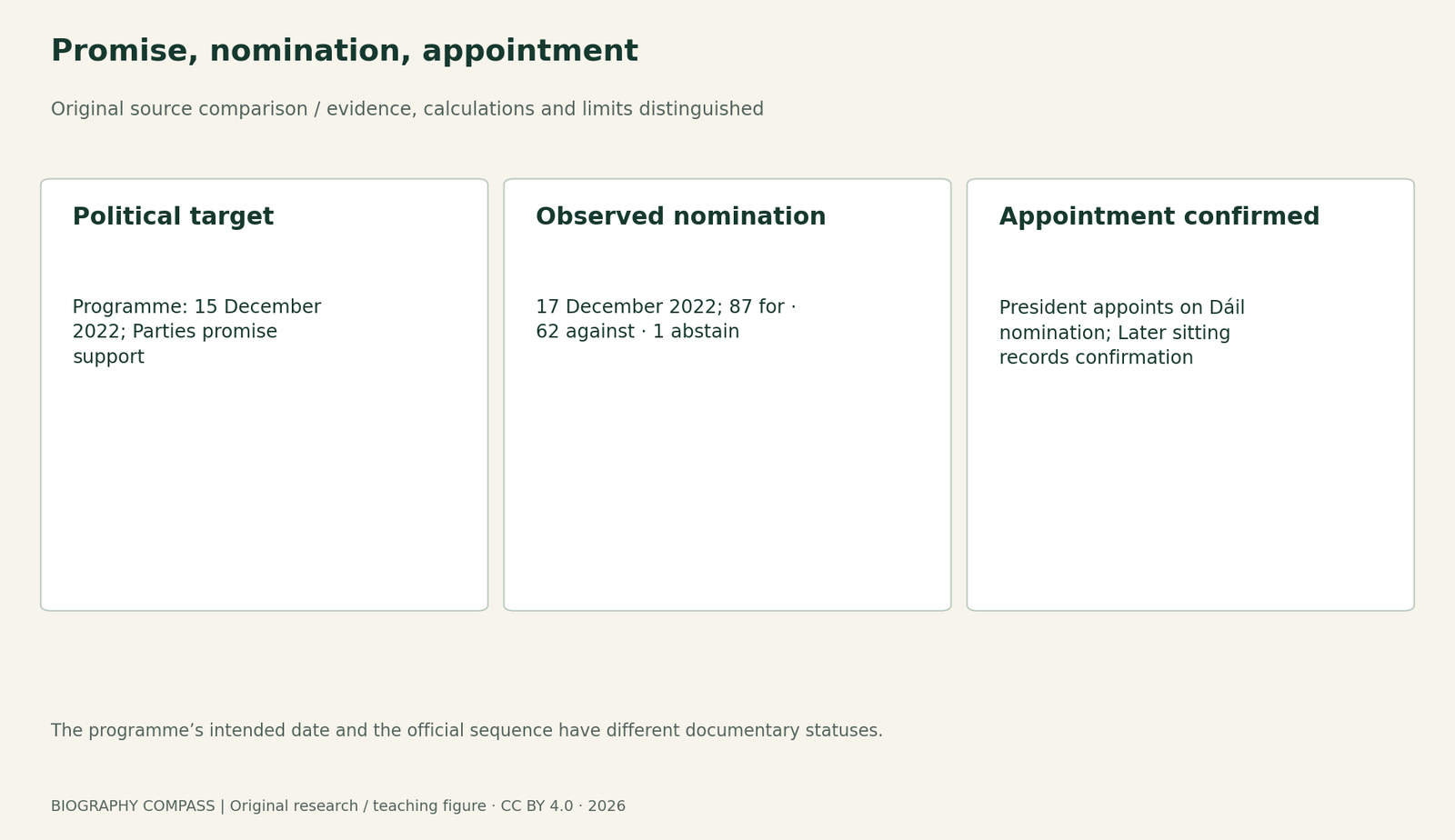
A coalition can promise to support a future leader without appointing that leader. Follow the 2020 programme’s proposed rotation through the formal events recorded in December 2022.
Compare the records
Promise and constitutional action
Keep the document, unit and inference limit attached to each entry.
| Record | Actor or record | What it establishes |
|---|---|---|
| Coalition programme | Supporting parties and TDs | Promise to support future nomination |
| Dáil division | Members voting on nomination | 87 for, 62 against, one abstention |
| Appointment confirmation | President’s appointment, reported by Varadkar | Completion of a separate institutional step |
Chronology
A timeline of the turning points
Coalition programme
Parties commit to a rotation and support for nominations.
Original target
The programme names this date; it is not the observed changeover.
Resignation reported
Martin informs the Dáil of his resignation to the President.
Dáil nomination
The House divides 87–62 with one abstention.
Appointment confirmed
Varadkar tells the House the President appointed him.
Begin with the political commitment
Page 123 of the June 2020 programme says the supporting parties and TDs would back Fianna Fáil’s leader as Taoiseach first. It then provides for his resignation on 15 December 2022 and support for the nomination of Fine Gael’s leader. These are undertakings by political participants about how they intend to act. The wording itself anticipates resignation and nomination rather than stating that a document can automatically transfer the office. A researcher should preserve that distinction before checking whether the intended sequence occurred.
Sources for this section: [1]
The Constitution assigns different acts to different institutions
Article 13.1 provides for the President to appoint the Taoiseach on the nomination of Dáil Éireann. Article 28.9 permits the Taoiseach to resign by placing the resignation in the President’s hands. A party leader, the Dáil and the President therefore do different jobs. A coalition programme may secure promised parliamentary support, but it does not replace the constitutional acts. This guide uses those selected clauses to interpret a historical transition, rather than presenting a comprehensive account of every discretion or government-formation dispute.
Sources for this section: [2]
Resignation did not create a gap with no duties performed
Article 28.11 provides that when the Taoiseach resigns, the other government members are deemed to resign, while the Taoiseach and ministers continue carrying out duties until successors are appointed. That continuity provision helps explain the institutional interval between steps. It is not proof that an individual retained every office indefinitely, nor that a coalition could dispense with the appointment of successors. The distinction between resignation and continuing duties is visible in the constitutional text and should remain in a chronology.
Sources for this section: [2]
The actual date differs from the programme’s target
On 17 December 2022 Martin told the Dáil that he had visited the President that morning and tendered his resignation. The programme’s proposed date had been 15 December. Two days’ difference does not make the documents unrelated, but it does mean the proposed date cannot be reported as the observed appointment date. A historical account should state both their statuses: an earlier political timetable and a later official record of actions. The inspected material does not independently establish every reason for the scheduling adjustment.
Nomination and appointment are separately corroborated
The official report records the nomination division as 87 in favour, 62 against and one abstention. Later, after the sitting resumed, Varadkar told the House that the President had appointed him. That later statement corroborates appointment rather than leaving the account at a planned future ceremony. The recorded division concerns participating TDs, not the whole national electorate. It should not be presented as a popular-vote percentage or confused with the separate process for approving other members of government.
Sources for this section: [3]
Exercise: annotate an incomplete transition card
A fictional archive card reads: “The parties appointed Varadkar on 15 December 2022 with 87 national votes; Martin’s resignation left no government duties being exercised.” Correct the actor, date, unit and continuity claim. Identify the minimum records needed to distinguish the coalition commitment, Martin’s resignation, the Dáil nomination and presidential appointment. Then explain why the 87–62–1 division should not be converted into a percentage of all eligible voters. The supplied sources contain enough evidence for the historical sequence without inventing private negotiations.
Reference answer: four stages, one documented transition
The parties promised support; they did not themselves appoint the Taoiseach. The programme proposed 15 December, while the Dáil records resignation, nomination and confirmation of appointment on 17 December. The 87–62–1 figures are a parliamentary division, with one recorded abstention. The Constitution provides continuity of duties pending successors. Use the programme for the promise, Article 13 and Article 28 for institutional roles, and the official report for the observed sequence. Keeping these records together prevents a shorthand rotation from erasing the steps that gave it legal and parliamentary effect.
Continue the chronology
Related history guides
Biography context
Explore Ireland through connected lives
Connected biographies
People connected with the records

1960–
Micheál Martin
Fianna Fáil leader and Taoiseach in two periodsMicheál Martin moved from teaching and Cork politics through four Cabinet portfolios to party leadership. He became Taoiseach in 2020, exchanged roles with Leo Varadkar in 2022 and returned to the office in January 2025.Read biography
1979–
Leo Varadkar
Doctor, minister and Taoiseach, 2017–2020 and 2022–2024Leo Varadkar moved from medicine and local government into Cabinet and two periods as Taoiseach. His career includes transport, health and social-protection portfolios and the 2022 exchange of roles with Micheál Martin.Read biographyQuick answers
Common questions
- Did the programme make the transfer automatic?
- No. It promised resignation and support for nomination; the constitutional acts still had to occur.
- Which date is established for the observed transition?
- The inspected Dáil report records the formal sequence on 17 December 2022.
Primary and institutional sources
How this history was checked
The sources have bounded reading scopes. Original exercises distinguish what a document establishes from what requires another record. This article was reviewed on 27 October 2026.
- Government of Ireland / coalition partiesProgramme for Government: Our Shared Future, June 2020, pages 123–124
- Office of the Attorney General, electronic Irish Statute BookConstitution of Ireland, Articles 13, 16.6, 28.9–11 and 41.4
- Houses of the OireachtasDáil debates, 17 December 2022: resignation, nomination, division and appointment