
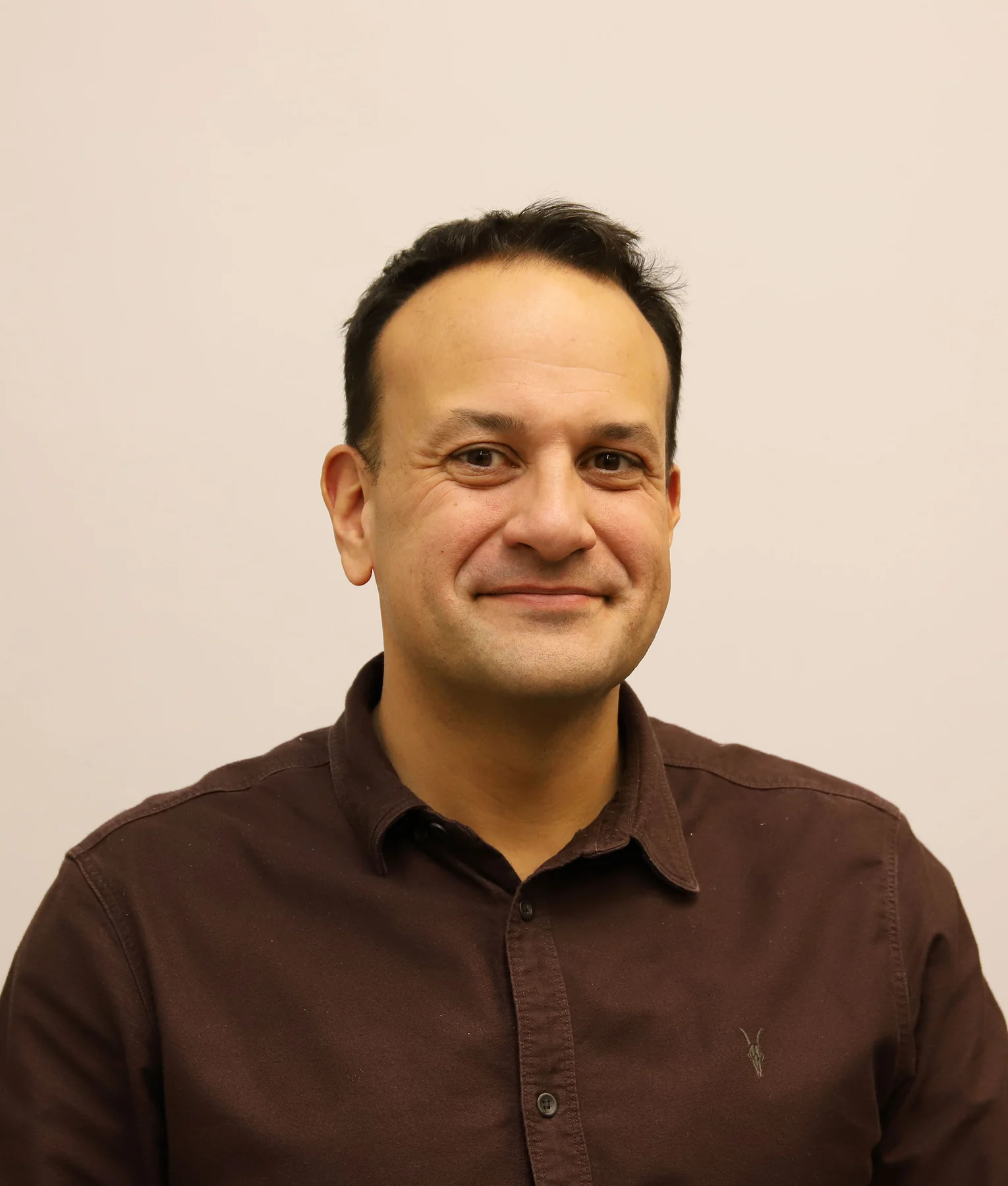
In this biography
Quick facts
- Born
- 1979
- Birthplace
- Dublin, Ireland
- Country
- Ireland
- Nationality
- Not independently established
- Known for
- Two premierships and coalition government
- Birth precision
- 1979; Dublin
- First Dáil election
- 2007, Dublin West
- First Taoiseach period
- June 2017–June 2020
- Second Taoiseach period
- 17 December 2022–9 April 2024
Why this life matters
His record helps distinguish professional training, constituency elections, party leadership and the constitutional steps required to head a government.
Timeline
Key moments
Birth
Born in Dublin; this profile retains year precision.
Local government
The official biography records Fingal County Council membership.
Dáil election
Entered the Dáil for Dublin West.
Transport portfolio
Served as minister for transport, tourism and sport.
Health and social protection
Held health, then social-protection responsibilities.
First premiership
Became Taoiseach in June.
Coalition Tánaiste
Served alongside Martin under the new coalition arrangements.
Second premiership
Returned on 17 December 2022; the official biography dates the end to 9 April 2024.
Medicine and local government
Leo Varadkar was born in Dublin in 1979. The official government biography identifies him as a qualified doctor and a graduate of Trinity College Dublin. It records membership of Fingal County Council from 2003 to 2007, followed by election to the Dáil for Dublin West in 2007. These were different forms of experience: medical qualification concerned professional training, while local and national representation placed him in political institutions. The selected sources do not require an embellished account of every early job or a more precise childhood chronology.
A constituency mandate before national executive office
The 2011 election return records Varadkar as one of four elected members for Dublin West. He received 8,359 first preferences and reached 8,555 after a transfer from Joan Burton’s surplus, above the constituency quota of 8,495. The return supplies a documented electoral result; it does not describe a national vote for Taoiseach. His later executive appointments depended on the parliamentary and presidential processes governing formation of government. Preserving that distinction prevents the constituency mandate from being mistaken for a separately elected premiership.
Ministerial work across three departments
Varadkar held transport, tourism and sport from 2011 to 2014, health from 2014 to 2016 and social protection from 2016 to 2017. The government biography describes initiatives in tourism, primary care and social insurance. Those departmental summaries establish the areas of responsibility and the government’s account of its programme; they are not independent evaluations of every outcome. The sequence matters because an initiative proposed under one minister may need legislation, implementation and work by subsequent officeholders before its practical effects can be assessed.
Sources for this section: [1]
The first premiership and a later coalition
Varadkar became Taoiseach in June 2017. In 2020 the government arrangements changed: Fianna Fáil, Fine Gael and the Green Party agreed a shared programme with Martin taking the office first and a later rotation to Fine Gael’s leader. The document also provided for an enhanced role for the Tánaiste and for inter-party coordination. Varadkar served as Tánaiste during Martin’s first period. A party programme explains political commitments and the intended division of work, while the constitutional text identifies how the offices themselves are filled.
A second nomination and presidential appointment
On 17 December 2022 the Dáil voted 87 to 62, with one abstention, on Varadkar’s nomination. After the sitting resumed, he informed the House that the President had appointed him. These are separate pieces of evidence within one day’s official report. The coalition’s earlier target had been 15 December. Describing the result simply as an automatic rotation would erase both the changed date and the formal acts. The record also shows Martin moving into other government responsibilities, rather than a new general election being required solely because the Taoiseach changed.
The end of the second period
The government’s former-Taoisigh account dates the end of Varadkar’s second period to 9 April 2024. His two terms therefore need separate dates rather than one uninterrupted span beginning in 2017. His career combines elected representation, ministerial work and leadership within a coalition system. The inspected records support those responsibilities and the mechanics of the 2022 transition. They do not by themselves settle the effectiveness of each policy or turn promotional claims about national recovery into a measured individual achievement.
Quick answers
Frequently asked questions about Leo Varadkar
- Did the coalition agreement automatically make Varadkar Taoiseach?
- No. The Dáil nomination and presidential appointment were separately recorded on 17 December 2022.
- Were his two periods in office continuous?
- No. Martin served as Taoiseach between Varadkar’s first and second periods.
Keep exploring
Lives connected to this story
- Enda Kenny
Read the Taoiseach under whom he held ministerial portfolios.
- Micheál Martin
Follow the other leader in the 2020 coalition and 2022 changeover.
- Mary Lou McDonald
Compare elected parliamentary representation and opposition leadership.
Sources and further reading
Explore the evidence
These references support the biography and offer further reading. Official records, first-person accounts and independent reporting provide different perspectives; image records document attribution and licensing.
- 1. Department of the TaoiseachFormer Taoisigh, updated 23 March 2026: selected biographies
Selected Varadkar subsection supplies education, council, portfolio and second-term dates. Government assessments of policy success are treated as attributed summaries, not independent impact measurement.
- 2. Irish State Administration DatabaseLeo Varadkar: minister record, birth field only
Only the birth year/full-name field of this database record is used. Its present-tense office text is stale and its council date differs from the official biography; those claims are excluded. Exact day is not promoted into the birth field.
- 3. Houses of the Oireachtas2011 general election: results, transfers, explanatory notes and statistics
- 4. Office of the Attorney General, electronic Irish Statute BookConstitution of Ireland, Articles 13, 16.6, 28.9–11 and 41.4
- 5. Government of Ireland / coalition partiesProgramme for Government: Our Shared Future, June 2020, pages 123–124
- 6. Houses of the OireachtasDáil debates, 17 December 2022: resignation, nomination, division and appointment