
The short answer
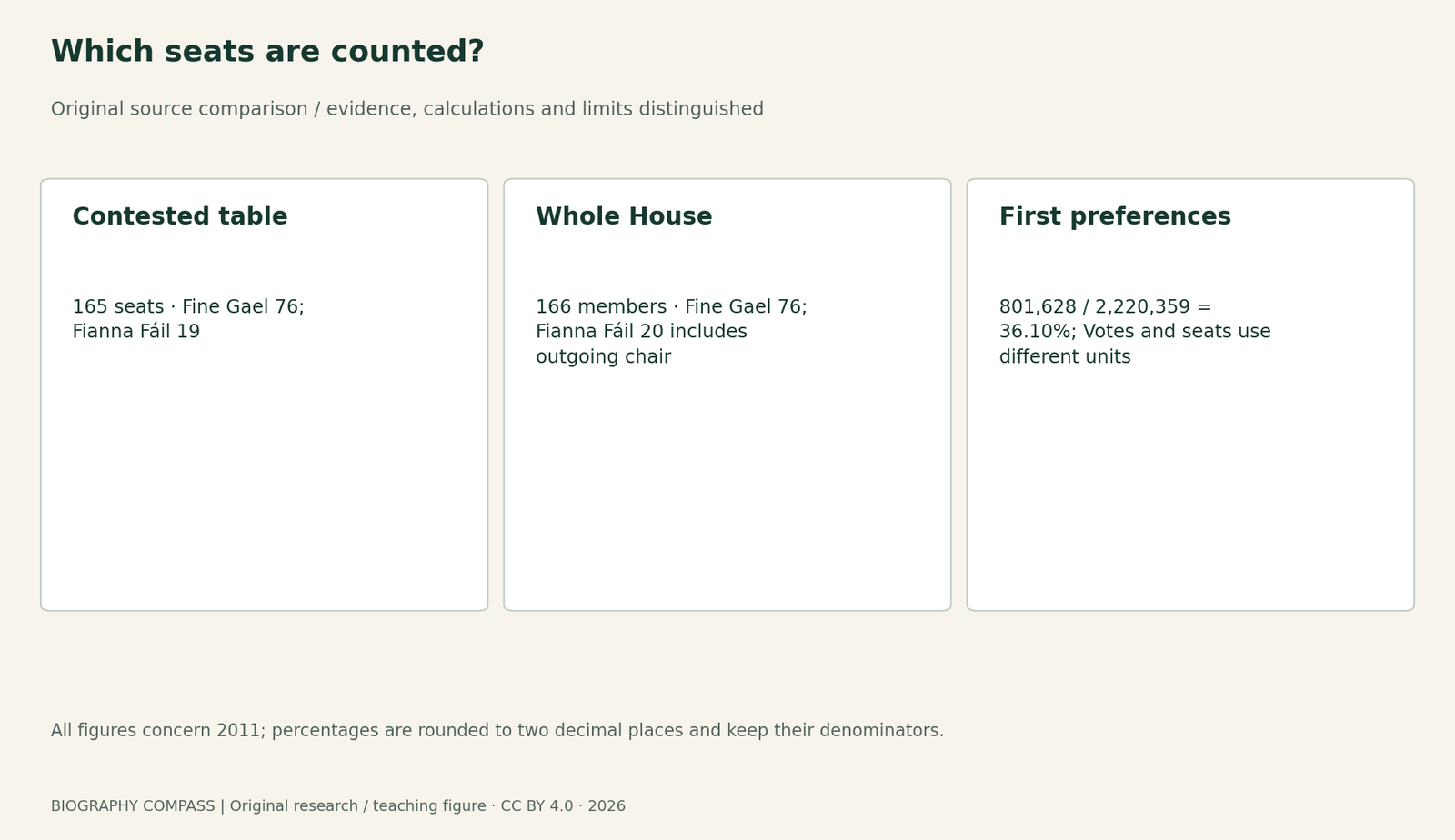
One official return lists twenty Fianna Fáil members while a statistics table counts nineteen seats. The difference is a defined electoral category, not necessarily an error.
Compare the records
Three numerators and denominators
Keep the document, unit and inference limit attached to each entry.
| Record | Calculation | What it measures |
|---|---|---|
| Fine Gael contested seats | 76 / 165 = 46.06% | Share of contested seats |
| Fine Gael whole House | 76 / 166 = 45.78% | Share of all members |
| Fine Gael first preferences | 801,628 / 2,220,359 = 36.10% | Share of valid first preferences |
Chronology
A timeline of the turning points
Polling day
The return separates constituency results and transfers.
Return compiled
The explanatory notes identify returning-officer and departmental information.
Two seat universes
The contested table excludes the outgoing chair’s automatic return.
Begin with two tables in the same return
The Oireachtas volume compiles election results from returning officers and supplies statistics from the responsible department. Its party-position list on printed page 69 records twenty Fianna Fáil members, seventy-six Fine Gael members and thirty-seven Labour members. The contested-election statistics on page 75 instead give nineteen Fianna Fáil seats and a total of 165. Before treating the difference as inconsistent arithmetic, read the table headings and footnote. The documents are counting related but different sets of seats.
Sources for this section: [1]
The outgoing chair explains one extra member
The footnote identifies the outgoing Ceann Comhairle as returned unopposed. Article 16.6 provides for legislation enabling the member who was chair immediately before dissolution to be deemed elected without an actual election. In this 2011 return, that automatic return is included in the whole-House party position but excluded from the contested-seat statistical denominator. It is therefore possible for the party list to contain twenty Fianna Fáil members while the table shows nineteen contested seats obtained. The difference concerns one member’s route into the new Dáil.
The same numerator can produce two defensible percentages
Fine Gael’s seventy-six seats are 76/165 = 46.06 percent of contested seats, matching the rounded statistics table. They are 76/166 = 45.78 percent of the full House. Neither calculation is useful unless its denominator is named. The first measures a share of contested seats; the second measures representation in the complete chamber. Switching denominators while keeping a percentage label unchanged would mislead readers even though both divisions are arithmetically correct. This comparison concerns the 2011 record, not an assumption that every subsequent Dáil has the same size.
Sources for this section: [1]
First preferences are a third unit
The same table records 801,628 Fine Gael first preferences out of 2,220,359 valid first preferences, or 36.10 percent. That does not contradict its seat share: votes and seats are different units, and the election operated through multi-seat constituency counts and transfers. Nor is a valid-first-preference share a percentage of all registered electors or all residents. A national summary cannot on its own explain every constituency result. The volume’s separate count tables supply the evidence needed to investigate an individual candidate or transfer.
Sources for this section: [1]
Parliamentary strength still differs from executive appointment
A party’s seat total measures representation. It does not itself appoint its leader Taoiseach or prove a specific coalition agreement was fulfilled. Article 13 identifies appointment by the President on the nomination of Dáil Éireann. The distinction is particularly important where the largest party has fewer than half the full House’s seats. A researcher studying government formation needs nomination and appointment records in addition to the election return.
Exercise: repair three captions
Using the actual 2011 figures, audit these proposed captions: “Fine Gael won 46.06 percent of all 166 Dáil seats”; “Fianna Fáil’s twenty members contradict its nineteen contested seats”; and “36.10 percent of Irish residents voted Fine Gael.” Recalculate the full-House Fine Gael percentage to two decimal places. Explain the one-seat Fianna Fáil difference, then identify the appropriate denominator for the first-preference percentage. Add one record needed before asserting that an election result appointed a Taoiseach. These are original questions applied to historical data, not invented election results.
Reference answer: label every set
Fine Gael held 45.78 percent of the 166-member House, while 46.06 percent uses 165 contested seats. Fianna Fáil’s party-position total includes the outgoing chair returned unopposed; nineteen concerns contested seats. The 36.10 percent figure uses valid first preferences, not residents or the entire electorate. A nomination and presidential appointment record is needed for the Taoiseach’s office. The exercise shows why an extra seat, a percentage and an electoral mandate each need a precise category before they can be compared.
Continue the chronology
Related history guides
Biography context
Explore Ireland through connected lives
Enda Kenny
Place the largest party’s result within Kenny’s route to government.
Explore the biographiesCompare the opposing party leaderMicheál Martin
Read the political context of Fianna Fáil’s electoral collapse.
Explore the biographiesRead an elected member’s careerMary Lou McDonald
Move from national totals to a specific Dublin Central return.
Explore the biographiesConnected biographies
People connected with the records
1951–
Enda Kenny
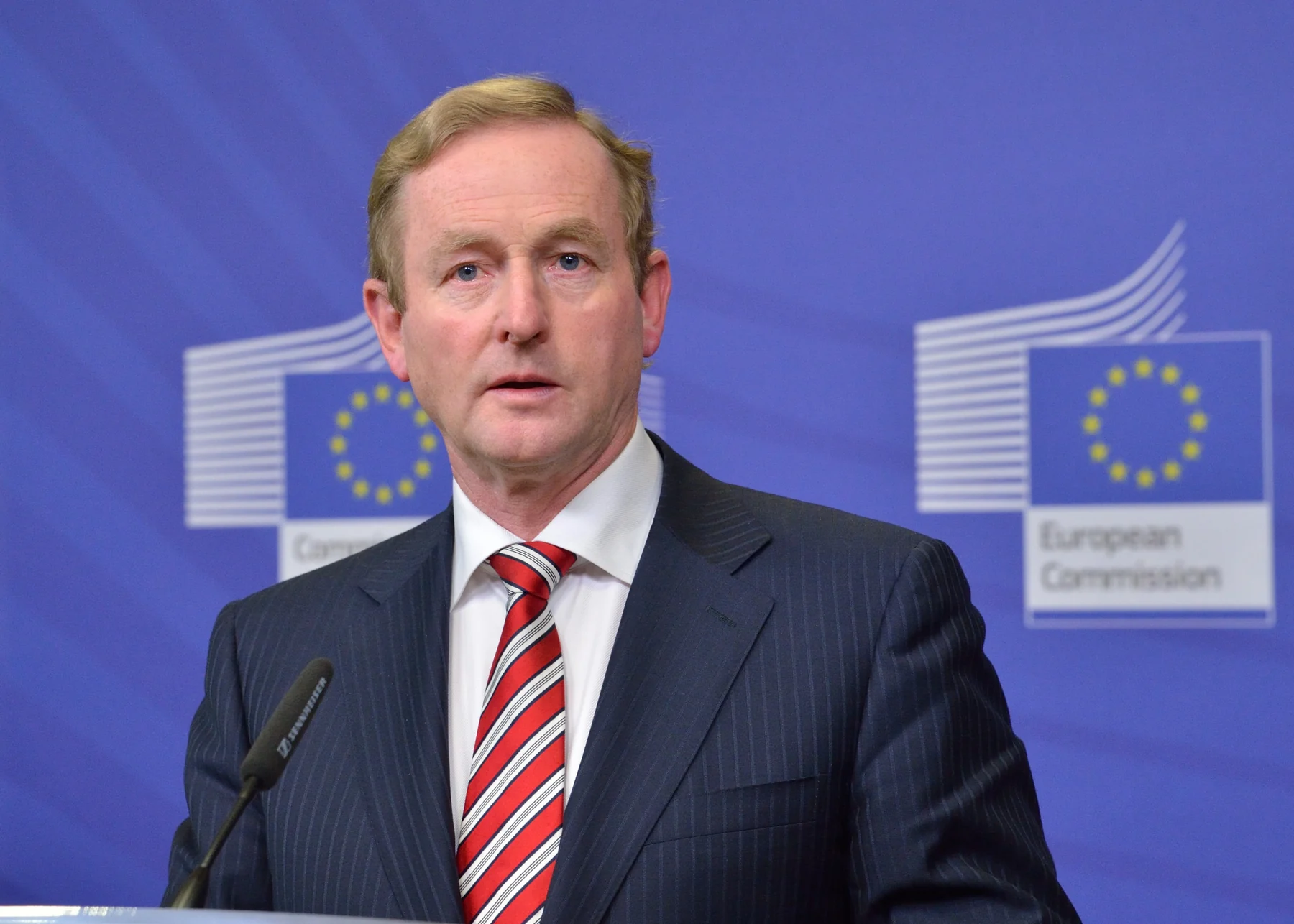
Fine Gael leader and Taoiseach, 2011–2017Enda Kenny entered the Dáil in a 1975 by-election after working as a primary teacher. He led Fine Gael from 2002 and became Taoiseach after the 2011 election, returning to government in 2016.Read biography
1960–
Micheál Martin
Fianna Fáil leader and Taoiseach in two periodsMicheál Martin moved from teaching and Cork politics through four Cabinet portfolios to party leadership. He became Taoiseach in 2020, exchanged roles with Leo Varadkar in 2022 and returned to the office in January 2025.Read biography1969–
Mary Lou McDonald
European and Irish parliamentarian; Sinn Féin leader from 2018Mary Lou McDonald served in the European Parliament before winning a Dublin Central Dáil seat in 2011. She became Sinn Féin leader in 2018 after work in parliamentary scrutiny and party leadership.Read biographyQuick answers
Common questions
- Is 46.06 percent wrong?
- It is the rounded share of 165 contested seats. It should not be labelled a share of all 166 members.
- Why did Fianna Fáil have nineteen and twenty in different tables?
- The full party-position list includes the outgoing Ceann Comhairle returned unopposed.
Primary and institutional sources
How this history was checked
The sources have bounded reading scopes. Original exercises distinguish what a document establishes from what requires another record. This article was reviewed on 27 October 2026.