
The short answer
How could many nominations produce an uncontested election?
Evidence comparison
Read the records together
The records were created for different purposes and support different kinds of claims.
| Record | What it establishes | Question to keep open |
|---|---|---|
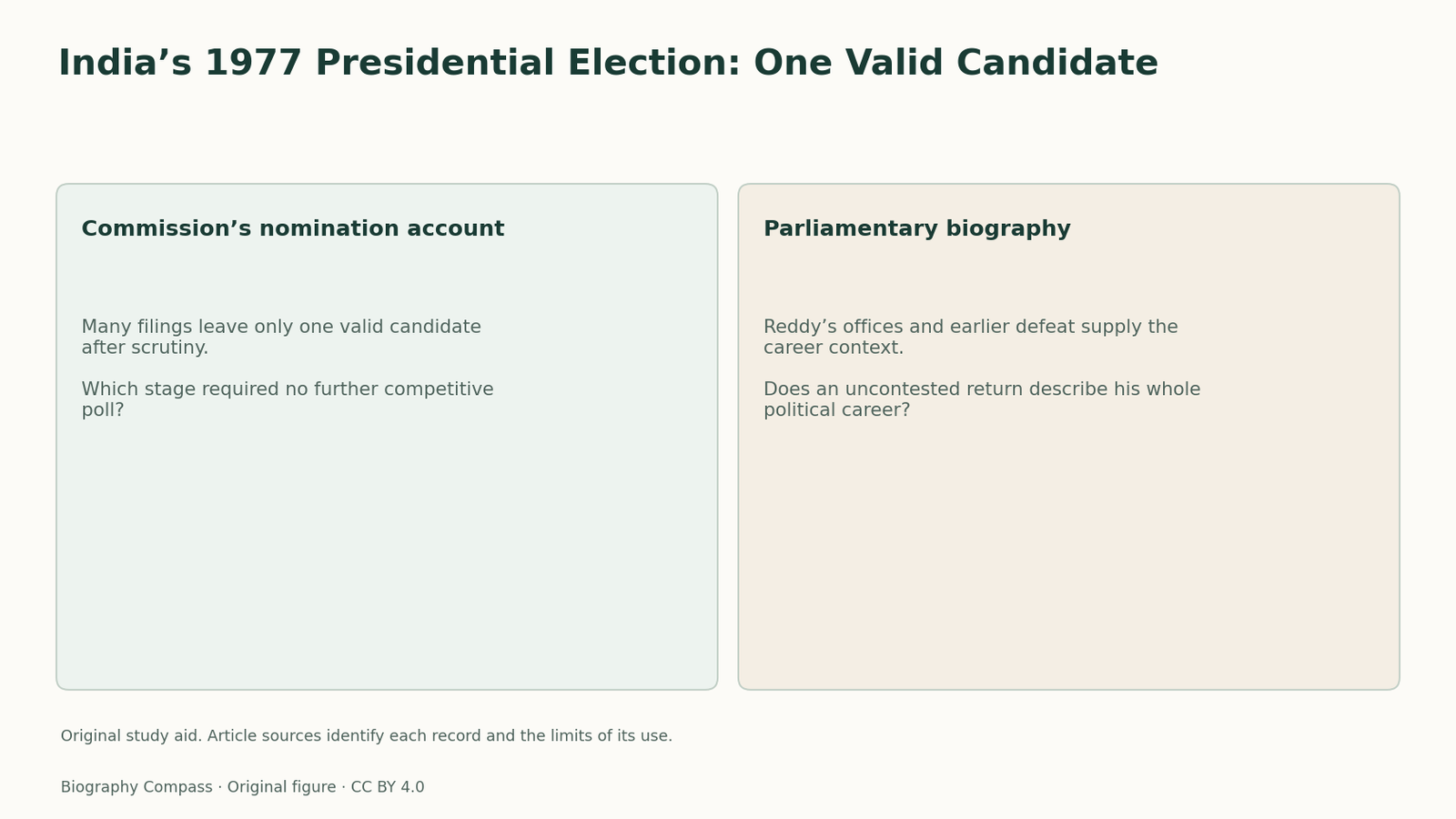
| Commission’s nomination account | Many filings leave only one valid candidate after scrutiny. | Which stage required no further competitive poll? |
| Parliamentary biography | Reddy’s offices and earlier defeat supply the career context. | Does an uncontested return describe his whole political career? |
Chronology
A timeline of the turning points
Speaker again
Reddy returns to the Lok Sabha chair.
Presidential return
One valid candidature produces an uncontested election.
Separate filing from a valid candidature
The Election Commission’s illustrated account states that thirty-seven candidates filed nominations, but the Returning Officer found only Reddy’s valid. Filing and acceptance are therefore distinct stages. Describing the result as an election in which no other person tried to stand would erase the scrutiny process. The relevant question is how many valid candidates remained after the papers had been examined under the applicable rules.
Sources for this section: [3]
Distinguish a schedule from an event
An election programme can include a prospective polling day even when the nomination stage later makes polling unnecessary. The Commission’s account explains that there was no need for counting or publication of a poll result in this case. A date printed in the initial schedule is not evidence that voting actually occurred. The declared outcome must be read alongside the stage at which the process ceased to require a contest.
Sources for this section: [3]
Connect the result to Reddy’s career
Reddy had already held state leadership and two Lok Sabha speakerships, and he had lost the earlier presidential election of 1969. His uncontested return in 1977 therefore belongs to a particular nomination process, not to a permanent absence of political competition throughout his career. The parliamentary biography locates the offices he left and entered, while the Commission identifies the administrative reason a poll was unnecessary that year.
Make a process funnel
Draw stages for papers filed, scrutiny, valid candidates and poll if required. Enter thirty-seven at the first stage and one at the valid-candidate stage. A sound answer leaves the poll stage marked unnecessary rather than inventing unanimous ballot figures. The diagram demonstrates why an uncontested election can still involve nominations and formal scrutiny, and why a scheduled date should not be converted into an event without evidence that it occurred.
Continue the chronology
Related history guides
Biography context
Explore India through connected lives
Connected biographies
People behind the records
1913–1996
Neelam Sanjiva Reddy
State leader, speaker and presidentReddy moved through state leadership, Parliament and the Lok Sabha chair before becoming the only valid candidate in the 1977 presidential election.Read biographyQuick answers
Common questions
- Did thirty-seven valid candidates contest the poll?
- No. The Commission records thirty-seven filings but only one valid candidate, making a competitive poll unnecessary.
Primary and institutional sources
How this history was checked
Sources support the chronology and the record comparison. The reading exercise is original. This article was reviewed on 7 November 2026.