
The short answer
How did the amendment distinguish a Cabinet decision from informal advice?
Evidence comparison
Read the records together
The records were created for different purposes and support different kinds of claims.
| Record | What it establishes | Question to keep open |
|---|---|---|
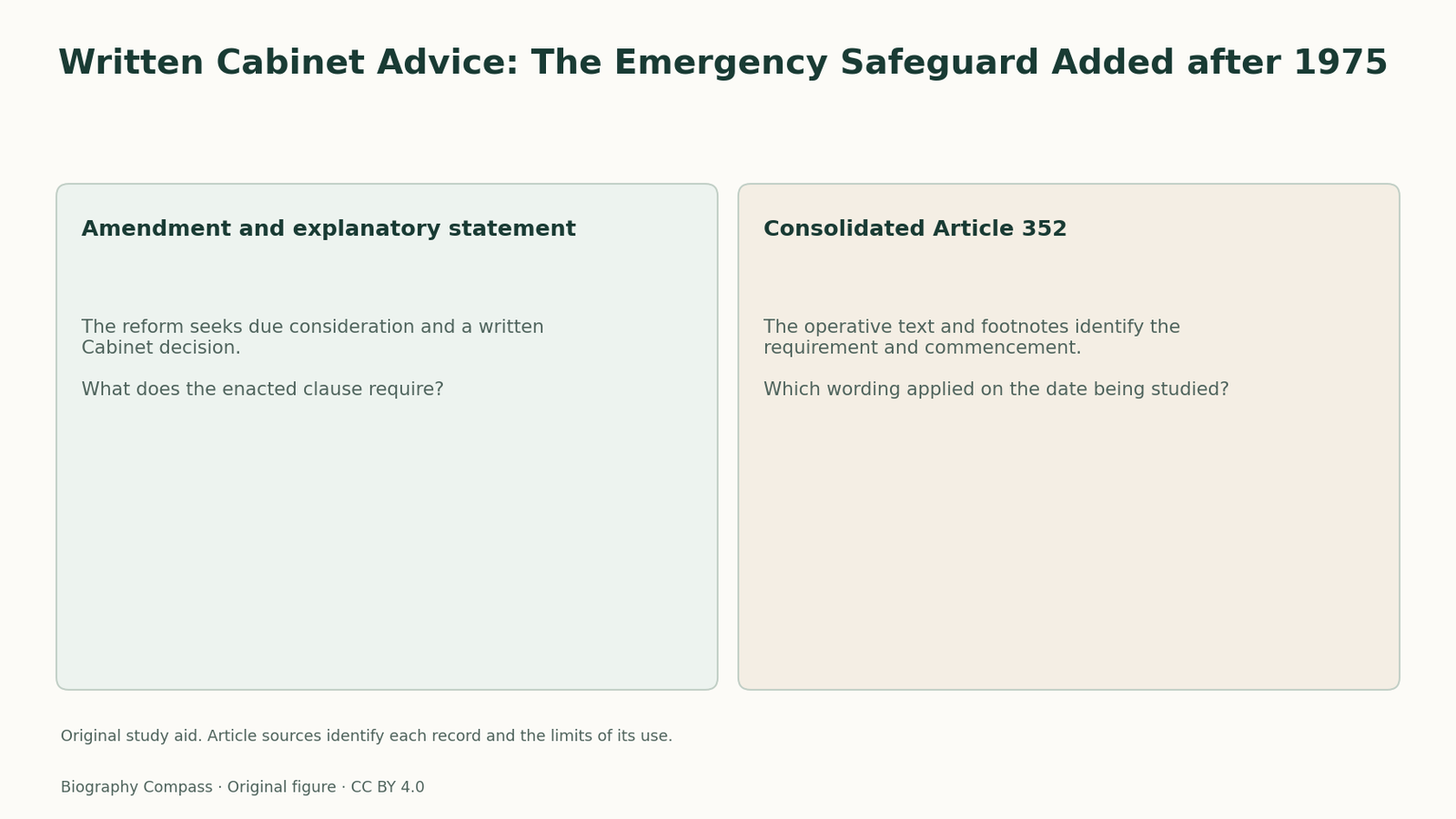
| Amendment and explanatory statement | The reform seeks due consideration and a written Cabinet decision. | What does the enacted clause require? |
| Consolidated Article 352 | The operative text and footnotes identify the requirement and commencement. | Which wording applied on the date being studied? |
Chronology
A timeline of the turning points
Emergency proclaimed
Ahmed acts before the later safeguard.
Amendment operates
Written Cabinet decision requirements become part of Article 352.
Read the stated reason for change
The amendment’s explanatory statement argues that emergency powers needed safeguards against abuse. It specifically proposes written Cabinet advice so that a proclamation follows due consideration. That passage records the reform’s stated purpose. It does not replace the enacted clause or prove how every earlier decision was reached. The distinction allows the historical response to the Emergency to be explained without inventing private conversations or an undocumented account of an individual official’s intentions.
Sources for this section: [4]
Identify the collective decision
Article 352’s amended wording refers to a decision of the Union Cabinet communicated to the president in writing. The provision identifies both a collective body and a documentary form. A conversation with one minister is not the same record as a Cabinet decision. Reading the definition matters because the safeguard was designed around a specified decision-making process, rather than the presence of any written message carrying the general idea of advice.
Keep title, assent and operation apart
The Act carries 1978 in its title, but the printed record dates assent to 30 April 1979 and provides for commencement by notification. The consolidated Constitution’s footnotes date the relevant Article 352 changes to June 1979. These different dates describe different stages. A reference using only the title year would not establish the day on which the new requirement became operative, nor the wording applicable to a proclamation issued several years earlier.
Build a documentary chain
Create boxes for collective decision, written communication, presidential proclamation and parliamentary consideration. Mark which record would establish each stage. Then place the amendment’s title, assent and commencement on a second line. A good answer keeps the safeguard’s design separate from evidence of compliance in a particular case. This makes the constitutional change understandable while preserving the further historical research needed to evaluate an individual emergency decision.
Continue the chronology
Related history guides
Biography context
Explore India through connected lives
Connected biographies
People behind the records
1905–1977
Fakhruddin Ali Ahmed
Lawyer, minister and presidentAhmed’s career moved from law and Assam politics to Union portfolios and the presidency, where his 1975 Emergency proclamation became a defining event.Read biographyQuick answers
Common questions
- Does 1978 in the Act’s title prove the clause operated throughout 1978?
- No. The printed Act and commencement notes distinguish its title, 1979 assent and the date of operation.
Primary and institutional sources
How this history was checked
Sources support the chronology and the record comparison. The reading exercise is original. This article was reviewed on 7 November 2026.
- Rajya Sabha SecretariatFakhruddin Ali Ahmed: parliamentary sketch
- President of IndiaFakhruddin Ali Ahmed: former president record
- President of IndiaFakhruddin Ali Ahmed: profile
- Legislative Department, Government of IndiaConstitution (Forty-fourth Amendment) Act, 1978
- Legislative Department, Government of IndiaConstitution of India, Articles 54, 55, 111 and 352