
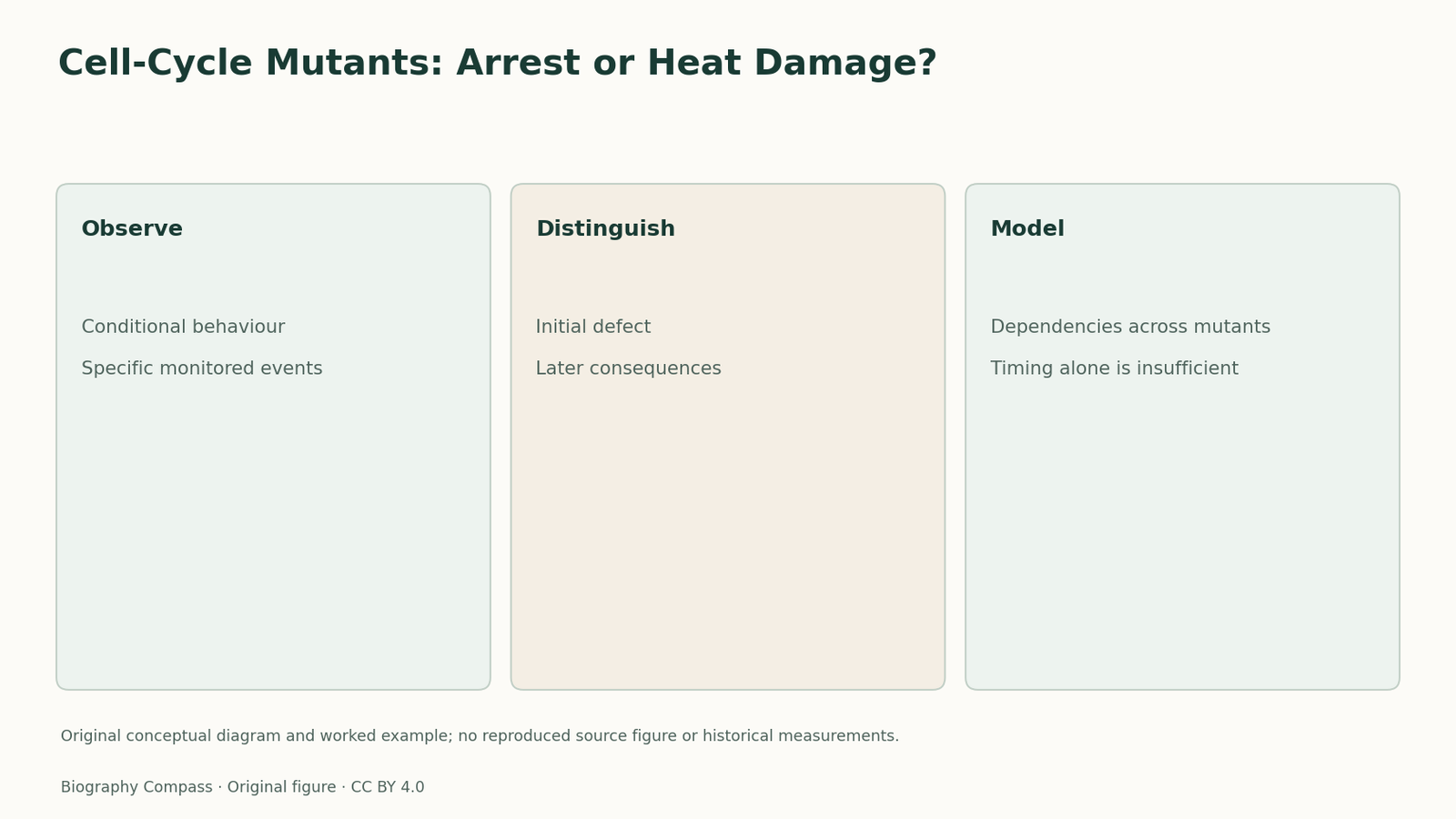
The short answer
How did conditional yeast mutants identify cell-cycle steps rather than merely report nonspecific effects of temperature?
Read the evidence
Different records within the same investigation
The following comparison distinguishes the specific questions answered by the inspected records.
| Record or test | What it establishes | What remains different |
|---|---|---|
| General growth failure | Shows a broad functional endpoint. | Does not identify a specific cycle defect. |
| Initial observed defect | Identifies the first monitored failure. | Is not necessarily the earliest molecular change. |
| Dependency model | Uses continued and failed events across mutants. | Cannot be inferred from normal timing alone. |
Conditional defects opened a route into essential events
Hartwell’s programme used yeast mutants that functioned under permissive conditions but failed under restrictive ones. That design made essential processes accessible without requiring the cells to survive permanent complete loss of the relevant function. The concrete question is what a conditional arrest reveals. A cell that ceases dividing could have a specific cycle defect, a failure in another essential process or nonspecific damage. Its behaviour needs to be interpreted through the events measured and suitable comparisons, not just the fact that growth stopped.
The initial defect was an operational observation
The 1974 paper defined the initial defect as the first monitored cell-cycle event that failed under the restrictive condition. That wording is carefully bounded: it concerns events the investigators could observe, rather than claiming immediate knowledge of the earliest molecular disturbance. The distinction prevents a visible endpoint from being mistaken for a complete mechanistic diagnosis. A late morphological state can result from an earlier requirement, and different assays can reveal different aspects of the arrest.
Sources for this section: [1]
Continued events helped distinguish dependencies
The same paper reasoned from which events did or did not occur after particular defects. It distinguished a proposed dependent sequence from events such as bud emergence and DNA synthesis that could be experimentally separated despite similar normal timing. This is a stronger argument than arranging photographs in chronological order. Co-occurrence does not alone establish dependence. Conversely, a shared endpoint does not prove that two mutations affect the same component. The pattern across multiple perturbations supplies constraints on an organisational model.
Sources for this section: [1]
The genetic programme preceded complete molecular identities
The later first-person retrospective describes practical problems in recognising cell-cycle mutants and identifying the molecular defect behind them. It credits students, technicians and collaborators within the early Washington laboratory. The Nobel award later recognised key regulators, but those later identities should not all be backdated into the original phenotypic screen. The early model made progress by connecting reproducible defects with functional relationships. Its usefulness did not require every isolated mutant to arrive with an already sequenced gene or a fully established checkpoint mechanism.
An original arrest exercise and answer
Imagine fictional events A, B and C. Under normal conditions they occur in that order. Mutant X completes A but not B or C; mutant Y completes A and B but not C. Is A–B–C a reasonable dependent-pathway model? It is consistent with those observations, but additional alternatives and measurement limits remain. These letters are not historical CDC genes or an experimental recipe. A control showing general damage with random failure would weaken a specific cycle interpretation. If a separate event D continued in X, that would show why the whole cell should not simply be called inactive. The answer names the earliest observed defect, distinguishes downstream effects and retains the difference between a model consistent with the data and a complete molecular mechanism.
Continue the chronology
Related history guides
Cyclin 1983: Accumulation and Destruction
Examine the original cyclin paper through labelled protein patterns, periodic disappearance and developmental timing, with an original exercise on synthesis and turnover.
Read the timeline1977–2004Ubiquitin 1980: A Tag Before Degradation
Examine the 1980 protein-conjugation model through ATP use, linked forms and later breakdown, with an original exercise distinguishing a tag from a completed outcome.
Read the timelineBiography context
Explore United States through connected lives
Connected biographies
Researchers and related approaches
1939–
Leland H. Hartwell
Geneticist and cell-cycle researcherLeland Hartwell used yeast genetics to investigate cell division, connecting conditional mutant behaviour with models of ordered and interdependent cellular events.Read biography
born 1949
Paul Nurse
Cell-cycle geneticistNurse used fission yeast to study how cells decide when to divide.Read biographyQuick answers
Common questions
- Does any temperature-sensitive arrest identify a cell-cycle gene?
- No. Other essential processes or general damage can stop growth.
- Does simultaneous timing prove dependence?
- No. Functional separation requires additional evidence.
Primary and institutional sources
How this history was checked
The references below distinguish the original study from later explanations. The worked exercise and comparison are newly written for this article. This article was reviewed on 8 November 2026.
- Hartwell, Culotti, Pringle and Reid, Science, 1974Genetic Control of the Cell Division Cycle in Yeast
- Reid, Culotti, Nash and Pringle, Molecular Biology of the Cell, 2015Forty-five years of cell-cycle genetics
- Nobel Prize OutreachLeland H. Hartwell — Facts
- Nobel Prize OutreachLeland H. Hartwell — Biographical