
The short answer
How does Orwell separate personal experience from the larger political interpretation of Spain?
Read the evidence
Sources, interpretation and production roles
The records answer different questions about this work. The final exercise is an original teaching model.
| Record or question | Supported reading | Boundary or contrast |
|---|---|---|
| Biography | Dates and affiliations locate Orwell’s participation. | They do not independently corroborate every memoir episode. |
| Memoir | A participant describes experience and develops an argument. | Observation and political explanation have different scopes. |
| Original exercise | Classify observation, reported information and interpretation. | Each category suggests a different corroboration task. |
A participant with a position
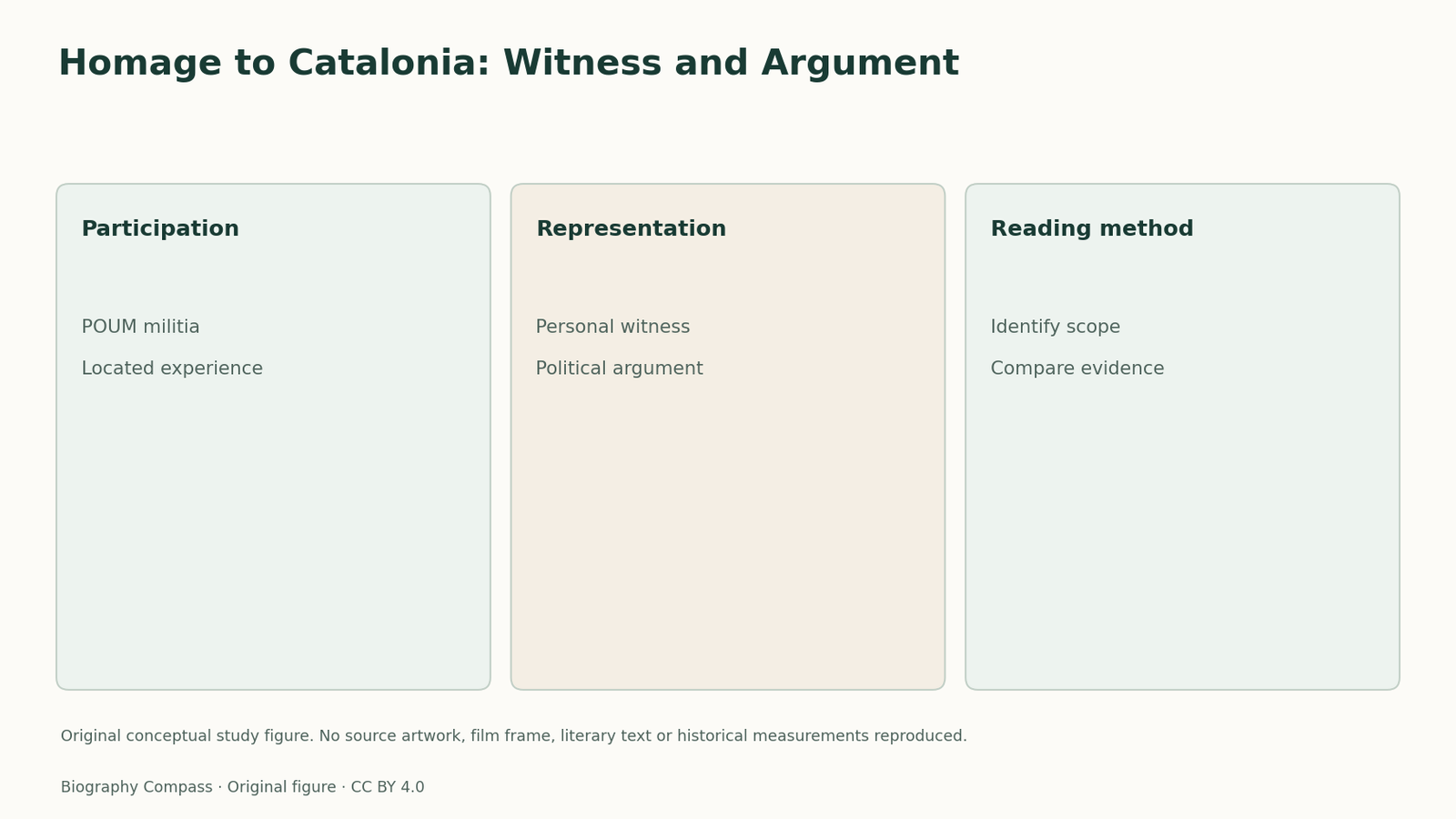
Homage to Catalonia grew out of Orwell’s participation in the Spanish Civil War and appeared in 1938. He went to Spain in late 1936 and served with the POUM militia on the Republican side. That affiliation matters: it gave him particular comrades, locations and experiences rather than access to the whole war. His support for resistance to Franco and his criticism of repression within the Republican camp coexist. The book is therefore both a personal account and an argument about political representation.
What direct witness contributes
A participant can describe the circumstances he met, the conditions of militia service and his experience of being wounded. Such passages derive force from proximity. Yet proximity has a shape. Someone at one position cannot simultaneously observe every front or every decision by party leaders. Orwell’s account is valuable when its field of observation is specified, rather than enlarged into universal knowledge. A reader can mark the difference between a description anchored to an episode and an explanation assembled from reports, conversations and political judgement.
The argument reaches beyond the episode
The book’s political discussion considers the organisations fighting within the Republican cause and the stories told about them. Labels such as POUM do explanatory work only if readers understand which organisation is being discussed and when. Later knowledge should not silently replace the author’s situation during the conflict. Nor should the emotional force of a personal danger be used as sufficient proof of every wider claim. Those are questions about how a historical witness reasons, not reasons to discard his testimony.
Sources for this section: [3]
An original evidence-sorting exercise
Take three hypothetical statements: I heard firing from my building; an acquaintance told me which group controlled the street; the fighting resulted from a national political strategy. Place them under observation, transmitted information and interpretation. A supported answer puts them in that order. Then ask what additional evidence would strengthen each: another located witness, contemporary organisational records, or a comparison across places and dates. These invented statements model the different levels of a memoir; they are not quotations or claims about an uninspected incident in Orwell’s book.
Sources for this section: [3]
How to use the book alongside biography
Orwell’s biography establishes when he served, was wounded and published the account. The memoir supplies his representation of events. Broader historical research can test particular interpretations, but this guide does not pretend to settle the entire conflict from one witness. Read the two levels together: a located participant explains why an event mattered to him, while the reader asks how far each explanation extends. That practice preserves the book’s political urgency without turning personal experience into unlimited authority.
Continue the chronology
Related history guides
Biography context
Explore United Kingdom through connected lives
Connected biographies
People and related creative practices
1903–1950
George Orwell
Novelist, essayist and journalistGeorge Orwell connected reporting, political experience and literary form in works about poverty, empire, propaganda and coercion.Read biography
1899–1961
Ernest Hemingway
Novelist, short-story writer and journalistErnest Hemingway was an American writer whose novels, short stories and journalism made understatement, sharply observed action and the consequences of war central to twentieth-century prose.Read biography1912–1995
John Halas
Animation director, producer and studio co-founderJohn Halas moved from Hungarian animation and design to a British studio partnership with Joy Batchelor that joined commercial production to artistic ambition.Read biographyQuick answers
Common questions
- Is the book only a war memoir?
- It also argues about political organisations, repression and the representation of events.
- Does witness mean complete knowledge?
- No. A participant’s direct experience is located in particular places and times; broader explanations require further evidence.
Primary and institutional sources
How this history was checked
Sources include production records, institutional collections and the specifically identified passages discussed here. Interpretations and teaching models are distinguished from credits and publication facts. This article was reviewed on 7 November 2026.